
The OSR is a wide roof with room for a great variety of games, alle more or less compatible with the old way of the dungeon from the 1970ies and 1980ies, before the rise of the storytelling system and nu-D&D’s d20 system shifted focus away from exploration and survival and more toward high adventure and heroic tales.
Some systems are named more often than others when someone who comes from 5e gets curious and wants to know what’s going on over in that “OSR”, of which many gruesome tales of woe are told, but whose players then turn out to be not quite the horde of primitive hateful violent alcoholic cave-dwellers that gamers are led to expect, judging by the shrill warnings that make the rounds on the interwebs.
BFRPG
One such system is “BFRPG”, Basic Fantasy Roleplaying Game, a labour of love which is graciously provided for free as PDF and very cheap on paper. It has a solid fanbase and is claimed to be especially nu-school-player friendly to teach them the ways of the OSR.
Edition Sedition
How so, I wondered, as I had taken a first glance at it and found it to be rather similar to the standard fare of the OSR, B/X.
B/X, or Basic / Expert Dungeons & Dragons by Tom Moldvay and Jeb Cook, is the “alternative” to “Advanced Dungeons & Dragons” and often derisively called “for little kids” by 1e enthusiasts. Not necessarily in bad faith: That is just what 1e-shills always used to say to hook players who were not sure if they were yet ready for something “Advanced”.
“Nah, you don’t need Basic. That’s just for little kids! Advanced is for smart mature people like you and me!!”
Either way, obviously that is nonsense, and B/X is the very best version of D&D [JOKE! of course tastes differ]. Therefore it is no accident that many of the best and most successful OSR games, like Lamentations of the Flame Princess, Labyrinth Lord, and bare-bones B/X-without-flavour-text Old School Essentials, are all built on the durable chassis of B/X.
[I wanted to add DCC, but that is arguably so far removed that the B/X core is hardly recognizable.]
Each of them do their own thing: Just as an example, Lamentations spins far into the weird and unsettling, and developed a distinctive set of rules that still manages to be easy to learn and stay fully compatible with B/X, which in turn remains mostly compatible with Original 1974 D&D, especially Greyhawk and Holmes.
Old School Essentials chose a different path and took on the task of sifting through B/X, unearthing the very core of its rules, clarifying its ambiguities, and re-ordering the rules in a very accessible way. The last of these points being the reason for OSE’s runaway success to become the (probably?) main OSR game out there: No other OSR-game is ordered so logically.
But back to BFRPG.
What makes it the same as Moldvay’s Basic classic from 1981?
A lot. The rules are very close.
What makes it different?
Also a lot. But that takes a moment or two to spot and unpack.
One factor is that it separates “race” and “class”.
That is an old debate.
Some people (many) are not content playing “a Dwarf”, they want to play “a Dwarven Cleric”. So while in B/X “Dwarf” is simply a “class” like any other category like a fighting man or a wizard, an Elf or, full circle, a Dwarf, there is one kind of gamers (probably the majority?) who wants separate “classes” and “races”, where they regard “class” as some kind of “job” and “race” as “are they human, dwarf, elf, or kobold?”
They are right in one aspect, namely that there is no reason why a Dwarf should not have a job other than “miner”. Of course that will be a thing. But they are wrong in another aspect, namely that the job of a person is (at least if you ask me) a question of roleplay, not of rules.
So, full disclosure, I like to think that the class should just be a broad category to understand the basic framework of a character, it is not meant to nail the character down in detail. 1 character, 1 class, finished.
I digress…
New School has classes and subclasses, races and subraces, so you are not just a Dwarf, you are a Forest Hill Dwarf who is also a Red Cleric of Almera, and each of these things makes you in some way mechanically different from a Rock Cave Dwarf who is a Paladin of Zhesh.
Whereas in Old School a Dwarf is a Dwarf, and a Human a Human, and it is you, the player, who makes your character special and different from the character of the player next to you. Old School has Strength, Intelligence, and Charisma and a couple of torches, and that is it. Everything else, like the colour of a person’s fingernails or what kind of hat they wear is fluff and needs not be written down and connected with dice roll modifiers.
So yes, that is a big issue that separates Basic from Advanced:
Advanced has races and classes, BFRPG calls itself Basic but has races. In this case the separation serves as an open door: Those who are used to play an “dwarven cleric” or an “elven magic user” can do so; even though it is technically only a superficial thing. It does not really change the Basic D&D experience, but it makes it more accessible to modern players.
Like a gateway drug.
What else makes it different?
A handful of small details of tangential importance, (among them ascending armor class, which some people find of great importance… but it is not that important if you know Thac0 well … then it is all basically the same.) but there is one big difference with impact.
The list of thief abilities is different, namely, more favourable for the players.
Encumbrance is in pounds instead of coins, which avoids the old debates about how much a coin *really* weighs. (and yet, BFRPG changes the coin weight between 3rd and 4th edition, from 10 coins a pound to 20 coins a pound, doubling the amount of gold loot you can carry.)
It also ties carrying capacity to strength, which has the disadvantage that it is much more granular than in OD&D and B/X, where the carrying capacity is in both cases independent from individual strength,
but has the advantage of satisfying players who feel that it is weird to see a 4 STR weakling shoulder the same load a 16 STR crossfit master lifts.

BFRPG also replaces declarations for retreats etc with the opportunity attack beloved by most. Truth be told, that makes some sense, as the declaration phase is really something many players struggle with, and the solution of Basic Fantasy RPG is a very easy and practical fix.
There are also differences in spells. As an example, the Sleep Spell is one of the most powerful there is, because it is available at low levels and hits X hit dice without a chance for a saving throw. In BFRPG it hits a particular area, no matter how many targets are there, so it may potentially bring down many more enemies if they are stacked closely — but they do get a saving throw. This changes tactical considerations.
Etc.
Thing is, the OSR is all about messing with the rules and homebrewing ideas. Even the inventors of D&D went right ahead and changed the dying rules in their own games, so such tweaks and little changes fit right in.
Favourable mention:
BFRPG has a decent section with GM tips to help fresh OSR-joiners understand some of the important concepts and ideas.
XP for Gold vs. Kills vs. Milestones
Old School play generally rewarded characters for stealing old treasure from monster-infested ruins. How you did that was your own affair. Trick the monsters, kill them, ally with them, that is all the same if it gets the result you want and need: Gold, sweet, sweet gold.
Since that alone can be a bit harsh if you do many things but don’t find a lot of valuables in the wilderness, there is usually a small side tally of experience for surviving dangerous encounters.
That is the old school way, and no, it is not perfect, because collecting XP is basically the objective of the game, and if you only get meaningful XP for gold, then you are practically forced to seek and take gold. Which can feel a bit limiting if a game leads you into a situation where you have interesting moral choices and want to save a village from starvation or sickness, and none of that is rewarded if the GM does not find a convincing way to let you find gold on the way for some contrived reason.
So games soon branched out and tried to find other ways to reward players, like giving out XP for the number of hours you played, or for the missions you accomplished, the distance you travelled, or for the monsters you killed.
In this particular case, BFRPG goes full new school and gives a whole lot more XP, predominantly so for killing. It raises these numbers and thus makes fighting and killing more attractive. And, as a side option, for “other things”.
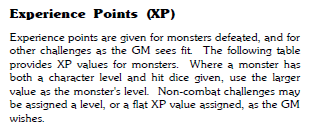
Again, not strictly old-school, but it paves the way for new players to ease into the idea of XP for gold.
Individual Fight vs Group Fight
Old School combat is all about teamwork and units fighting battles together — that is a holdover from its roots in wargames and lives on in group initiative and the hiring of retainers and mercenaries for overland travel, important core concepts of old school gaming that got shed like a snake skin over the evolution of the game from one of exploration of dangerous lands to self-expression of purple half-Dragonborn-half-Tiefling multiclassing warlock-cavalier ladies.
This group-focus is, among other things, underscored by rolling side initiative: 1 d6 for the whole group, which facilitates working together as a unit, supporting each other.
BFRPG goes the way of modern games and individual initiative, where every party member has a personal moment to shine, which discourages teamwork but encourages zooming in on heroic feats.
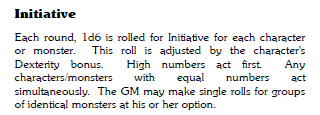
This slows down combat by a great margin.
Group initiative is done in a moment, while individual initiative, and ordering it, needs some time. In that way, combat in BFRPG grows its chrono-real-estate in addition to its XP-real-estate. Which means, the whole system is more combat focused than gold focused.
66% Old School (plus/minus something)
There we have it: The bridge to appeal to new school players, because 5e tends to be that: some groups just make it an endless parade of fight after fight after fight, and others give XP for “other things”, as decided by the GM, even for reaching narrative “milestones” toward a pre-determined plot.
XP for stealing gold, no matter if you are a fighter, mage or thief, that is not an easy to grasp philosophy for people who want to play a noble hero, or have any original character concept in mind. So BFRPG just skips that and stays with modern ways of levelling. Be they killing, doing noble deeds, spending time at the gaming table, or succeeding at predefined missions.
Still, combat kills, and sometimes kills very fast, and that is the trick where we have the spirit of Old School sneakily drawing the innocent new-schoolers into an older mindset where you have to take fights more seriously than in the superheroical New School.
So some 66 or 75% or so old school rules for new-schoolers to get their feet wet, discover the old school ways of thinking, and learn most of the B/X rules en passant before going full OSE … and beyond.

 PAPIER UND SPIELE
Interestingly, BFRPG got copy-pasted, serial numbers filed off, and sold more expensively under a new name.
https://www.youtube.com/watch?v=Rwrswtn4vgo
LikeLike