An example that I remembered well – as a cautionary tale – down the years: Once upon a time I played a dwarf in an adventure where I got separated from the group underground and met, in an old derelict mine shaft, a monster. It attacked me, and while I defended against it, my weapon broke. Not only that, but the creature was clearly superior in fighting prowess. Disadvantage breeds creativity, so I was thinking about alternatives to drawing my little dagger. Playing on time I said that I would grab some of the materials that were lying around and throw them at the monster for distraction.
My game master was surprised and told me there was nothing to throw.
I was not sure what he might mean. My own mind had populated the mine shaft with old wooden boards, some refuse, stones, and piles of dust, even a broken tool or two. So I asked: “What is there around us in this mine shaft? What is on the walls or on the floor?”,
and he answered quite definitely:
“Nothing.”
There is nothing around you
This is an extreme example. But lesser versions of this idea are very common. I even dare say that an easy majority of RPG combats happen within a rather sterile environment, with fighters trading blows like in a sandy arena, or a dojo.
Although one may be tempted to think of 5e combat with “I hit it with my sword” going around the table repeatedly, this is a fallacy: Empty Room Syndrome is not tied to any specific system, it is universal, in games as well as in fiction.
However, there are some rules systems that address the issue specifically and deliberately.
Let us get to that after a short detour into the world of film.
John Woo
John Woo is the master of the not-empty rooms. Shootouts happen in rooms with plants, ceramics, windows, candles, wooden furniture and what have you, and all of that gets a thorough thrashing.
Jackie Chan
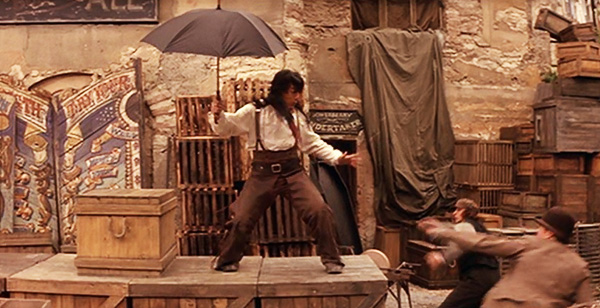
Jackie Chan is another excellent example of things done right — maybe even going a bit too far doing it. Most Jackie Chan fights will involve a wide range of improvised unlikely weapons like umbrellas, ladders, boxes, sticks, and even lemons.
From film to RPG
Movies are, like books and video games, a main source of inspiration for roleplaying gamers. So it stands to reason that some of the good vibes of using background and environment to heighten drama and make blank empty rooms more interesting found their way into gaming circles already.
FATE’s advantages
The RPG FATE does not hide this in the least: Although it often fights the uphill struggle to get the goodness into reality. FATE has four options what a character can do in a given situation: Attack, Defend, Overcome (that is basically a skill roll against a problem that does not bite back), and Discover or Create an Advantage.
What is Discover or Create an Advantage?
Discover an Advantage is finding some aspect of the current situation that might be helpful. Like, a big barrel of oil, or a pile of precariously balanced crates. Such things, once discovered, can be put to creative use, in the next round or by the next ally, and give a bonus of +2 on the roll.
More advantages make more +2s, and so it is important to stack a number of good ideas to overcome some strong opposition.
Using the concept
It is not necessary to play FATE to see the value of creative use of the environment. Bonuses for being higher up, narrative advantages for keeping foes at a distance with a rake, or the smashing of priceless vases by stray shots missing a friend or a foe, these things can be incorporated in any game.
Imagine the area, see the place in your mind’s eye, and it may populate itself with all manner of useful items to use as distraction, improvised weapon, or tool.
Free thinking and player input
Not everyone has an easy time to “imagine” the area. This is not necessarily a skill issue, it can be an organic thing. Some people love to read because the letters translate to action and a “movie” in their heads. Others pick up information from the letters and have to actively build an inner picture deliberately, which takes energy, and so their enjoyment of reading is severely hampered.
For GMs, that is one step farther: Juggling player questions, rules, NPCs, and background information that the players are not aware of, can be taxing enough to make the idea of coming up with additional detail for every location daunting.
The good news is: You don’t have to.
Cooperation
Go teamwork!
Let the players make it up. When they ask: “What exactly is there in this room?”, you can just answer: “Yes, what is there? What do you see? You tell me.”
If you have mature players they will furnish you with a living environment that you alone would never have thought about. If you have fools they will try to weaponize their freedom and claim that they see all kinds of wonderful treasures and effective weapons — well …. then you just say No and ask the better players. And also try the quiet ones, they may have awesome ideas that they just don’t share because the aforementioned fools are talking over them.
.
Image: Still from Jackie Chan’s Shanghai Knights.

 PAPIER UND SPIELE