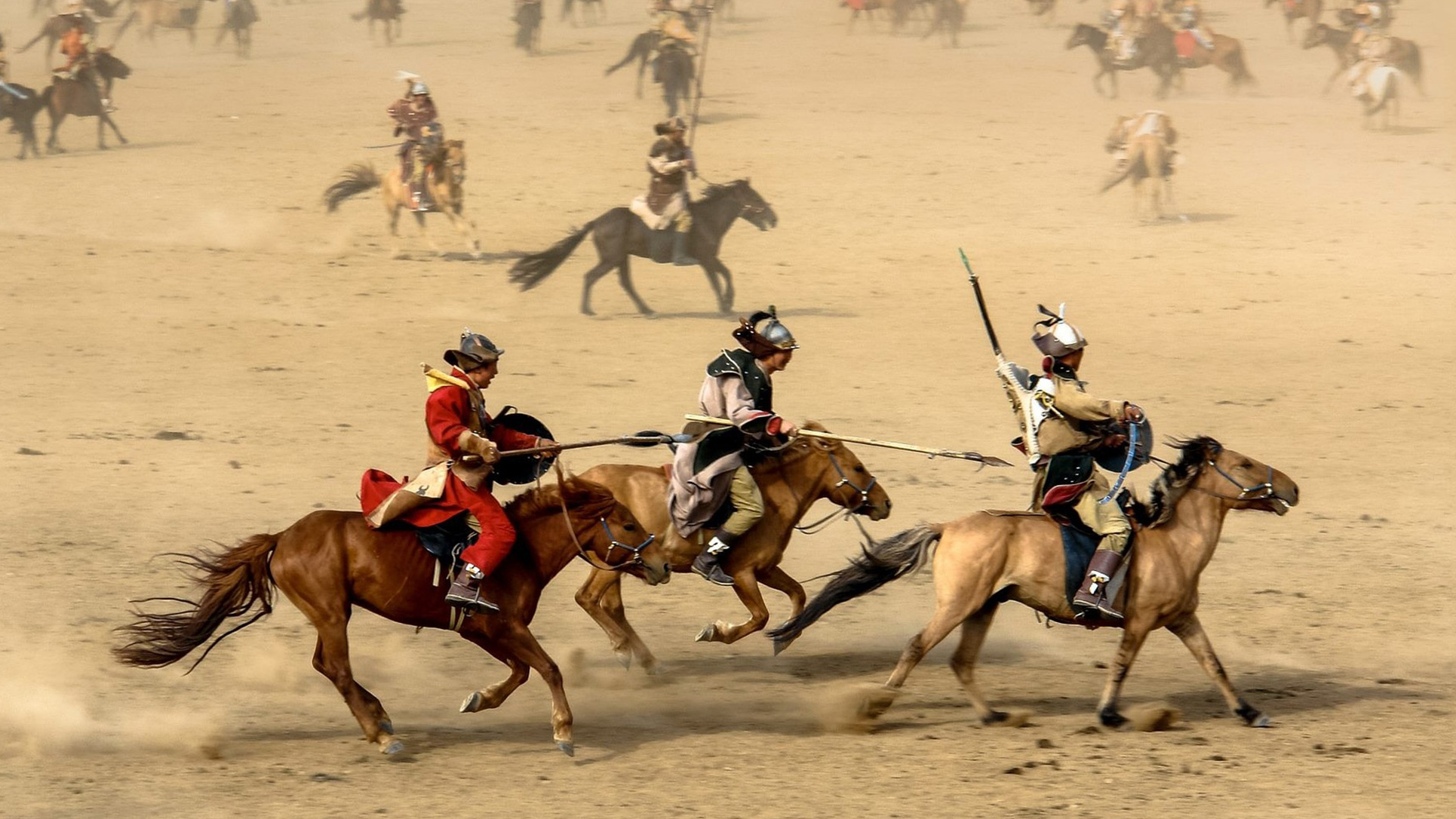
Mass Battles with the rules of Barbarians of Lemuria:
I have spoken about the 2d6-based rules set itself. Barbarians of Lemuria focuses on Sword & Sorcery, heroic action, and larger than life cinematics, not on number crunch.
But it has a way to deal with large bodies of men riding each other down or lobbing huge stones at each other’s castles: Chapter 4 of the rules covers “Wars of Lemuria“.
Marching distance in general is measured in miles, and an army can cover 12 to 15 of those in a day. Mounted units may be able to double that. But that is already the level of detail we get.
Armies are most often built from peasant levies (generally unarmored, but may have shields), professional infantry (light, medium or heavy) and mounted units (light skirmishers or heavy shock troops). Battles are more strategic than tactical, with army combat rounds taking up an hour or even a day(!), depending on army size, and may even represent a full month in a siege.
So no combat rounds in any D&D-adjacent sense, no armor ratings or to-hit-numbers. That is all way too much detail for a true Barbarian.
Army Ratings
Armies have a rating, that is, the weaker one has +/-0, and advantages in number, experience, terrain or supply/equipment may add +1s or +2 to an army score. An overwhelming numerical advantage would give +4 right there. Moderately better training will give a +1.
The use of magic on the battlefield is frowned upon, and most spells are not strong enough to leave a mark anyway … although spells of the second order are hard to overlook and spells of the third order can make or break a battle.
Heroes never Die
In regular army action, Heroes = PCs don’t get hurt and don’t die. They simply swim with the ebb and flow of the battle and find themselves either on the winning or on the losing side, but as long as they don’t stick their heads out they have plot armor and remain safe.
Which makes sense from a storytelling standpoint because it would be unsatisfying to have your character die in some faceless encounter on the left flank.
Heroes do Die
But wait up, does that mean a battle is the safest place on earth for a hero?
No, because they are called to do special ops. We will get to that later, but it can kill or wound them. Heroes don’t fall to random spearmen, but they can die heroically.
Before we look at these special ops, we have to understand the regular army around them.
Minigame
The actual combat between Lemurian armies is an abstract mini-game starting from a value of zero and attempting to reach +10 victory points to win. Or -10 victory points to lose the battle.
The Battle Roll: Each Battlefield Round, one of the
Heroes makes a Task Roll (called a Battle Roll) for
their side in the battle. The Battle Roll is 2d6 plus
their Army Rating minus their opponent’s Army
Rating. Take the result and subtract 7, keeping
a negative result if necessary. This is how many
Victory Points their side achieves this Battlefield
Round, and is added to their running total of
Victory Points. Repeat this Battle Roll each round
until the Heroes’ army reaches +10 or –10 Victory
Points, and the battle ends.
7 being the average outcome of a 2d6-roll. We see at once, that left to its own devices this system makes it with a bit of bad luck that a battle can take ages, as victory points are gained and lost ad infinitum.
That, if the two armies are evenly matched.
If they are not, the army with the superior numbers or position will slowly but surely turn the tide and win, as the laws of statistics will it.
Example: Army Blue versus army Yellow. Army Blue is better equipped and has better training and a smart tactician as commander, so it gets +3. We roll a whopping 11, add 3, subtract 7, so we actually subtract 4, and gain 7 victory points right away in the first round of battle — which can be an hour or so?
In round 2 we roll a 7, that means we get 3 victory points. Done, we are at 10 points, army Blue wins.
No Details
It is clear that this battle system of “Barbarians of Lemuria” does not care for details, like numbers of casualties, which unit attacks which, and how certain weapon classes fare against certain armors, missile ranges, movement speed on certain terrains during a charge … that is all fluff, narration, up to the Game Master to decide on a whim, inspired, but not determined by these two d six.
Heroic Actions
Statistics make the overall outcome easy to guess: The stronger, better placed army wins. As long as there are no outstanding people pulling the strings of Fate.
So far, so good, but what about those heroes, those player characters? Because who is more outstanding than player characters?
Their heroic actions can be any kind of input to manipulate the battle. To give rousing speeches, rolling on their appeal attribute, for example. Or they can scout and spy. They can deliver a crucial message all across the wild hills. They can take “Hill 25” at the head of a ragtag group of misfit soldiers recruited fresh from military prison. They can infiltrate a stronghold and steal important battle plans. They can be tasked to assassinate a gifted enemy commander in the midst of battle. They can take a bridge, or sabotage a line of catapults. They can hold out in a crucial position (Left Flank! Suddenly important.).
Or any number of outstanding moments, of which so many come, flare up, and are forgotten a moment later. That’s war.
But all such heroic actions are played out in zoom-in mode, focusing on the deeds of heroes. They can even be, a certain complexity provided, complete roleplaying adventures. After all, what else is the assassination of an important NPC or a daring heist in a mountaintop castle? Only, in this case they are not standalone, but have an effect on the overall flow of battle/war.
What is that effect?
Another Bonus (or, in case of failing that mission, a Malus) to that 2d6 die roll.
So we don’t just roll 2d6+3 for our Army Blue all the time, but give it a -2 or -4 if the heroes of Army Yellow hurt it in some significant way.
Suddenly we roll 2d6-1 before we subtract 7.
I.e., 8-1 = 7, -7 = zero.
The battle draws on, grinds to a halt, and there is one battle round where neither side makes progress, all thanks to the Heroes eking out a small advantage for the weaker Army Yellow.
In this way, heroic action can twist and turn a military campaign, and be instrumental to the weaker army win against all odds, because their heroes are just better.
Conclusion
Is it good?
The mass battle resolution of Barbarians of Lemuria is a very good fit for a cinematic, heroic Sword & Sorcery Battle. It does not get in the way of epic adventure, provides quick outcomes, but with more than enough freedom for the GM to spin an epic, rousing tale out of it.
Genre-appropriate!
Is it useful to play out mass battles á la a wargame?
No, not at all. Much too vague for that, and with the statistic heavyweight “7” for 2d6, we need heroes to make it more surprising or the longer the battle takes, the more it borders on the bland. Especially given the lack of casualty numbers or even army troop sizes at all.
How many people do we have? No idea, and not important. A big army! Bigger than the enemy’s.
Very Barbarian!
Is it easy to drop into other sorts of RPGs beside Barbarians of Lemuria?
Only in cinematic ones. As the system is so loosey-goosey with numbers and casualties, and with heroes unable to be killed in it outside of special missions = classic personal RPG-adventure sessions, it has its theme: Heroic Sword & Sorcery. Useless for more crunchy or detail-heavy roleplaying systems.
So Barbarians of Lemuria Land Battles is absolutely useful if you want to let the dice check out the general flow of a battle, but it is simply a pointer: no wargame and not really a mass combat rules set at all.
Image: Image by Enkhtamir Enkhdavaa from Pixabay

 PAPIER UND SPIELE