
There is a British author named Susanna Clarke – I believe she is not terribly well known to the population at large, but has made a quality name for herself within literary circles with a book about (superficially) magic in England (but rather about the tragedy of human interaction… or at least that is what I read out of it). Anyway, that is not the book I want to speak about.
I just finished “Piranesi“, a book that I would have overlooked because someone decided to print something about a Woman’s Prize on it; and that twice!
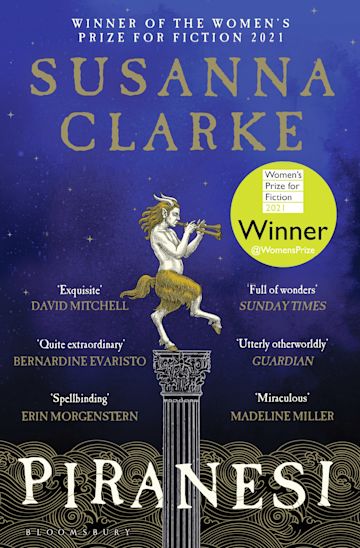
(In general, I do not think much about prizes; even less about prizes based on demographic categories. But more prizes in general. And if you have to write on the cover TWICE that you won some bogus trophy, what does that say about your product’s actual content?
Of course, that is twisted thinking on my part: Prizes have nothing to do with the content, neither in a positive nor in a negative way. A lesson that this very book itself was about to teach me, first on its cover, then in its content.)
Riddles within riddles
Anyway… someone spoke positively about this work, so I decided to ignore the weirdo marketing and check it out.
Piranesi sets off with a narrator in something that appears first like a post-apocalyptic setting: all alone, or almost alone, in a generously spaced palace. A “House”, as it is often called, but rather more of a “Maze”; underscored by the presence of great minotaur statues in the Entrance hall. Halls upon halls upon halls full of statues, close to a sea that seems to slowly swallow it. But what appears to be a museum in a venice of the year 2100 at first glance soon makes room to take on a fantastical tint as there are hundreds and hundreds of rooms, too many for any museum in Venice or anywhere else, and the statues are clearly something else: symbols and representations, sometimes of actual plastics; sometimes more of psychological concepts, myths, or classic literature. And sometimes of something else entirely, but even more fascinating, but that will only become clear at the end.
Where the heck is this person climbing around?
The narrator is alone most of the time, tending to the “House”, speaking with animals and the remains of the dead, apart from those regular, strictly timed academic meetings with someone else, a man who is called “The Other” and has the air of a professor… and also, in some ways, of an estranged husband.
The two of them seem to be the only creatures alive in the world, not counting the albatrosses and the fish.
What has happened?
Then the story gradually introduces doubts about the reality as concluded so far. Some things don’t add up. “The Other” has an agenda, and access to surprisingly well-preserved items of our own modern civilization. And so the story changes and takes on aspects of, first, a psychological thriller, then of a crime mystery. Yet always when the reader decides that now the puzzle is solved and the answer is clear, the labyrinth takes on a new aspect and what was an answer becomes just another falsified hypothesis.
The story combines the fantastic, the psychological, the criminal, the scientific, and the superstitious, and invites to reader to accompany “Piranesi” on a quest of discovery.
What does it mean?
The actual meaning of this book is, I believe, for you, the reader, to decide. It repeatedly leads the reader to second-guess and backtrack, and to me that is the meaning: That what we perceive is not necessarily fact. Like my own initial dismissal of the book based on an insignificant detail. I was in error, acting rashly, even arrogantly – not unlike a particular character in that very book.
In the end, it is the narrator, whom “The Other” calls “Piranesi”, who appears to be, in a state of almost childlike innocence, yet equipped with a sharp analytical mind, wiser than most of us who presume to “possess” knowledge – and very aware of the futility of some concepts that we “modern” people take for granted.
Like: Who “are” you? And how fixed is this “being”?
Recommendation
You may take something completely different from this book, as it is probably highly reader-dependent, and I suspect that with the proper education about, say, Art History, one may recognize themes that I with my pedestrian gaze fail to grasp. But it will definitely give you ideas and invite you to think differently about ingrained rotes of reasoning.
Even more so, it is written in a way that has fallen out of fashion, but works particularly well in this setting: The epistolary novel. Lacking a recipient for letters, the narrator essentially logs discoveries in a research journal – the perfect choice for someone who is spending a life with research or, more precisely, discovery.
So I heartily recommend to pick it up and come on a gripping, often surprising, and definitely inspiring journey of seeing a weird world (or even two of them) with Piranesi. It is an excellent experience.
And on that note, must go ahead and likewise recommend Susanna Clarke’s work as a whole, for it turns out that Jonathan Strange & Mr. Norrell is also a multi-faceted, awe-inspiring work that one should not be remiss to read — and wherein even certain parallels to Piranesi appear. I have no prizes to hand out, but I have praise to express.

 PAPIER UND SPIELE