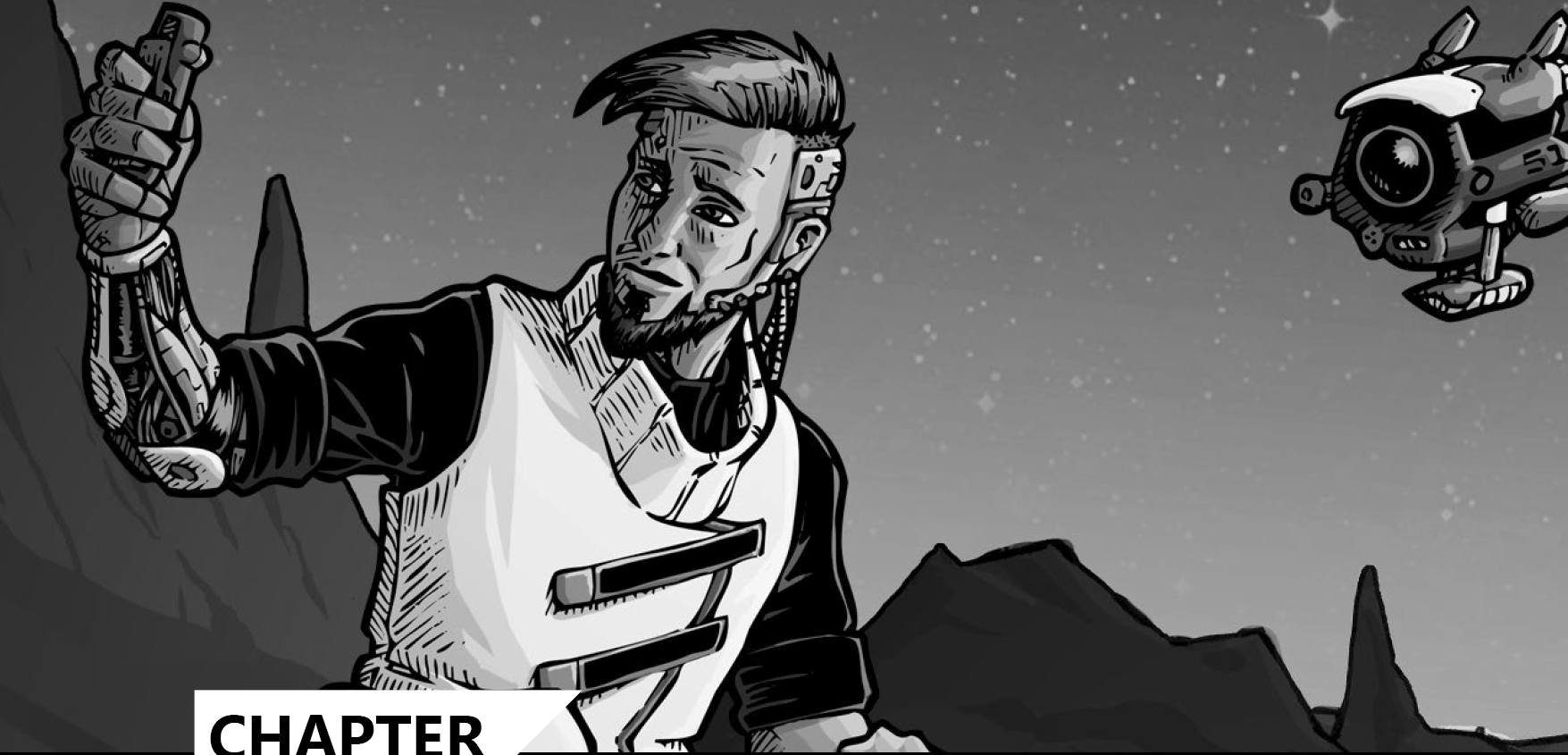
Branching out from playing Stars Without Number I stumble upon a SciFi game system called “White Star” by “Barrel Rider Games”. White like in White Box. The name is no accident: it is, in its essence, Old Original D&D, simplified with a Swords & Wizardry mindset, wrapped up and kicked into the far future out in space.
That already tells you everything about the system: a simple, sturdy, OD&D core, +1 for attributes over 15, with everything twisted toward a raw mix of every Sci-Fi flick you have ever seen.
This is where the blog post could end, but let us go deeper and look at some specifics that stand out from that core. Also, let’s see some of the Art, because I find it carries a lot of the actual “feel” of the game.

White Star Extras
For one, after the core classes, the rules throw two dozen extra classes and aliens at the reader, roughly balanced between extra powers, OD&D Hit Dice, various semi-random Level-Caps and XP thresholds veering off the standard fighter-2000 to level up.
Thanks to the strong foundation in Swords & Wizardry, that tactic works.
Whatever has more extra powers will either have fewer HD or take more XP to level up.
If anything doesn’t work, fiddle with these gauges until you find the sweet spot.
With that in mind, any GM with OD&D or S&W experience will have an easy to time to add whatever crazy individual class idea any player can throw into the ring.
Fighter and “Not-Jedi”, Alien and “Not-Hobbit”, Robot, Bounty Hunter, Space-Wizard and Psychic, Pilot and “Jedi-Pilot” … or even Star-Squirrels. Anything goes in the wild we…universe.
Their classes may have special skills.
For example, the “Two-fisted Technician” has a skill called “Man of Science”. He must roll equal to or higher than this rating on 1d6 to operate unfamiliar tech. It starts at 5 and goes down to 2 at Level 10. So the base chance is 2-in-6, rising to 5-in-6, with +1 if he has some familiarity with the sort of tech. Other powers may work automatically upon spending time on their application.
Optionally, every character can start with 3 skills, two at 2-in-6 and one at 1-in-6, and may add additional skills or get better at skills upon certain level-ups.

Gaining Experience
XP rewards a tricky thing in Space: The simple “XP for gold” logic can fail if you throw in so many different character concepts. What does a mystic or a jedi do with gold? Therefore the system leaves this part, beyond the classic XP for killing foes, intentionally vague. It leaves it to the GM to reward based on missions, “good roleplay”, “clever deeds”, behaviour at the table, or heroism.
This is not very helpful. How to hand out XP is something that a White Star GM will have to think about before kicking off the adventure, and communicate to the players. It can be frustrating if players don’t know what course of action will be rewarded or punished, especially in a system that gives off such a strong “anything goes” vibe.
Attempt to aim for an XP-amount similar to what you would throw out in a classic D&D game and you will be fine; by whatever metric comes in handy – given the swinginess of the options presented it may even be good to offer a fixed amount for playing in a session instead.
Equipment
Equipment is as you would imagine it: Take anything you ever saw in a sci-fi-movie, slap a price D&D gold/credits on it, and if it is a weapon, give it 1d6 damage with a modifier between -1 and +1, or +2 if it is very special and expensive. Done.
Hirelings
I have mentioned it before, I love hiring NPCs, so this section is especially interesting for me.
Costs for hiring are roughly based on OD&D or S&W, but on a narrower scale: minimum wages are higher, maximum wages lower. The amounts are for week in either case.
White Star:

S&W White Box:

Combat
OD&D combat. Rate of Fire is two for a combat round. Higher level fighters can melee low-level grunts with [Number of Level] attacks per round – and special Ion Weapons to take out robots.
Missile weapons have short/medium/long and extreme range. For a rifle that would be 150 short, 300 medium (modifier -2), 450 long (modifier -4), and 600 extreme (modifier -6).
Like in S&W, characters also have a BHB, a base to-hit bonus; practically akin to their better Thac0 at higher levels in OD&D.
Death rules are exactly as in S&W, i.e., pick one of various options like the strict 0 = death, or 0 = unconscious and bleeding out, and death is at -[Level] HP. Heal 1 HP per day or more with medicine, magic, psionic healing or with the aid of the “Not-Force”.
Starships
Now we get to the nitty and gritty of space.
Initiative, fly-roll, shoot-roll, and damage.
Easy! Starships act exactly like characters.
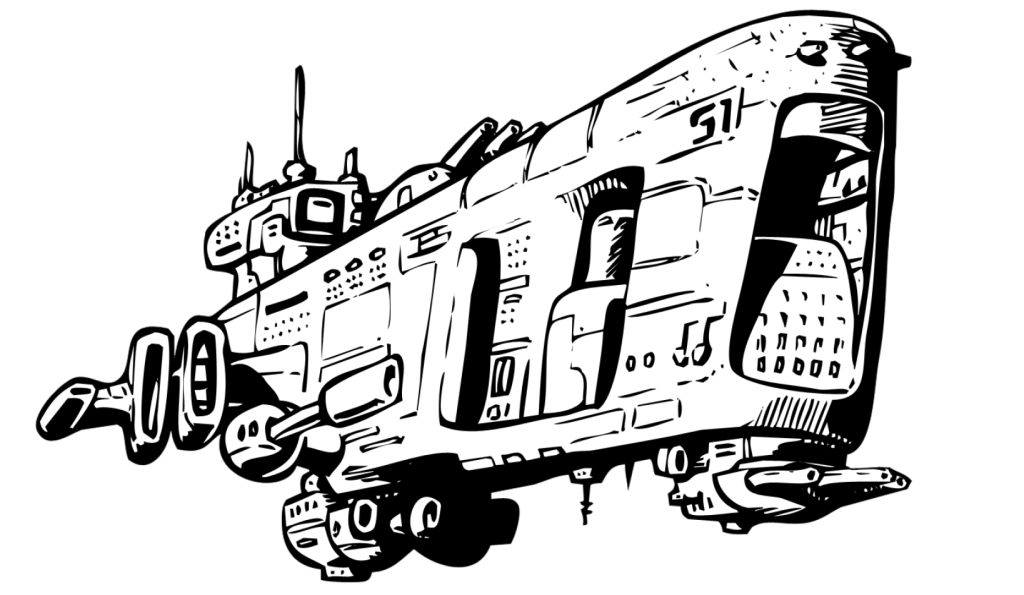
In addition they have shields that reduce damage, and every time they do so they lose 1 point of shield strength. If the GM wants, there is also the option for cinematic extra-effects at 75%, 50%, and 25%, like shield generators shorting out or motor functions limping. At 0 Starship HP, the vessel explodes and everyone is dead.
Repairs are super-cheap at 1 day and 20 credits per SHP. 20 credits is the price of two normal steel swords or one future mono-sword.
A little spit-fighter has 5 hit points and no shield. A big assault craft has 75 hit points and 5 shield. A heavy battleship has 200 hit points and 20 shield, 20 heavy lasers, 8 ion charges and 4 proton missiles, so don’t freaking mess with that if you don’t have 100 allied ships with you.
Ground or air vehicles operate along pretty much the same principles. But they do double damage against individuals, while suffering a -2 modifier to hit such a smaller target. Attacking a mecha, the vehicle does half damage. Attacking a starship, the vehicle does a quarter damage, while the shield potency is quadrupled and does not suffer degradation from such a puny projectile.

Is that all?
That is all!
White Star is easy enough that grade schoolers can run it.
Mechas & Not-Transformers
Who doesn’t love mechas? They make little sense from an economic or strategic perspective, but if you have limitless resources, they are a fun concept.
To make things simple, Mecha Rules in White Star are fundamentally the same as for space ships or vehicles, only that Mechas can also use melee weapons and may, upon destruction, be ruled to be just immobilized, not obliterated. They generally use one weapon in a round, like a character.

Mechas suffer 1 HP damage per d6 damage potential from small weapons, half from vehicles, and in turn do half-damage to starships, while starships do double damage to mechas and quadruple (or more, depending on the circumstances) damage to vehicles. Mechas suffer a -4 penalty for targeting a little running human on the ground, but if they hit he won’t tell any tales.
Repairing a mecha costs 10 credits a day for 1 HP. White Star mechas have “Hard Points” for weapon mounts just like SwN mechas. Again, super-easy system that focuses on the fun of the action and not on economics and grit.

Cyber
Speaking of fun: There is also cyber. The rules are almost too simple: Pay money for powers.They are not cheap, but cybernetics-rules don’t get any easier than that.
In conclusion
White Star is a fast-and-easy, chaotic free-form space game that can be thrown together in the spur of a moment if the GM, and optionally the players as well, are familiar with Original or at least Basic D&D. It has an “anything goes” attitude that allows it to be run with low- or even no-prep.
The downside of this is that if you want to play it in earnest, you have to take good notes to keep the world and the rulings consistent. But that is something you should do anyway, so it is not really a down side.
An actual down side (for gamers who are into settings) would be that it really has no actual setting, only a lot of potential. This too is no actual downside if the group likes OD&D, which comes with that same attitude, where LotR-adjacent heroics, Conan-esque daring, Morte d’Arthure craziness, UFOs and dinosaurs all fit together seamlessly: the primordial soup that birthed Dungeons & Dragons itself.

The Art, btw, comes from these fine people:


 PAPIER UND SPIELE