
New Weird. That is how some people describe the Genre in which the author China Miéville set his imaginary city New Crobuzon. Its chaotic jumble of uncounted inhabitants under an oppressive, autocratic, and crime-riddled system include humans and various aliens whose exact origin is glossed over… now they live as sub-cultures in the bustling districts of the only city that matters.
The feel of New Crobuzon must immediately jump out at any reader who is familiar with the RPG system “Into the Odd”, and its “Electric Bastionland”. Although there are some differences in the vague detail, the atmosphere is strikingly similar.
So striking even that it would be extraordinary in the extreme if Chris McDowall would have come up with the city of Bastion while unaware of New Crobuzon. Both feature slums stacked upon middle class residents, a vivid economy and a wealth of opportunity for the enterprising.
And yet, they are not the same. New Crobuzon is tightly controlled, under the thumb of a strict militia, and lorded over by an autoritarian mayor with no discernable opposition or laws to limit his pouvoir. By contrast, Bastion is partially organized-ish by various semi-, quasi- or basis-democratic institutions who block themselves and each other, ungovernable in its complexity, and therefore anarchic and free.
The name
Perdido Street Station is, just as it sounds, a main hub for public transportation in New Crobuzon. It is a station where most of the trains connect, as all the main lines originate there and spread out across the cityscape. It is also where the seat of power is located in “The Spire”, the main militia/police and administrative high-rise — an eternal, widely visible reminder of the presence of central power and what it can do.
What is the book about
Perdido Street Station was published in the year 2000. It features a cityscape where magic and steampunk, gaslight and electricity, crossbows, artificial intelligence, humans and aliens and bioengineered twisted people all live over, under, with or next to each other in a bizarre chaos of underground, street-level, roofscapes and skyscrapers.
Drastic social differences in close proximity, subcultures rejecting the local way of life, the mainstream sidelining and mistreating minorities, and also vibrant artistic communities bridging most gaps you can think of: in this wild, creative climate we meet Isaac, a braggart genius scientist with a private lab equipped out of all sorts of legitimate, semi- and non-legit channels.
Isaac is in a relationship with Lin, a khepri woman who is a) an incredibly gifted artist and b) an insectoid creature who has left her ultra-orthodox home to integrate in the free society of New Crobuzon.
Everything is more or less wonderful until Yagharek shows up, a bird-man from the desert, who has a problem: He has been mutilated and can no longer fly. Isaac has been recommended to him as the one guy who can make anything possible. He is Yagharek’s only hope if he is ever to take wing again.
Isaac does intense research with all sorts of winged creatures and taps into underworld connections to get even more specimens.
That provides him with one creature that is going to make a ton of problems for everyone, from the poorest beggar in the dankest corner of the street up to the mayor itself, from humans and cactacae to weird parasitic hands, transdimensional weavers and the Lords of Hell itself.
Weirdness
New Weird is a fitting word. To enjoy the book it is important to throw all preconceived notions overboard and buy in: accept that New Crobuzon is all sorts of crazy, tragic, wild, fun, and disturbing all at once.
China Miéville sells all this weirdness well by not even bothering to explain. It is what it is: There are incredible creatures, and where it matters their ways and physics are described, but where they all come from and how it came to pass that this particular circumstance evolved, that is hardly ever a concern. Live in the now, that is the motto of New Crobuzon.
The captivating lives right next to the ugly. Violent crime happens just a doorstep away from the cozy. The rich in their high towers must avoid looking out of their windows or they cannot miss the grime. In this way China Miéville gives us fantastic and breathtaking, but with a healthy dose of critique — at least if we dare read some kinship between this city and ours out of these pages.
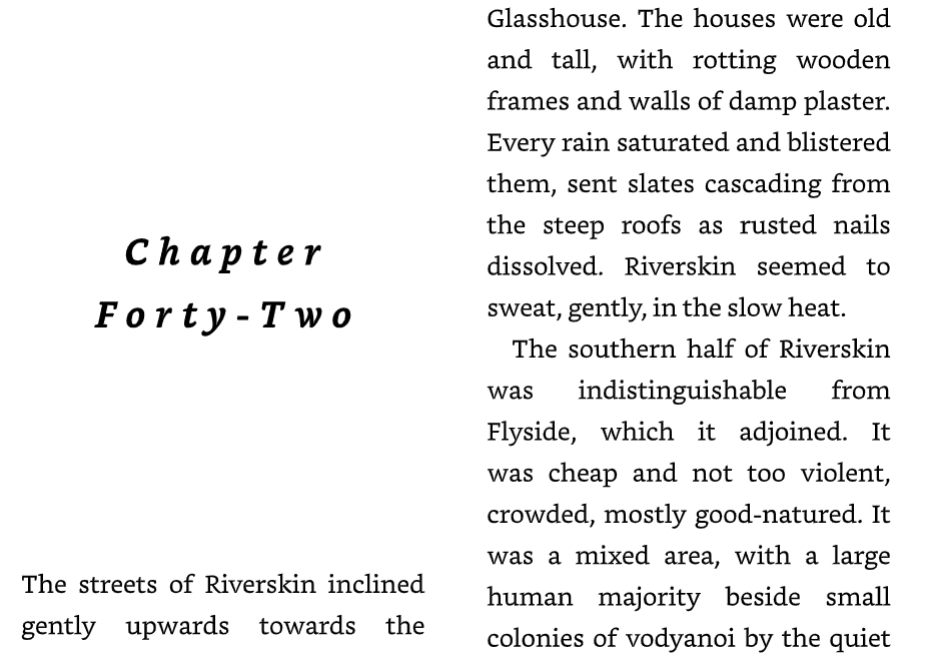
Miéville’s writing comes in a style that feeds the reader’s mind through detailed yet varied descriptions which paint in broad strokes and leave gaps for the reader’s mind to fill. The author’s vocabulary is vast, and he makes use of it. He picks his verbs and adjectives with purpose. They tend to bring the unseen to life in a vivid fashion, and paint the atmosphere, sometimes underlying the soft and wobbly, at other times the hard, concrete and jarring.
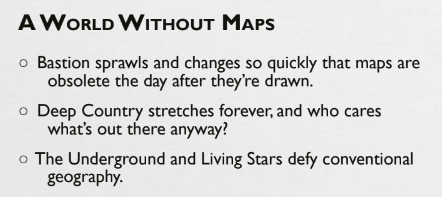
Pretty much like Electric Bastionland claims the city is supposed to look like: Ther is no map to lean on, because Bastion is different for everyone.
The adventurers
For roleplayers, there are multiple things that jump out of these pages and tickle our fancies. Obviously, the closeness with Electric Bastionland, which is unfiltered inspiration by the bucketfulls. Also, the effortless combination of varied characters into a party of protagonists, which simply allows leaps of imagination to take root — to see the commonalities rather than the differences, and the ways to interlink relations to build a web, or a network of characters with desires and motives who can work together or against each other, as the situation demands.
The other is a gem of a description of what an adventurer is, which is best shared in the original:

In conclusion
This book is not for everyone. You need to be open to the weird and the fanciful, or it will rub you the wrong way. Do not go into that book with expectations. Do not judge. Rather, open it as an observer, ready to discover. If you can do that, it might just be an unforgettable, fantastic journey.
Now I am off reading the sequel: The Scar.

 PAPIER UND SPIELE