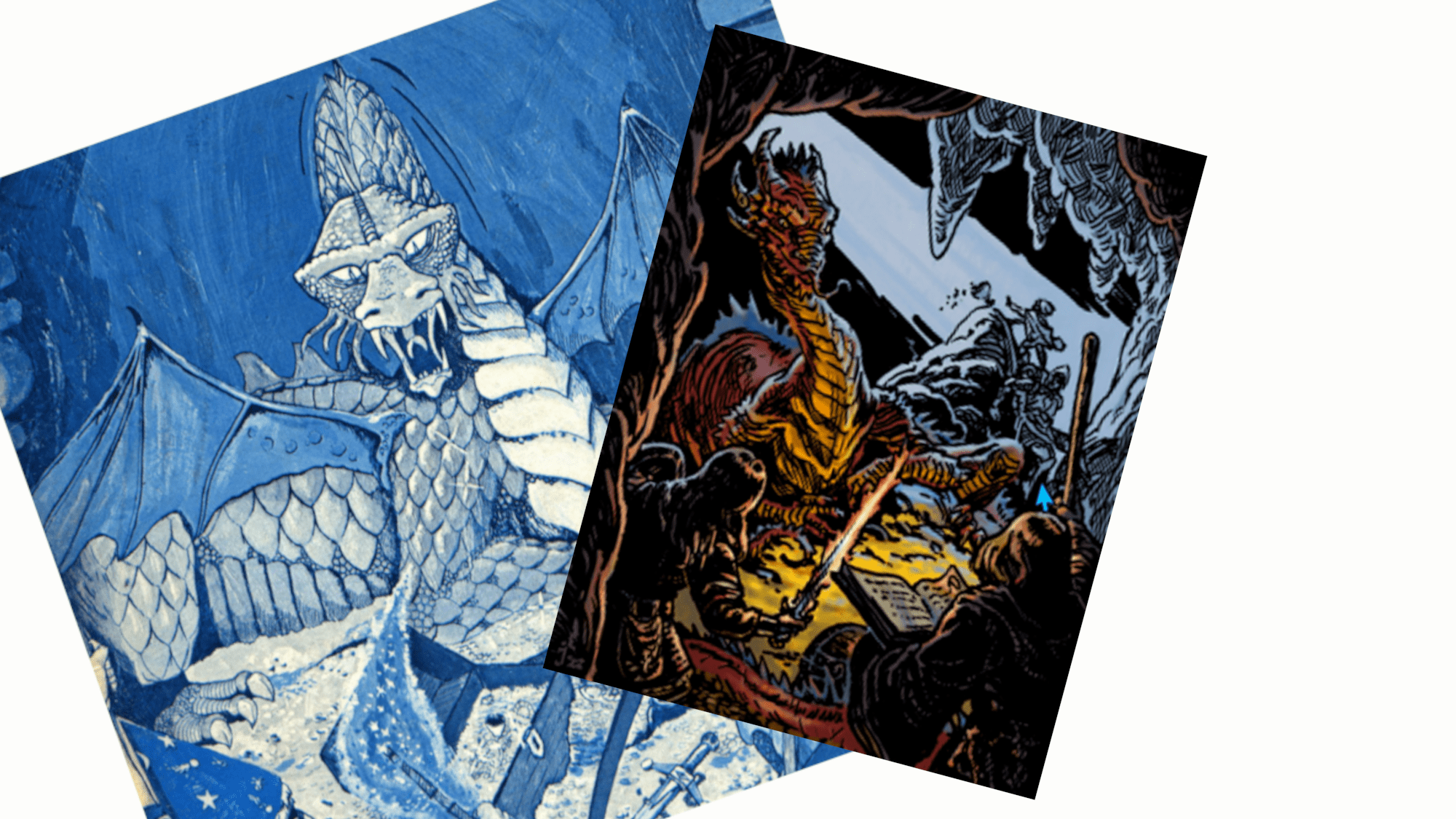
Holmes & Clark, that is not an 1805 duo of explorers working with a native guide, nor a 1976 duo of detectives where one is a robot. Instead, it is anotherTM retroclone, this time based on … you guessed it: Holmes; the original basic; newly interpreted, amended, developed and expanded on by a fellow gamer named Clark.
Old School D&D is the core of the game, and if you read this blog you will have some idea about what the OSR is, so I will not go into those too much in this particular post. You know the drill: The classic six Attributes, d20-rolls, attacks against a fixed Armor Class, character classes to define approximate skill-templates, XP to level up. And player decisions to overcome challenges in a shared head-space, which may be won through player skill, luck of the dice, timely retreats, … or failed at.
But let us focus on Holmes & Clark now.
New rules
So, in what way do these rules differ from your classic OSR rules?
While the requisites and 3d6 down the line are the same as in most OSR systems, starting funds are 3d10 x 10, so you have more money. Attribute based modifiers are as in original Holmes in on the plus side (smaller than in B/X) 15-16 is +1, 17 is +2, and 18 +3, while 8 and below are all -1; this was 6 or below in Holmes original.
Interestingly, Holmes & Clark goes with the 3-tier-alignment (my favourite) as opposed to the singular use of a five-way alignment that Eric Holmes introduced as something between the old 3-way and the newer AD&D 9-way alignment. But that just as an aside.
Wounds get a special treatment for characters: While monsters are simply based on hit points, for PCs it is a mix between D&D and elements from Electric Bastionland:
When hit points are exhausted damage is applied
to Con. Anytime a PC receives Con damage they
must test Con to remain conscious.
Any damage applied to Con should result in drastic
wounds, the PC and DM storyboard the grievous
nature of the wound and the lingering effect. See
Appendix W for some guidelines.
Friends can check any unconscious PC, Save vs
Death + any remaining Con. Upon a successful
save the PC recovers with 1 hit point and 1 Con if
necessary. If the save is failed the PC has
succumbed to their wounds.
1d6 hit points can be recovered with 1 hour of rest.
Con is recovered at a rate of 1 point per day or
with Cure Serious Wounds equivalent.
At level-up, players can decide in what way their character gets better. Creative ideas are welcome, otherwise it may be simply more bonus points or an additional attack per round.
Easy Encumbrance
Instead of coin values, encumbrance is handled STR-dependent: Carry half your STR No of items without penalty. Carry up to STR No of items encumbered. Small items can be bundled as one. Exceed your STR capacity and you become fatigued, with results like loss of CON, loss of carrying capacity, loss of speed, and disadvantage(c) to all rolls, among others. Narrative sense comes into play: Explain how and where you carry your items.
Shields and helmets provide AC bonus, DEX penalty and take up Encumbrance slots.
Actions and Challenges
Within a round of combat, every PC has two basic actions: move, attack, cast a spell, use an item: You can move + one of them, or move twice, or, depending on GM ruling, maybe use an item twice if that makes sense, if you are not moving.
Challenges are rolled equal or under the relevant stat, with the goal of rolling high, but still under. Roll under but as high as possible without going over: that’s how you win. There is a table about that to clear up possible fuzziness:
Battle-Dice
To decide the outcome of struggles between groups, Holmes & Clark uses “Arnesonian Dice”: Both sides begin with 2d6, then add more d6 for perceivable advantages like superior numbers, equipment, fixed defensible positions, etc.
Finally, both sides roll and add up their two highest rolling dice.
Therefore, it is always possible for an underdog to win. Roll boxcars with 2d6 and you beat a stronger opponent rolling 1, 1, 2, 2, 3, 4 and 5: because 12 beats 9.
Then the GM interprets the results creatively.
Speaking of Creativity: The rules take a page out of the legendary “Over The Edge”: Fighters have the option of attempting a “Daring Deed”; something specifically heroic that may have a greater effect on the overall conflict. They discuss the possible gains and risks with the GM, then roll a d3 — or can opt, at higher levels, for larger dice in place of HP-increases — and pull their stunt off at a 3+.
There are also various options how to handle thief skills in different ways than in the original D&D style. Among them a simple split between “Fiddle” and “Sneak”, or a personal point-buy option for the lot, taking from Climb to feed Trap-removal, and similar.
Levelling
We spoke of options at levelling. So we must speak of XP.
The XP Thresholds are basically the ones handed down through the editions since 1974: The fighter levels at 2000, 4000, 8000; the magic-user at 2500, 5000, 10000. For earning XP, Clark gives the party a slight lift up by offering extra XP for surviving and 25 to 100 for discoveries.
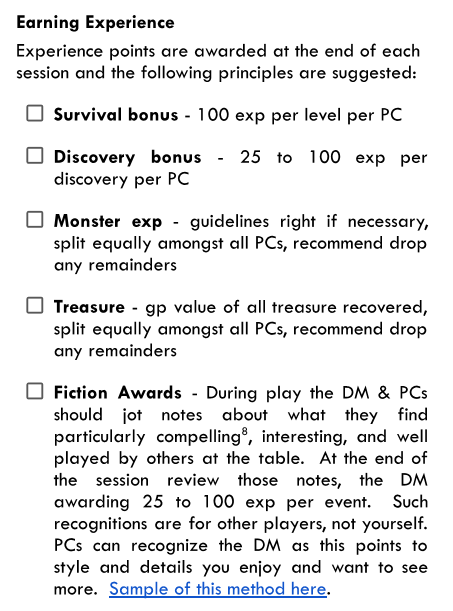
I am personally also partial to the idea of handing out XP for special discoveries, if they have the potential to become important at some later point in the adventure. At the same time, I am less enthused by a survival bonus, if it does not come with actual mortal threat. So if I as a GM would look at the PCs going to gain 100 XP just for not dying, I would be tempted to do more than usual to make them earn that.
Which is probably an empty promise on my part, as I am known to be quite the cuddly carebear (well… apart from that ONE player group that accuses me of being extremely strict. But since it is only that one group and everyone else laughs at my empty threats, I chalk that up to the group, not me). Yes; I am a very soft GM… which is probably why 100 XP for not dying feels like a Swedish kindergarten participation trophy for me.
I can see it working for more dangerous DM’s who see regular PC deaths though.
Magics
Magics get some extra wrinkles taken from 1e, like minimum and maximum number of spells based on INT.
There is generally a “Comprehension ability” like in 1e, but it is not used in the same way. Holmes & Clark gives the option to learn a spell very quickly, and in that case it has to be rolled if the spell “clicks”. But if you take just 1 day per level to learn a spell properly, it can be understood without this limitation.
Funny mention to discourage spell-sharing among mages:
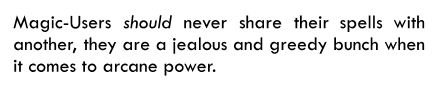
Will this discourage smart players from doing the long-term profitable thing and work together in study groups?
Be that as it may, it is a nice reminder that in Vancian fiction not everyone is as cooperative as a smart party.
Speaking of Vance: The rules give MUs the option to cling to a cast spell and keep it in their strained minds. However, this comes at a price. Either in the form of a CON-loss, or at a random loss which can do a wide range of damages to magic user or party.
So maybe it is wiser to just let it go… still good to know the option is there.
Turning Undead works with a d20 instead of the more common 2d6, but that just as an aside. More importantly, Turning the Undead in Holmes & Clark is not just a faith-based ability, it is a spell; and thus it only works for clerics of Level 2 and higher; and also, less often: They simply get 2 spell slots instead of 1 at Level 2. No mass-turning of whole cemetaries for Holmes & Clark parties.
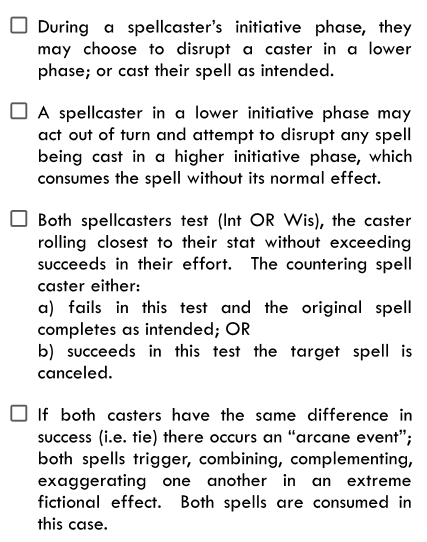
Special: Disrupt a spell
Spellcasters can disrupt an opponent’s casting.
Identifying Magic
With careful study Magic-Users and Clerics may
attempt to derive the purpose of any magic item.
For every day spent in study (Clerics every 2 days)
a single property of the magic item is discovered.
Aesthetics
The rules opt for a traditional “early-D&D” small print font style, but, thanks to tech advancements, with much better formatting and white space so it is still easily legible even for modern eyes raised on an overly soft Apple-Store-diet. Whereas the original Holmes rules… well… I am not the biggest fan of that layout. Which means I am all for this more modern, but still respectfully nodding toward the past, look.
The cover Art has a “real” feel, like you can see how humans made this and thought about Art while doing it. Within the book the Art is unobtrusive, supporting atmosphere without trying to shoulder its way to the forefront.
In other words: Well done.
In Conclusion
Holmes & Clark offers optional crunch for lovers of crunch in roleplaying systems, but also allows for a straightforward and quite sensible OSR experience. Going beyond Holmes’ 3 levels and raising to 9. Also including a nifty page of DM Advice that feels like an “of course” to OSR old hands, but can be a stunning eye-opener for newer game masters.

It is solid work, still easy to learn while also providing various options and “unique builds”, as many players crave. And the price can’t be beat: You can pick it up as a work of love for the community, all gratis at DriveThru.
I was in a playtest session, more to come in the future.

 PAPIER UND SPIELE