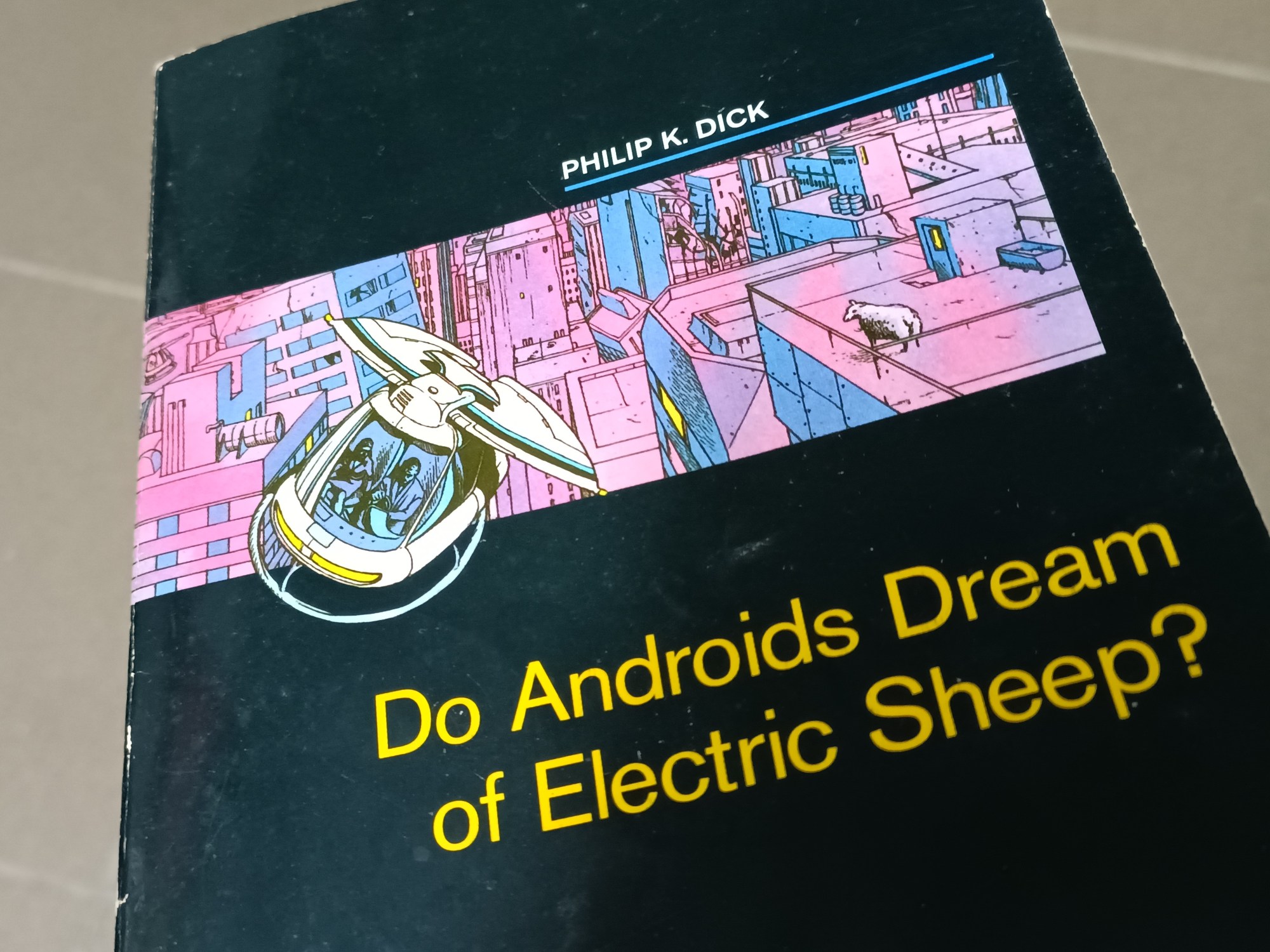
Do Androids Dream of Electric Sheep?
This short novel(ette) by the inventive visionary Philip K. Dick, who wrote Minority Report, A Scanner Darkly, and a host of other important creations … this book is probably not even best known as itself. It holds special mass appeal for its “children” — as the inspiration to the movie “Blade Runner”, which has a large cult-following and impacted many other creative works, and later “Blade Runner 2049”.
However, even back then, in the olden days when Blade Runner was filmed, not everyone stayed faithful to the source material, and so the book and the film are two very different beasts in many aspects. Not the same story at all.
We will focus on the book here, so if you know the movie, don’t wonder about weird differences.
Empathy
The book is less a book about a man hunting robots who try to blend in, more about what makes a human a human. And the answer is thrown at us right from the beginning and never lets up: It is empathy; despite our apparent lack of it when it comes to fellow humans.
The robots in the book don’t fit in. They can’t. They are very obviously not human, despite the manufacturer’s dogged attempts to make them pass as such. This is not going to end well somewhere down the road: The company is actively trying to subvert attempts at distinguishing between human and android. Their (secret) goal is to make a robot that is so human-like in its reactions and autonomous mind, that it will pass any test thrown at it and manage to evade notice.
While that sounds very fair and nice if you think about the plight of the poor robot forced to serve us, that’s the human in you speaking. It isn’t fair nor nice, because one thing the company cannot build in. A conscience. “Goodness”.
Yes, Philip K. Dick thought about good and evil. And while the robots are not “evil” evil, they are things. Uncaring like a doorbell, which also cares not who presses it, or how long, and if that person is healthy or sick, or dying. They simply do not care.
Rick Deckard is a bounty hunter tasked with discovering, identifying, and “retiring” = killing, clandestine robots, or rather, androids, that have escaped their duties on Mars or elsewhere (by murdering their owners) and gone to Earth. Common parlance calls the androids “andys”.
Why do the andys come to Earth? That is a mystery they cannot quite fathom themselves. Because Earth is actually not so grand.
There was a big war, most people are dead, others suffer from effects of radiation, the smart and semi-smart have left the planet and live elsewhere — but it is insinuated that it may not be that grand elsewhere either.
Mars is lonely, says one android.
Everyone who leaves Earth gets a personal android as a bonus or reward, so there are massive numbers of androids out there, wherever humans try to live. Just not on Earth.
What’s with the sheep?
Earth is bleak. Most animals have died, most species died out even, and the same goes for many of the humans who have not gone off planet. Whole cities worth of real estate stand empty or house only few individuals. Of those who stayed, many are affected by radiation — so-called “specials” — which either slowly kills them or degrades them; in many cases they suffer from diminished intelligence, which leads to them being called “chickenheads”.
Emotions
And here we have the juxtaposition: The chickenheads are regarded as “dumb”, and are looked down on, but they do not lose their sense of empathy. Somehow this is often suspected to be happening, but the emotions survive.
The andys are smart and getting ever smarter, and they often try to fake feelings, but they don’t have any.
With so many creatures on Earth dead, it becomes extremely interesting, even almost mandatory, for humans to have pets to care for. And this is Deckard’s prime motivation: To get a real pet. Because his shitty salary does not allow him one yet — he and his wife Iran care for an electric sheep, a robo-sheep, as a stand-in for a real one, which they covet. Rick Deckard goes nowhere without his catalog of animals and their going retail prices.
The Deckards hide from everyone that their sheep is fake, out of shame. How many others do the same? There is no way of telling.
In addition to the care for animals, humans have religion. Their dominant one involves a messianic figure and the use of a network to “share” emotions: To upload feelings that can be experienced by others in turn, according to a set of numbers to dial. Deckard’s wife likes to walk on the edge, to give herself despair and sadness, which greatly disturbs him.
The andys like to experiment. Generally not with any great plan, just trying what their whim commands. How long to kill this creature? What will make this human sad, upset, or despair? What happens to my fellow android if I kick it down a stairwell?
But sometimes they follow grand, convoluted plans too, like: Can I manipulate powerful humans? Can we destroy human society? Or can we trick bounty hunters into long-term working for us instead of the police? Can we make them kill each other instead of us?
The topic of the book is not so much the hunt for the andys, even though that is a pretty hair-raising affair too, where Rick himself struggles with his own issues. One of which is his growing empathy with constructs that have none for him.
The main issue is what is true and what is false, and what is intelligence worth if it comes at the expense of feeling? What is empathy worth if it is wrongly placed? What is faith worth? And even thwarted, tricked, betrayed or mistaken: is it worth going on based on a dream when your intellect tells you it isn’t?
So, what do you think: do androids dream of electric sheep?

 PAPIER UND SPIELE