Finding the right degree of opposing force is often a difficult task for a GM. Be too soft, and the game is boring, lacking challenge. What is victory worth if it drops in your lap? But be too harsh, spoil every daring plan, and the game becomes frustrating.
Let them find too much treasure, and they upend the game economy (a problem since the earliest days of RPG, where many, many GMs asked for advice how to drain the deep pockets of the party, leading to solutions like harsh taxes, having to pay for level-ups, vile theft, and rising demands of henchmen.) And yet, be too stingy with treasure and the party is stuck with too little resources to take on bigger challenges, stalling progress.
How the softness or harshness of the world and its opposition is experienced, that is highly dependent on the tastes of a particular group and its individual players — and also the rules system.
System Matters
OSR games based on earlier D&D versions are generally a less forgiving backdrop than, say, 5e: The main focus of 5e is that you have a colourful character and enjoy expierencing the world through it as a medium. If you carefully craft a character for 2 hours, write a few pages of backstory and draw your hero in various situations of his pre-adventuring life, it would be a hard blow, and just not fitting, that you should die from falling into a pit. Obviously the story of such a unique character, potentially coming with some art lovingly drafted by the player, involves a long and illustrious career. And so 5e characters level up rather faster than OSR characters.
OSR games feature simpler characters like “Bob the fighting man”. If he falls down a flight of stairs and breaks his neck, “Jim the fighting man” is there to replace him in a minute, so a tougher, more brutal, and shorter life can await adventurers and meet players who take casualties with stoic composure.
But there is not only D&D: Some systems have Fate Points, Hero Points, or Drama Points, to keep characters alive in difficult situations, all in order to keep them going. But on the flip side, if you have such points to spend, the GM should put some pressure on so you are forced to spend a couple of them; otherwise what’s the … point?
GURPS has a wide range of rules and source books, and prides itself to re-create realistic worlds and challenges. But it also suggests to GMs that they should do what they can to keep characters alive, for the simple reason that if the party dies, the adventure is over and prep-work is lost.
Games with very simple, shallow rules, no great necessity for prep, and no big focus on realism, can play it fast and loose with character lives. If your character description fits on a napkin, you laugh about the hilarious loss of your hero and simply scribble up a new one.
Stars Without Number
Stars Without Number does not usually have Hero Points (although it is possible to include them), and the rules are only medium complex. Even so, it is a high-power game: Characters start out as relative pushovers, but due to levelling up after one mission, again after the second mission, and yet again after four missions (already level 4!), they grow at breakneck speed and are soon strong enough to master serious challenges and oppose impressive odds.
In short: It is a game that expects the PCs to be larger than life and make a big impact.
A Stars Without Number hero is a cinematic hero who can expect to survive a lot, and with only a few levels under the belt such a one should be perfectly capable to hack into government facilities, heal massive trauma, take out a squad of normal soldiers or a team of bodyguards of a VIP. A whole group of them can breach a military outpost with only a little planning and effort … and I deliberately call it effort, because that is especially true if they have some psychics with them. Psychic powers grow from weak to intense fast as well, and they mostly “reload” their powers every 5 to 15 minutes, so they don’t have any of the Vancian magic problems that haunt B/X players.
The Shadow of Great Power
Such power comes with a flip side: It makes fearless and careless, foster a feeling that the rules of normal people don’t count for a PC. Which should even be true to some extent:
The rule book suggests that people on a level footing with PCs should be few and far between. Sporting a +3 bonus on a skill roll should already be impressive, and a +4 bonus — something that PCs usually have early and in multiple skills — is suggested to make someone planet-wide elite.
In fact, coupled with some strong foci (basically special “feats”) a Stars Without Number character can expect to survive almost anything apart from sitting in a space ship when it explodes deep in the void.
So when it then happens, and one of them gets into a situation that is too tough, that can quickly feel unexpected, harsh, and unfair, even spoil the fun. And yet, if no consequences hit them for anything, can we even call it an adventure?
Example
I have an already over the top cinematic example.
Recently, one player in the party, Level Six with a whopping 36 hit points, decided to meet up with a potentially hostile faction, alone, while the rest of the team did something else in another place. He put on an explosive vest like a suicide bomber and rigged it with a dead-man-switch, just so he could take posthumous revenge in case he would be attacked and shot by superior forces. (I warned him that triggering a suicide bomb on his torso would be suicide regardless of hit points)
As it happened, the opposing forces did not even show up in person but had prepared an ambush for him in the form of six androids and with the meeting spot rigged with explosives.
I did not trigger the explosives under him, because that felt unfair; instead held them in reserve.
(Yes, I am soft. Truth be told, I am guilty of pulling my punches a lot more than that… the opposition hardly ever uses psychics of their own, because otherwise the party, reckless as it is, would run into snipers and heavy weapons all the time. Meaning, me being a big softie is a big part of the problem.)
The androids moved in on him. He threw his suicide vest at the first duo and started shooting and running, hoping to reach the police station for support.
However, he had to go through one of the other androids to get there, and that slowed him down enough to get into several rounds of melee and suffering a handful of wounds. At Sixth level though he can take some punishment and not think twice about it.
Finally when he got so far that it was looking as if he would get away any second, the bomb went off, sacrificing the androids. He made his saves, the foes did not, and he tanked some reduced amount of damage.
Then police showed up and took him in as a person of interest.
Now, he belived that it was the feds who had set this ambush (long story), and wouldn’t you know it, the feds did show up — because bombing a whole coffee shop is a bit above the paygrade of a local department.
The PC refused to answer any questions, slandered the feds and demanded a lawyer. This actually happening in a place under an authoritarian regime, they refused to give him a lawyer and went forward to transform him from a person of interest into an actual captive.
That was the moment he threw punches and wrestled a fed down. When more feds piled in to overpower him, he pulled a gun from out of his cybernetic leg and shot one in the chest.
The feds returned fire, and now it started to look slightly grim for the PC after all.
He attempted to rally the local cops to support him against the feds, rolled a skill, but very low, so no way or form of support was forthcoming (and it would be, while not impossible, still a bit difficult to argue in the situation).
So here we are: A lone PC in a live shootout using a concealed weapon against federal security forces in the middle of a police station after an apparent terror attack in an authoritarian state; and the player highly frustrated and at the brink of throw down for good — something that happens a lot in this game.
Learning Opportunity
Let’s set this particular situation aside for now and think of the bigger picture.
It is clear that I have to change my approach. My GMing style has already alienated several players (German language post) and now led one more to believe he can single-handedly take down an organized government force in their own base, employing lethal violence against a security force with no repercussions. (The other players act less brazen, but are also unfazed by opposition, due to routinely getting results of 14 or 15 on 2d6 plus boni, teleporting and doing massive amounts of damage in melee)
If I let stuff like that slide, what would there remain to fear? What would stop the party from simply driving up to a government palace and taking over?
The alternative to letting it slide is to push back harder.
Tougher opponents, and harder challenges. But such a change must be introduced with forewarning and care, to keep the setting consistent and predictable for the players, whose characters live in it .. once more it would be unfair if the world was to turn from sunshine to grimdark in an afternoon.
There is a potentially useful element in a sister game to Stars Without Number, which is called Cities without Number. CwN has a mechanic called “Heat”, a metric representing negative fame and its consequences. I.e., being wanted planetwide with a high bounty and lots of media attention would be a high level of Heat, while random police looking for a certain number plate as “stolen” would be low Heat.
I shall look into that and introduce it to this game.
And I shall ask more experienced Sci-Fi GMs for their advice.
Because living is learning.
.
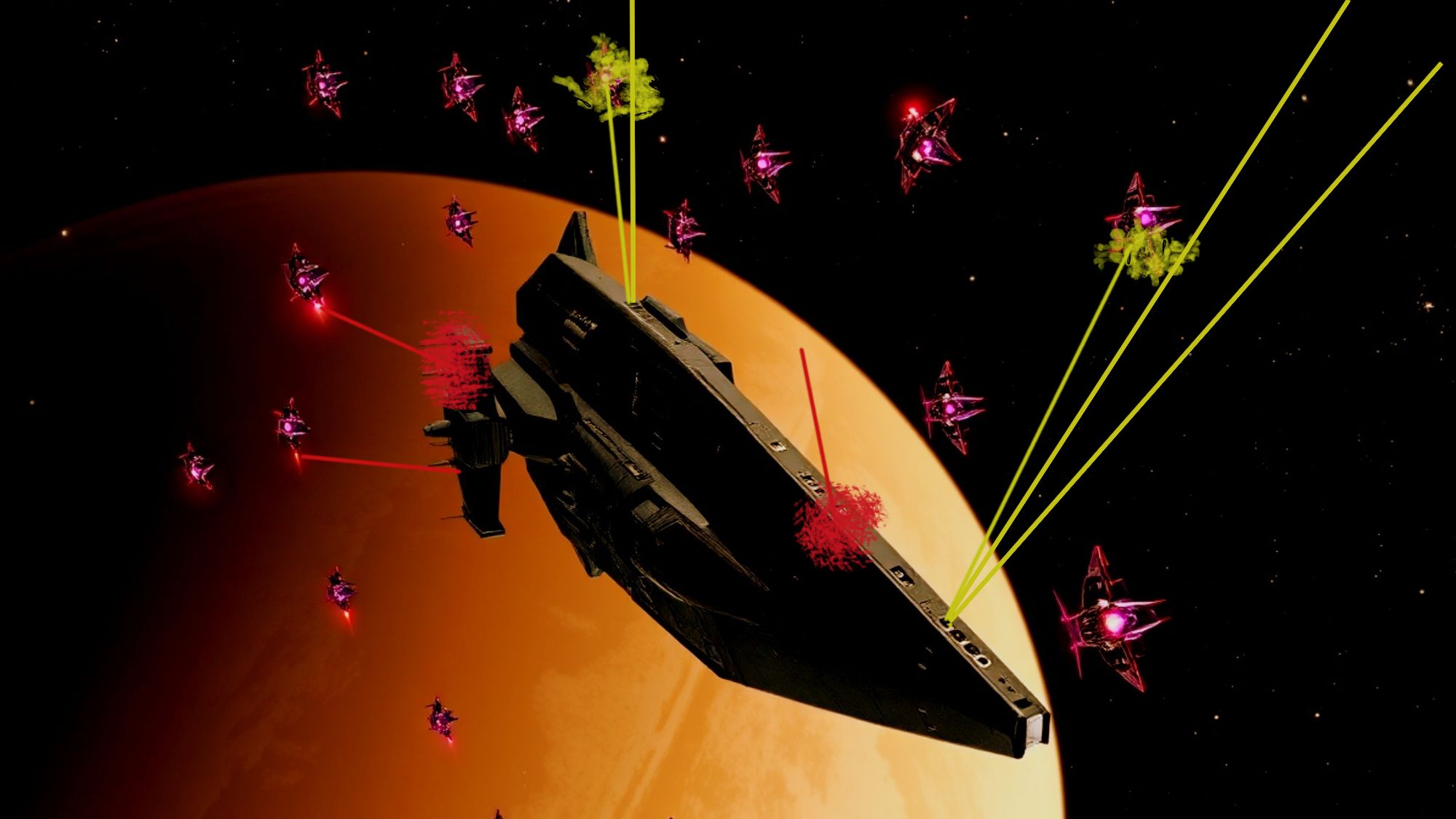
Image: An experiment – AI generated, with some add-ons by hand that did not quite work out as intended. But, well. It serves.

 PAPIER UND SPIELE