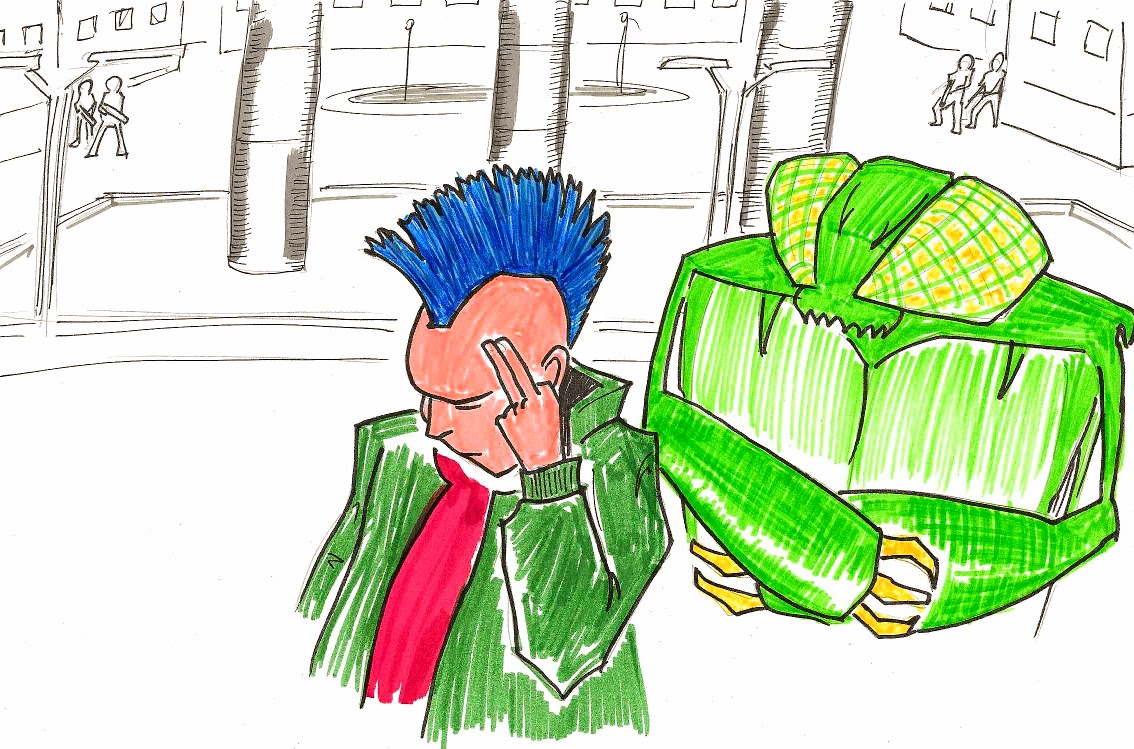
How strong are psionic powers in Stars Without Number? Too strong?
This question was discussed by the players in the beginning of a session that later turned out to provide a good showcase of the issue.
Psionics
Psionics tend to be the go-to when a game wants to put magic and science together. It is the easily acceptable handwavium of explaining the unexplainable with a thin vineer of pseudoscience to marry it with spaceships and computers. Arcane symbols and witchcraft are a better fit with swords and castles than with progressive modernity. Similarly, aliens fit well into Sci-Fi, while monsters fit well into Fantasy. Fundmentally the same, but one feels futuristic and the other medieval. They can be mixed and matched, but that is perceived as subverting rather than following genre-conventions.
Fundamentally, psionic powers in Stars Without Number are extremely strong, including “no wait, actually we didn’t do that at all, let’s turn back the clock”, “these are not the droids you are looking for”, teleporting for 1000 kilometers without breaking a sweat, and even at very low levels they involve shooting imaginary, but very real bullets out of thin air, with the power of a rifle. They bend possibilities to a fantastic degree — with two limitations: for one, they all only work within unaided line of sight of the psychic. For another, they need “Effort”, which is a limited resource, not dissimilar to “Mana”.
The visibility issue is an actual limiter: it explains why Oracles cannot just foresee any and all events, they can only foresee their own experiences of the future. The Effort-mechanic hinders no one because Psychics get their effort back. And often fast! That can be right after the scene, or in some cases even at once. Only for very strong effects is the Effort commited until the next day (which would be standard for vancian magic). But then there are some techniques that say you can do certain things with no effort at all. For example, the aforementioned teleportation-at-will.
Compared to old-school D&D, therefore, Psionics are hyper-magic.
The discussion
Now, one of the players called the powers “game-breaking”, while another said they were “fun” and not at all “breaking” anything. The first one posited that there should probably only be one psychic in a party of PCs, not several, because bending too many plot lines in too many ways was unbalancing the whole galaxy sector. The second one said that it if the players were to go too far and skip every challenge they would just spoil their own enjoyment of the game — he saw it as their own responsibility to meet the challenges they wanted to meet, and accept responsibility for skipping others.
They all agreed though that they were very relieved that the rules repeatedly state that psychics are very rare. So although a whole bunch of psychics are together in the party, that is not normal and they rarely have to square off against more than one or two (weaker) counter-psychics, and they feel it could be quite tough to take on an organised force of psychics. A similar situation to the one posed by snipers. All fun and games as long as the characters snipe unsuspecting NPCs as they sit at their breakfast table. But if the shoe was on the other foot and ruthless NPCs would shoot them through a window, it would be a troubling experience.
Which is one of the reasons why they never stay too long in one place. SWN’s sister game CWN has a mechanic for “Heat” a.k.a. a growing number of powerful enemies with axes to grind. This party does not need the mechanic: As soon as they feel that they are starting to accrue a certain weight of enemy attention, they book it to another planet and start afresh.
The Example
In the session at hand, the party was on a cyberpunk-planet and went to a hidden stash to pick up some valuable thing. They were a bit distracted after a big show fight, and their main “tank” (an alien life form) in need of rest. Their psychic lifted the valuable thing out of some difficult place, using psionic powers so two NPCs could load it up in a van, then went into the van to sit with the “tank”. One guy kept overwatch — and he noticed someone coming over at a leisurly pace, with a combat rifle + grenade launcher dangling in front of his chest.
This someone was the leader of an operator team waiting for someone to lift this valuable item out and had the place staked out. It was designed as medium-to-high challenging combat encounter against a competent, well prepared team. The leader and one of his people were strong fighters, another one was a good drone pilot, then there were six low level goons and one tech-specialist. Not easy to overcome without casualties, even if the “tank” were fit. (It had not been anticipated that they would go get this item right after the big show combat)
The leader was covered by three visible armed drones and played rather nice: He informed the PCs that he was doing a job and had to take that thing back there. But it was nothng personal, so he was willing to let them walk away. Nobody needed to get hurt. They should simply understand that they were outnumbered and outgunned and it would be wise to just accept this situation. No hard feelings.
He was very sure of himself, and with good reason: He could take some beating, he was the undisputed leader of a team that packed a good punch, and his people had good positioning. Any smart person would accept his generous offer and give up the bounty without a fight.
But: This party included a psychic who had just recently levelled up and unlocked a very potent power: He invaded the opponent’s mind, pulled the relevant memories, and replaced the description of the valuable thing with a different description. The target has a mental saving throw to resist such a move, but he botched that.
Now the operative could see that what the PCs were loading into their van wasn’t the item he was sent to capture at all, but something completely different.
In line with his personality and status (undisputed leader, sure of himself, professional, polite and fair) he accepted his “error” and apologized for the intrusion. “Would you be so nice and move along, please?” he asked instead. “We are waiting for someone to come to this very spot soon.”
“No worries,” answered the party. “Five minutes tops!”
“Awesome!”
He gave a hand signal to retreat and his team backed off.
Conclusion
That was a situation that could have been the loss of a valuable item, or a nasty (and potentially costly) combat. Instead, it was a memory edit, and resolved in a moment.
Did this break the game?
Not really. Although they dodged the combat, it was a moment of tension, where the party was aware that they were in an inferior position, and an error would cost them. It came down to the enemy leader’s mental save. Had he succeeded, he would have been immune against psionic intrusions for the rest of the scene, and they’d have played their hand and lost.
So although the situation was resolved fast and seemingly easy, the sense of accomplishment and the rewarding feeling for the player who had put so many skill points into this power, ceding other options, was real.
It “broke”, or skipped the encounter, yes.
After all, there was this whole ambush and team prepared, and now they were bypassed in a moment. But that is a risk every GM takes with every piece of preparation.
Players have a habit of overcoming obstacles in ways that are not always easy to anticipate. They avoid the NPC that the GM wants them to talk to, they kill someone the GM wanted them to befriend, they throw away an item the GM planned to make important.
And that is actually the point of roleplaying games: The freedom to decide and the infinte number of ways to tackle any particular situation. Not two or three pre-determined options to select select from, but imagination. A back and forth of ideas and reactions, and incorporating this flow to create the actual story.
Actions and Consequences
What we would call a “plot” of a roleplaying game is only apparent in hindsight, looking back after an adventure and making sense of how the scattered dots connect and how realities have shifted. If events were predetermined, the players would be a passive audience, not active agents of their own destiny. But they decide. And so psionics are an (immensely potent) tool of their agency.
They don’t break the game — but at the power level the party has reached, they need to encounter more opponent psychics. They need to get their own brains re-adjusted some time.
This shoe we spoke of, the one on the other foot: it needs to kick harder more often.

 PAPIER UND SPIELE