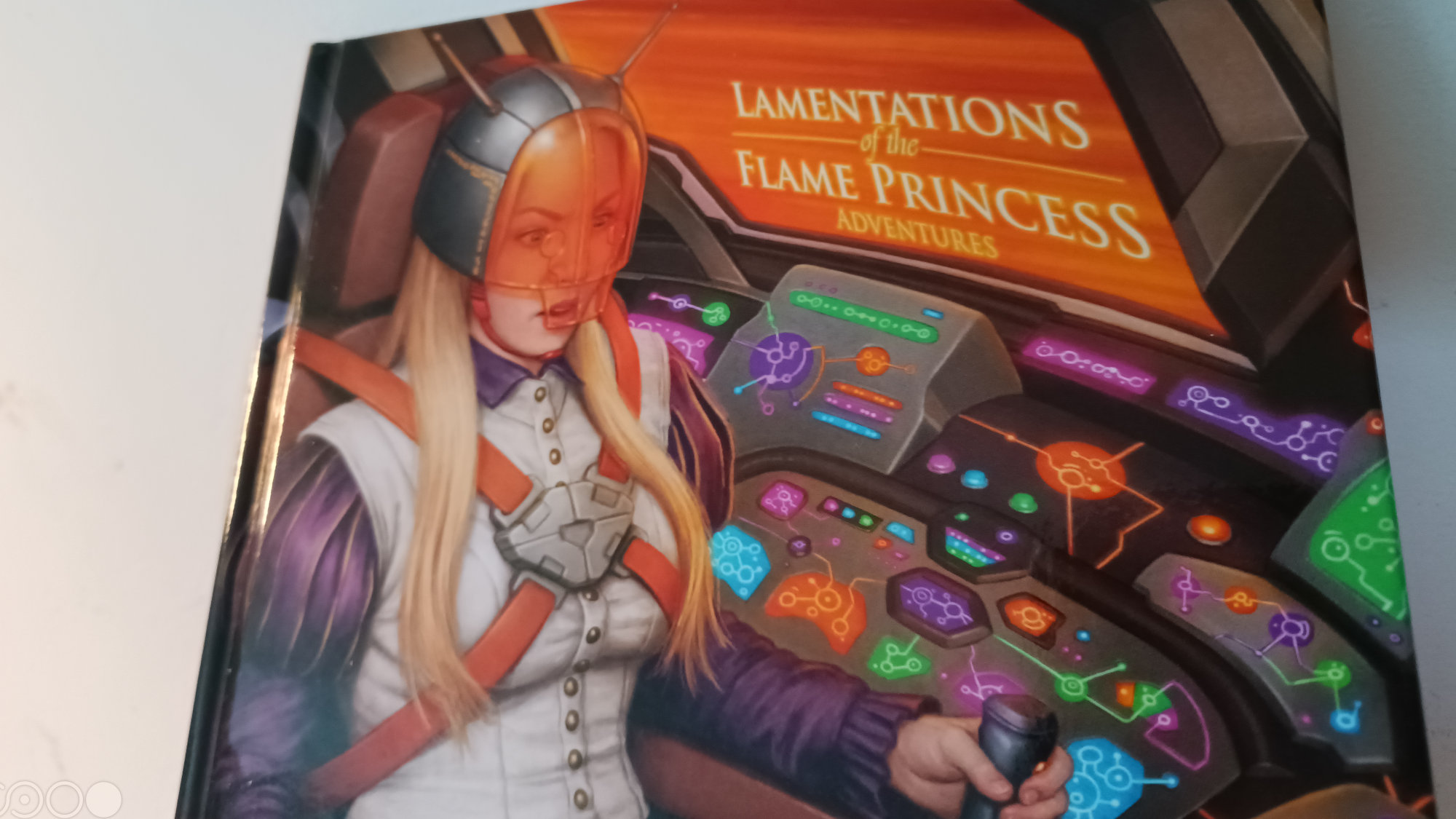
Earth Incubation Crisis, written and drawn by Alex Mayo, is an adventure module for Lamentations of the Flame Princess, a “weird fantasy roleplaying game” I have spoken about in the past. Recently I have received a number of adventure modules for review from LotFP. And I will start here with Earth Incubation Crisis.
Spoiler Alert: I will not spell out the big secrets of the module in detail; still, if you see any realistic chance that you may play in that adventure, you should stop reading here.
Magic & Technology
But if you do read on, it will not destroy the adventure for you. Earth Incubation Crisis invokes memories of the legendary 1980 D&D module S3: “Expedition to the Barrier Peaks”. In this foundational module something happened that was commonplace in the “old” times literature but has since fallen out of fashion when “hard sci-fi” and “epic fantasy” took the reins in the genre(s). Back in the days of Sword & Sorcery there was no solid dividing line between fantasy and science fiction. Modern sci-fi tries to be at least pseudo-scientific, and fantasy tries to pretend at historical pretext, so they don’t go together well. Old-school fantasy had no qualms putting in some aliens or an ufo here and there, or let a spaceman fight of little monsters with a sword. Earth Incubation Crisis runs with that idea and happily mixes and matches technologies, old and new.
All alone in the backwaters
Earth Incubation Crisis starts the PCs up in pretty standard fantasy adventuring situation: We have a remote location, some kids are missing, and people are worried. Where it goes from there depends on the players, but there is the potential for global effects.
The adventure is provided as a hexmap with all sorts of terrain in the general vicinity of our main village:
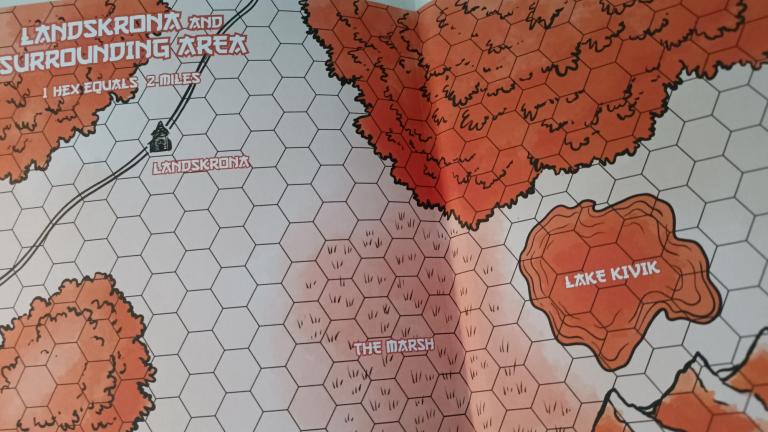
It is set in Skandinavia, but any remote area in the world will do if you change a few names.
There is a main village where nothing interesting happens, and the module even spells that out: the village is boring, players who stay there to talk to every countryboy and -girl will not learn anything beyond the rumors. The characters will have to go out into the wilderness to find adventure.
Lady Luck
That wilderness is randomized: There are a handful of encounters prepared for the grassland, a different set for the march, a different set for the forest… and here there is an interesting twist.
a) these encounters are unique, so once one has been rolled, it is off the menu, and
b) the order in which you roll the encounters will nudge the adventure into a slightly different direction than it would have gone otherwise. That means there is no set order in which the party will learn details about the land and its denizens, with potentially very different results. That will keep the Referee on his toes just like the players, because nobody knows what the immediate future may bring.
Layers
Classic Lamentations-adventures have layers:
You get to a place,
it has a certain appearance,
but then when you look closer you discover a different situation ….
and then, if you look even closer, or if you touch the wrong things, it spins out of control.
Example, you get to a house, it looks cozy, then you find out that it is actually the scene of a horrible crime, but then you discover that crime is not the half of it and you are in real trouble and in the presence of a nightmare-creature.
It is all about the twist that changes the whole situation. And the second twist that changes it again.
In that sense, Earth Incubation Crisis is such a classic adventure.
You get to the remote village of Landskrona,
you hear rumors or get hired,
you go out into the wilderness
and you meet a host of different threats, mundane and magical, and getting ever tougher to handle.
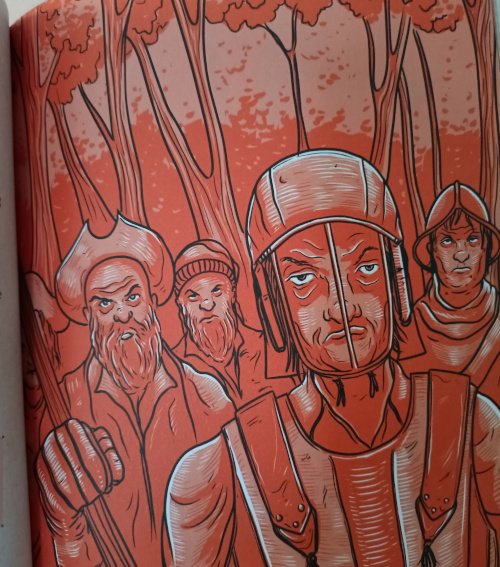
The order in which you meet the threats will inform how you interact with those who come next, as they are all part of a multi-faceted web of relations with each other. In essence, this is not an adventure, it is an adventure locale. The players will be very free in how fast or slow they go, and if they continue or pull back … only each of these decisions has certain consequences down the road.
And the threats come in different threat levels. Bandits and a posse of mercenaries, wild animals, wilder creatures, mutants, misguided environmentalists, magic most foul, and technology most weird.
Can this little town even still count as a rural backwater with so many subplots and crises going on all at the same time?
What’s doubtful?
Only three small details.
There is some mild teenager-humor (“haha, he said Penis!!”) that feels a bit contrived. Or is that connected with the fact that half of Norway’s population runs around naked in this module? Make sure to state that it all happens in summer.
The hexmap suggests a lot of player agency … and in a way that freedom to decide the characters’ next move is fully there. And yet, the randomization of encounters kind of opposes that.
After all, if the dice decide whom I meet and where, then what does it matter which way I go? And the distances … do they matter? I am unsure about that one.
Although to be fair it puts the agency into the proverbial hands of the ultimate unbiased arbiter: the roll of dice. And it keeps the ball rolling: if any direction can lead to any encounter, there is no wrong direction.
The book is not fast to navigate to find something during play. The diligent Referee will need to re-organise the basic tenets of everything in his or her own scribbled notes. And/or stick multiple colourful post-it notes between the pages as bookmarks.
This issue is partially tamed by the nice key-ing of the map with book pages for relatively quick reference.
What’s wonderful?
Moral conundrums (there are some not-so-easy choices hidden in this) and out-of-the-box thinking. Decisions have consequences. And despite the quickly rising threat level the adventure is well-suited for characters of lower levels; high-level ones may find everything except the very end of it too easy. (Conversely, the end might rise a tad steep in difficulty if the party is Level 1-3)
Well — that’s the spirit of the OSR, right? The world is what the world is, and the characters will have to deal with it.
Multiple mysteries to keep players occupied.
Talk of town is that children have disappeard. In addition, teenage girls have disappeared. Some criminals are being hunted, and the whole area harbors a secret that will set all other challenges into their proper perspective.
You may remember that the main rulebook has useful quick-reference tables in the front and back. Well, Earth Incubation Crisis has two maps there: a GM-facing map at the start and a player-map (the one pictured up at the start) in the back. That’s better than an index.
The carefree tone of voice in the text is not classically a good fit for a story of fear. But it works, because this is not a story of fear. It is a story of surprise. And it makes the final twist that much more surreal. Cheeky talk as a foil to the potential mega-catastrophe that is brewing in the background.
And, as it is so often the case in LotFP-adventures, there are imaginative new spell ideas.
But most of all there is the relaxed ease with which Earth Incubation Crisis crosses the threshold between fantasy and into sci-fi. This nonchalance about genre conventions is a quality that may teach us, the readers, something about genre-conventions.

Conclusion
A flexible adventure that can be placed anywhere, at any time – although putting it into your gameworld in full is a bold move, because once this is played through the world will likely be quite different than it was.
More Lamentations of the Flame Princess on this blog.

 PAPIER UND SPIELE