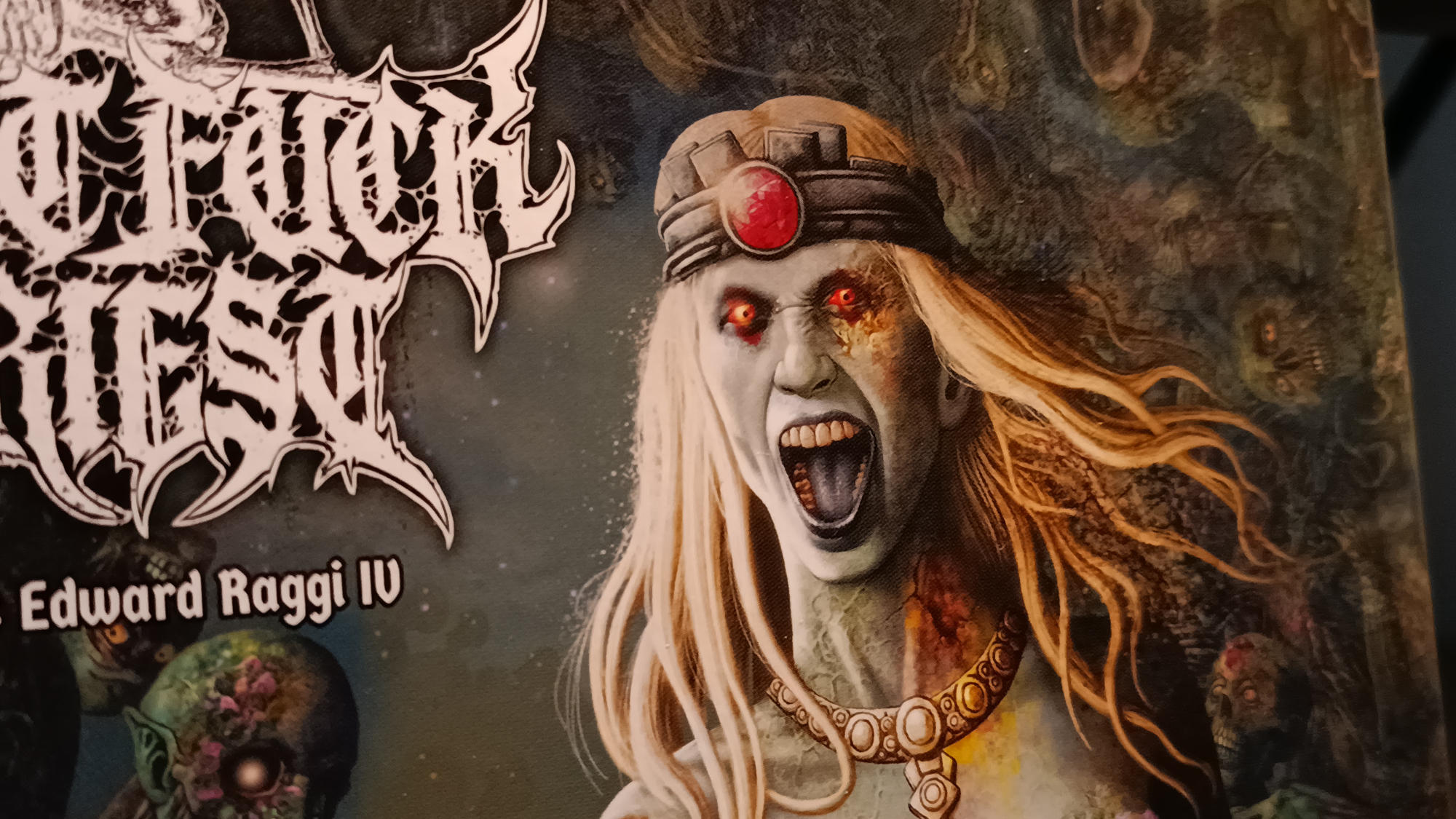
Really…. don’t fuck the priest.
Disclaimer: I have recently received a number of modules from Lamentations of the Flame Princess for review purposes. This is one of them.
“Don’t Fuck the Priest” is an adventure module written for LotFP, and by LotFP-creator James Raggi himself. And it is not just any module. This one puts out all the stops and reminds us of the subtle (or not so subtle) difference between happy little Elfgames … and Lamentations, the “dark underbelly” of Fantasy.
For experienced players
“Don’t Fuck the Priest” is definitely not the right material for any random table, especially not for a bunch of newbies interested in checking out the OSR for the first time. They would stumble away scarred. You will need a table of seasoned players you can trust and who trust you. Tough hombres and hombrines who can take a hit and don’t throw a fit.
This adventure will leave a mark. No way around that. And that is intentional. “Don’t Fuck the Priest” is meant to play hardball.

The atmosphere
James Raggi writes that this book is a return to daring the ugly.
Be uncomfortable! Filthy, gruesome death and bodily fluids. Character death. Weird character death. A wild stint that does not beg forgiveness.
This module does not hold back. More so, it literally forbids the Referee to dare and hold back.
Twisted reality without compromise. So if you dare to run this, follow these directions: Do not hold back. Go all in. Accept every dice roll as it falls. And if that is how it goes, let the world rot and die.
Any adventure that does not have far-reaching effects on a campaign is meaningless filler.
We have elsewhere talked about the special qualities of Lamentations as opposed to other OSR lines: It embraces, nay, celebrates exploration of the dark and the weird. It claims (rightly) that the more distance you have between player and character, the lesser the experience. It disregards balance and fairness — which are antithetical to horror — and accepts that really bad shit can happen. It invites the struggle against baser instincts of humans, who can often be more monstrous than monsters.

(quote from AD&D 1e)
In the main Lamentations rules, elements of horror like dangerous illusions, sickness, insanity and disgusting body horror are only tacitly suggested and atmospherically supported, but not enforced. Because mechanics cannot enforce horror. Horror is emotion, it is atmosphere, and they are explored in detail through many of the adventure modules.
Lamentations of the Flame Princess lets you ask the hard questions. And this particular module does so with a vengeance.
The Art
For something that comes with such a massive box with such a kick-ass cover, there is surprisingly little Art in Don’t Fuck the Priest. The whole book has fewer Art-pieces than the average woodworker has fingers.
But: the few pieces of Art there are carry a lot of weight. These are not some random scribblings, these pictures drive the setting home and nail it down. They are presented in ways that have texture.
And the Artist — his sketches versus the finished piece…. I will stop here and just let you look at his portfolio.
The premise
I don’t want to spoil much, so I must keep this brief and focus on what is encountered at the entrance to this structure.
In essence, there is a deadly dungeon. The module is highly flexible about location so it can be added at will, even as an extra layer in any other dungeon, or somewhere in the landscape, as long as it is not at a well-trafficked road or very near a population center.
The players are free to enter (an “evil” GM may force them into it, but given the mess the players are going to get themselves in it is far better if they go voluntarily, as agents of their own free will. Then it is their own fault, because) — should they? It does not look like a wholesome place at all. The walls and floor of the dungeon entrance are visibly and obviously disgusting. It is made of corpses! Hundreds and hundreds of moldering corpses packed together to form a tunnel of sorts. It stinks. It moans. It whispers. Going in means walking over a floor of rotting half-undead bodies.
This marks the first and most important decisions the players can make: Do we actually want to go into something like that?
Obviously, there are arguments in favour: Great riches to win, even a fleeting glance at some shiny gems? Disappeared people to rescue? The order of a lord? Maybe they need a place to lay low because they are hunted by superior numbers? Giving them a reason is your job, and you know your players best.
And yet: Actions have consequences. Going in, or staying outside, both lead to outcomes. Such is the law of the freedom to choose. (And so it behoofs the wise Referee to have an alternative adventure to offer for that evening. This dungeon won’t run away, and sooner or later curiosity may yet win out over common sense. After all … how dangerous can it really be?)
Magic Items
Usually, Lamentations of the Flame Princess keeps magic items rare. For good reason: Horror and Weirdness work best in well-measured doses. That’s why LotFP adventures are preferably grounded in our own, known world, not in a glitter fantasy phantasmagoria. The odd feels more personal set in a familiar, grounded context.
In Don’t Fuck the Priest we now have many magical items, and some may even show up multiple times, triggering unfortunate results.
A box, not a book
“Don’t Fuck the Priest” is unusual in many ways.
Let us consider the material. It is not simply a book, it is a box set for a single adventure. In that box there are some extras. First there is the actual book — in classic LotFP fashion it comes as a solid hardcover in durable quality, better than 96% of whatever else I have in my bookshelves. (And a chunk of those 4% are other LotFP-products).
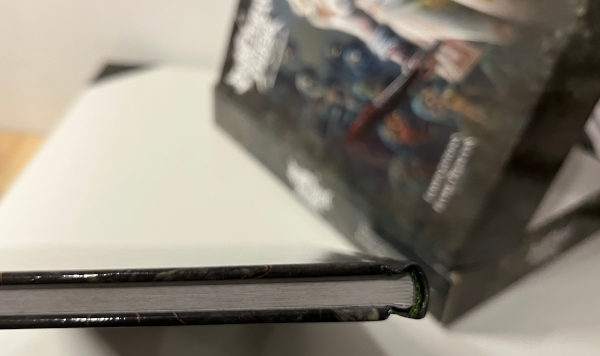
Advantage: It won’t fall apart and you can realistically expect to leave it to your grandkids.
Drawback: It won’t lie flat on a table like a ring binder. Stiff hardcovers put up a fight.
Second, there is a deck of 55 cards with dungeon elements, creating a . We will get to that in the next sub-headline.
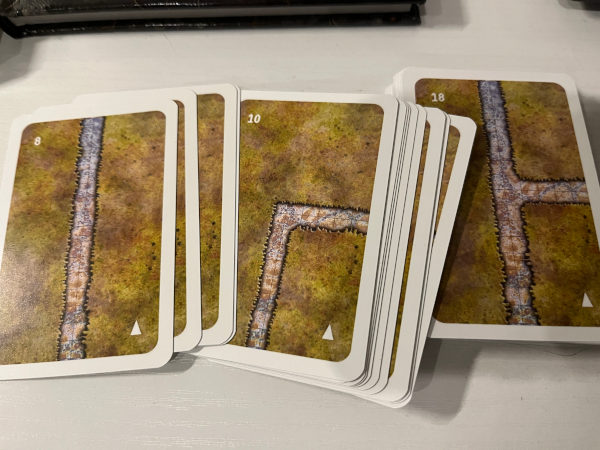
Third, there are two custom-made four-sided dice that do NOT work as caltrops.
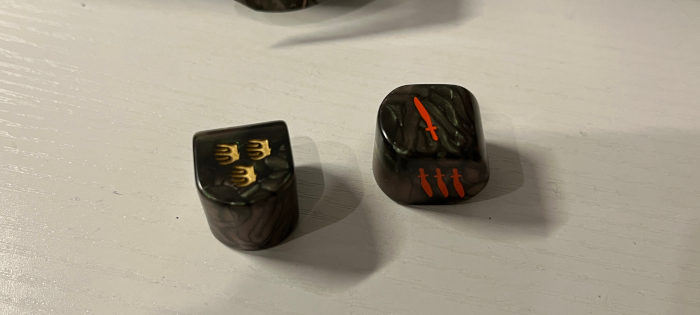
Cards? Dice? Why?
In a word:
Randomization
Strict abdiction of GM power is mandated for this adventure, and actually for all adventures of the Lamentations of the Flame Princess.
There is a tendency in some modules from other publishers to string up encounters and situations like the pearls on a rosary. One depends upon the other. First the PCs come to town X, there they speak with Y, then they go to Z, etc. Every experienced GM knows that this is not realistic. Suddenly the players don’t want to go to X, or they hate Y, and so they don’t get to Z.
And then the GM feels he must “force” them to Z in order for the plot to happen. Or to move the plot somewhere else, and wherever the party turns, the same adventure awaits.
That is not true player agency.

or as it was put ages ago in the old Referee book:
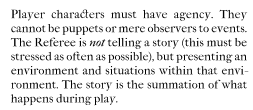
Players (should/must) have agency, and so they have their own minds and do things according to their own ideas. If you make the mistake to write out a scene in excessive detail, know that the players are not your creatures. They will not follow that script the way you would need them to. They will circumvent your challenges, or diffuse them, or one-shot your Big Bad.
And that is fine.
Don’t Fuck the Priest topples that modern apple-cart and embraces, even commands! Randomization.
Here comes the gaming philosophy:
This randomization is no accident, and no copout, no avoiding prep-work. It is very deliberate. “Crucial to the form”, says James Raggi, and who would honestly challenge that? Diceless games exist, but they tend to be pretty dry.

A Referee should be free from a desire to enforce particular outcomes.
Nay, he MUST be free of it.

UNFIT!
There is no doubt in any way, shape or form where James Raggi stands in the age-old “fudging for a better story”-debate.
No fudging in any way, shape or form, that means in this particular module, with its wild and destructive potential outcomes, that some very, very, really bad things can happen.
It can get ugly. Worse than death. Worse than a TPK! It can make a nice GM feel the resistance: Can I really do that to good old Jimmy? These are my friends!!
But:
It is not the GM who does it.
They chose their path. They weighed their options. They rolled their dice.

A bit stronger in phrasing, but again in sync with what was said in the old Referee’s book:
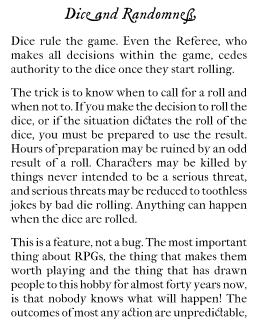
When the dice roll, you must abide by their result.
That special spark
This is more than a game you can wring your friends through. Even if they apply their autonomous agency and avoid the adventure, if nobody ever plays this with you, you profit just from preparing this module. There is a spark in there that reminds you of that spark of life that makes tabletop roleplaying games special. A spark that can stir you up and make every future game of yours sharper.
And that special spark makes this module more than just a dastardly, dangerous, deadly dungeon and a catastrophic campaign-ender: It is a reminder of the rules for referees; a philosophical proposition: a (playable) manifesto.
Excellent inspiration, and terrible woe even for a high-level party of PCs.
Once again: Not for the soft and tender-hearted.
.

 PAPIER UND SPIELE