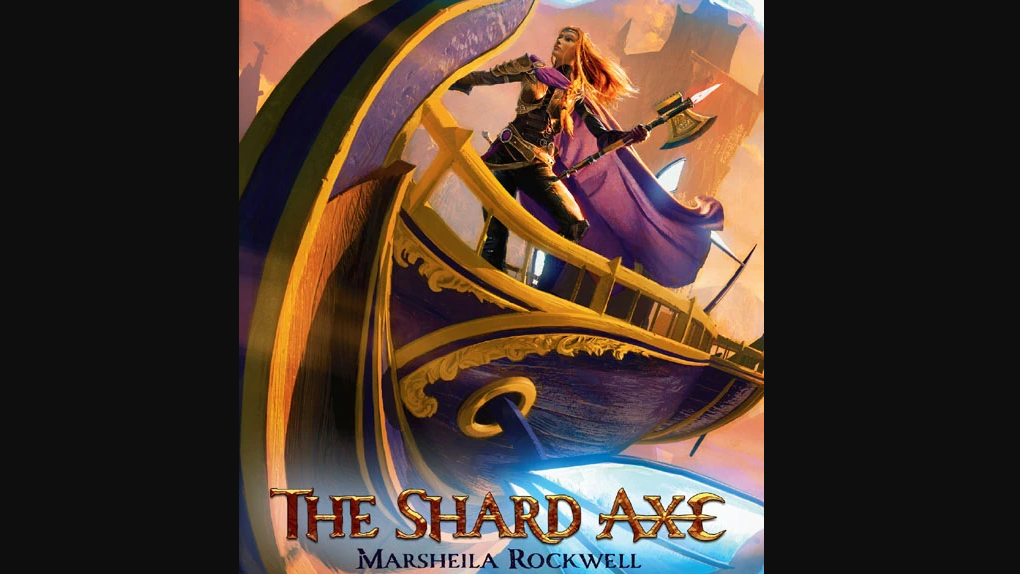
Recently in some online discourse I picked up a name that sounded familiar: Marsheila Rockwell, an author. In that online discourse she was painted in a less than favourable light, which surprised me, as she was the author of a book I read several years ago and kept in warm memory ever since: The Shard Axe.
Marsheila Rockwell is now, as far as I can tell, on Disney’s/Marvel’s payroll, so given the trajectory the Marvel franchise took after the conclusion of the Infinity War I suspect that will be where the negative online opinion comes from.
I can’t say anything about that, because I haven’t (and don’t plan to) read any Marvel novels. But I can say something about The Shard Axe, as, prompted by that online discourse, I have just re-read it.
Eberron
The Shard Axe is a “light novel” set in the WotC-D&D-Setting “Eberron” a post-war world full of all kinds of typical modern D&D-creatures and so-called “War-Forged”, basically sentient robots that were built for the war. There are skyships powered by elementals and cities full of typical D&D-populations, but the general tone is not the cookie-cutter light-hearted 5e cheerio, but rather a bit darker. There has been that war, “The Last War”, and it was not that long ago, so there are still grudges and open wounds. The fantasy races live next door to each other but there is emotional distance between them. Hierarchies in Eberron tend to have a corruption-tainted, maybe even noir-esque undertone, with strong class-divides between the haves and the have-nots.
The Eberron setting has a vocal and dedicated fandom and is also the backdrop of an online game — and to advertise said online game Marsheila Rockwell was hired by WotC to write The Shard Axe and other books.
A bit like she seems to be hired now to write Marvel-stuff. And in both cases she struggles with the same issues. We will get to those.
The plot
The novel follows a Sentinel Marshal (basically an FBI agent) called Sabira Lyet d’Deneith, who is excellent at her job but haunted by two problems: by a self-destructive streak that makes her drink and gamble way too much, and by a catastrophic failure in the line of duty several years in the past. Back then she managed to save a dwarf VIP from a serial killer, but her partner, who was very near and dear to her in private too, lost his life in the process. Stopping that serial killer earned her the status of a hero among the dwarves, who bestowed her with the eponymous “Shard Axe”, a magical weapon that lends her unnatural strength and stability. But everything that went wrong back then left her crushed with guilt and made her avoid those very dwarves and everyone else she knew back in her heyday, pursue her job (hunting down fugitives) with reckless abandon, and sink deeper into her gambling.
Well, then, while she is busy courting a premature death between violent criminals and angry creditors, suddenly her past catches up with her and she is requested to come back to the Dwarfhold. Why? Because the VIP she saved all those years ago, now HE is charged as a serial killer, and his friends want her to bail him out and do some detective work to find the real culprit. That’s also on a clock, as the VIP is about to be executed for “his” crimes.
Now, in theory it could be him. He wouldn’t be the first survivor of a serial killer case who came away twisted. And also, going back there would force her to confront the past and think a lot about that fateful day. But several people conspire to push and drag her into that because they think she’s the best person for the job. Which she clearly is, as she throws herself into the case with her usual verve and discovers glaring gaps in the previous intra-Dwarvish investigation that point to different suspects – and very different and relevant motives! – in no time at all.
What’s good
Sabira is a wonderful lead character, as she comes across as a very real, three-dimensional person despite her mythical hero-status. She has pretty crippling flaws, which really hold her back, and that boost sympathy for her. She is a very welcome contrast to your typical arrogant “Strong Female Lead” that can do no wrong and knows it all. And when she is separated from her Shard Axe she’s clearly hampered in her efforts. At the same time she is smart and dedicated, as well as honest and honorable, and grounded through endearing self-doubt.
Marsheila Rockwell has a good hand for portraying characters in general. All sorts of NPCs come to life in a few sentences, and they populate the world as a very believable and tangible cast where each person is clearly different from the next, and everyone who has the time “on stage” displays likeable as well as unlikeable traits, just like they do in life.
Fine character development is one of the greatest strengths of this author’s.
For a gamer, much of what’s going in has obvious roots in Dungeons & Dragons: there are spells that we recognize, there are scenes and architecture and set pieces that clearly fit into a gaming session, which warms a gamer’s heart, but is still worded so that a non-gamer can follow without issue.
Action scenes are well-paced and gripping, and while descriptions of the surroundings are not always perfect in a spatial sense, they are always clear and colourful, and most importantly: relevant. What happens in a fight in a tavern can only happen in the tavern, not anywhere else. What tactics are used in a narrow street fit that narrow street. Many authors do not make the best use of locations and their features, but Rockwell has the right understanding that location is not just a background colour to an empty stage, it gives a place texture and character. Another great strength here.
What’s not so good
Outside of action scenes: The pacing.
This book is pretty off balance when it comes to structure.
I strongly suspect that this is not Marsheila Rockwell’s fault. We should remember that The Shard Axe is a paid advertising stint from a faceless company, with a goal: sell the game. That leads to an unbalanced book: The first two, three chapters are weighed down by way too much exposition, as the author is, I assume, contractually obliged to explain that whole Eberron thing. (And the same thing happens in the follow-up book “Skein of Shadows”, with even less elegantly served exposition in inner monologue.)
80% of this information is unnecessary for the story at hand, and readers feel that. As a standalone fantasy book, much of this background info about House X and city Y could have, and should have, been cut out, and the book would stand much more solidly, like a warrior handed a Shard Axe.
After that introduction, once the corporation is out of the author’s hair, the story can really come into its own, and suddenly it flows much more natural, and much more engaging as a result. So as a reader you have to weather the beginning to get to the sweet stuff.
Although she makes that easier by sprinkling in a number of gripping action right from the start.
Then we have the opposite situation at the end of the book, when it suddenly rushes to a conclusion that works well for a D&D game concluding a campaign arc (those can get pretty rough as soon as the concluding “coda” narration replaces actual playing) as the situation is out of the player’s hands and that means it should be wrapped up fast: players are not there to listen in rapt attention as the GM explains some shit. They are there to play! But a book is different. Readers are there to read in rapt attention. So for a book it feels rushed. Uncharacteristic in comparison with the nice rhythm of the middle part, which is why I suspect the hand of the company again, asking her to wrap up fast with some loose ends to keep it “mysterious” and draw people into the game and book 2.
Conclusio
Why have I remembered this book so fondly?
Because after reading, the mind glosses over the unimportant and focuses on the core.
The unimportant is this heavy exposition and rushed end, issues that I had completely forgotten, and honestly, they don’t matter. The only real damage they can do is that readers can be put off by them and miss out on what comes later: the core.
The core is an engaging story following an imperfect, sympathetic character, whom we, the reader, really grow to like and want to succeed. We want to see Sabira grasp that she really isn’t to blame for that botched operation with the serial killer. We want her to close that chapter of her life and go on to be happy and well.
Strong recommendation despite the pacing flaw — I invite you to graciously overlook that.

 PAPIER UND SPIELE