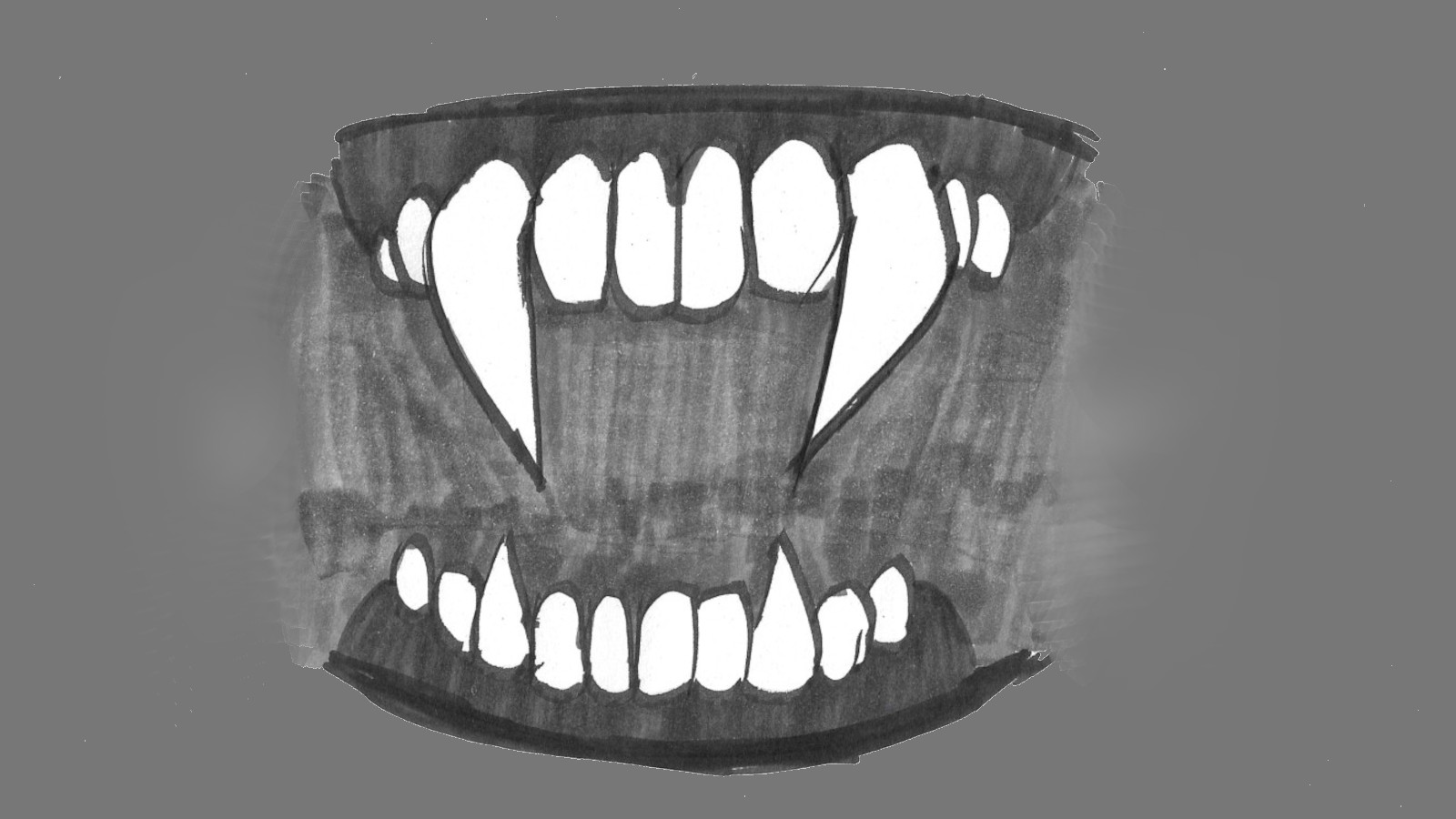
“Dracula” by Bram Stoker is a classic from 1897, and the main source material for basically every vampire tale popularly known today, from Nosferatu and the Hammer films to The Fearless Vampire Killers, Buffy the Vampire Slayer, Blade, or Underworld – if you can name it and it has Vampires, it is in some way inspired by Dracula.
Conversely, that means what we read about Vampires in this novel represents well-trodden ground and feels like we know it all, but we must not forget that this is the original(ish) thing. No – not the very first Vampire story, ever. Vampire lore existed in many, if not all cultures, an ur-horror of humankind for aeons, and even Gothic Vampire stories have been written before Bram Stoker, by authors like Polidori and Le Fanu.
But Bram Stoker’s Dracula was the most successful one. It is the book that triggered the classic Vampire, the film-version, and Vampire-lore that would become, over time, tropes – and he added some elements that have become staples, like the mirror-trick or the need for invitation.
That leads us to believe that we know Dracula as a matter of cultural course… but in error. This “old book” comes armed with some aces that the modern reader would not suspect. While some of its content has become popular base knowledge, other parts have more or less slipped the shared memory. Chief among those the “secret” heroine: Mina.
Letters and Diaries
The story is told as an Epistolary Novel, a collection of seeming letters, diary-entries and newspaper articles that approaches the whole tale from a variety of viewpoints, namely through the eyes and ears of all the (fictional) authors of these letters.
The form of the Epistolary Novel has long, long fallen out of fashion in western literature, but Dracula teaches us its merits. The Epistolary Novel has its strengths, and Bram Stoker uses these strengths with a master’s hand.
- The main strength being that every author has only the information he can know at the time of writing, so the chapters are all subjective and incomplete, which allows for a natural buildup of great tension when the reader, privy to the experiences of other in-the-narrative-writers, sees what errors the Vampire hunters make due to their gaps in knowledge.
- Another strength is that we are privy to thoughts that are not necessarily meant for publication (like in diaries), which lends us deeper insight in the individual’s personality. A look behind the facade.
- A letter in the novel can directly drive the plot forward, for example: a written order or an invoice that makes some development known to the reader without actually spelling it out.
- A weakness of the form is that a perfect author would write in entirely different styles to plausibly make it a collection of independent voices and letters. That is very hard to do, and even Stoker does not pull it through completely; his own Tom-Wolfe-like fascination with dialects shines through and that would be a fantastic quirk if only one character picked them up, but it is a mistake to show it in the notes of several of the crew.
Spoilers Ahead!
“Dracula” is an excellent read even knowing the whole plot, so spoilers are relatively tame by nature. Therefore I will leave it to you, dear reader, if you wish to go on or postpone and return until you have read the book.
Export of Evil
“Dracula”’s plot describes the experiences of a handful of westerners as they cross paths with the horrid and cunning Count Dracula. Dracula is the Vampire template, the quasi-original thing: a Romanian noble living for centuries far out in a remote castle in the forbidding transylvanian wilderness. Here he is the crime and the law, here he is Lord.
But Dracula is not content with sucking the blood from local yokels: He has read much about England, learned the English language very well, admires it, and now he wants to go to London to drink it and find more food than he could ever need, spawn himself some beautiful vampiresses and get access to the whole wide world.
To get a strong foot into the English door, he hires a fresh-faced, poetry-loving English lawyer, Jonathan Harker, to help him acquire some solid property in England. The nice and friendly Mr. Harker is in for a nasty surprise: At first the noble Count seems a wonderful conversationalist, and he has a well-stocked library and serves fine food. But over time Harker finds himself a prisoner here. He is surrounded by miles and miles of forest full of wolves and hostile people, the Count becomes ever weirder, and he is asked to pre-write and future-date a couple of letters that tell the world how happy he is, how everything is fine, and how he reaches certain places on the way back home.
Big red flag.
“We are in Transylvania; and Transylvania is not England. Our ways are not your ways, and there shall be to you many strange things.”
Indeed, the Count intends to feed the lawyer to a trio of highly attractive women while he goes on his big journey. But Harker surprises everyone, including himself, by daring a breakneck climb and running away into the cold, trackless, wolf-infested wild.
“The old centuries had, and have, powers of their own which mere ‘modernity’ cannot kill.”
Fear the Monster
Dracula owns great amounts of gold that he has amassed over centuries, he is master of beasts and the elements, can hypnotize, can turn into mist and change his physical form,… but he also has some limitations. He cannot enter an abode without the assent of someone who lives or works there, he is weak and sleepy by day, and can only change his form at sunup or sundown, and he is pained and repelled by the blessed host and the crucifix (although he can overcome crucifix-wielders by directing a pack of wolves to attack them or by paying mercenaries to take them out).
And he must rest in his home soil. That’s a problem if you want to travel. But there is always commerce! Now that he has estates in England, he simply packs up home soil in 50 boxes and ships them to his new home addresses. He himself rests in one of the boxes and (ab)uses the ship’s crew as his food source on the long boring journey.
He reaches England, prowls the countryside as a huge, deadly wild dog, makes a mental patient called Renfield go ballistic, preys on some easily overlooked people – and also commences to slowly savour the blood of the local beauty queen, one Lucy Westenra, savoring the helpless horror of her friends.
And so he meets the most dangerous foe he would ever encounter. Mina Murray.
Mina Murray
Remember Jonathan Harker?
He is fiancé to a woman called Mina, a very smart and capable lass of a lower middle class standing who loves her young lawyer very much.
Jonathan wrote, when he met the three brides of Dracula: “I felt in my heart a wicked, burning desire that they would kiss me with those red lips. It is not good to note this down, lest some day it should meet Mina’s eyes and cause her pain; but it is the truth.”
Until her Jonathan may return from his long business trip to faraway Romania, she visits her best friend Lucy, who has just agreed to marry one of her many suitors, and so the girls think how nice it may be if they marry at roughly the same time and have kids at roughly the same time and remain fast friends for their whole lives. They have a lot of fun, roam the countryside and enjoy life.
Mina is not your average girl. She is an avid writer with a knack for interviewing and journalism. She loves to get the facts right, she knows foreign languages, and is ever interested in learning new things. She knows how to write shorthand and she loves trains and learns their schedules by heart as a pastime.
And we soon find out that she is brave as all hell, even though in her own modest words it does not quite sell all the way. One night as her friend has sleepwalked out and away, she dashes through the town to seek her in the night, alone and without hesitation. Then she sees her, and sees with her a spooky figure with glowing red eyes. And what does little Miss Mina in her nightgown and with no weapon in hand do? She worries for her friend, doubles down to race toward the danger, and yells out, driving him away for the moment.
Mina proceeds to share a room with Lucy, lock it and keep the key tied to her wrist. Simple and effective: as long as that goes on, the Vampire is frustrated.
Alas, it is at this point that Mina gets news that her fiancé is treated in a hospital in Budapest, sick and half-mad, so she leaves Lucy in the “capable” hands of her mother and fiancé and journeys to the Austrian-Hungarian Empire to find out what on all earth made her Jonathan disappear from the face of the world for weeks on end.
She finds him traumatized and learns that he has spent his first weeks in hospital mumbling of regrets and wrongs. But, in Mina’s words: “[The nurse] is a sweet, good soul. […] ‘You as his wife to be, have no cause to be concerned. He has not forgotten you or what he owes to you. His fear was of great and terrible things, which no mortal can treat of.’ I do believe the dear soul thought I might be jealous lest my poor dear should have fallen in love with any other girl. The idea of my being jealous about Jonathan! And yet, my dear, let me whisper, I felt a thrill of joy through me when I knew that no other woman was a cause of trouble.”
And this, the hospital in Budapest, is where she marries her love and is henceforth Mina Harker.
The men
With Mina gone, nobody locks Lucy in at night, and soon she is being sucked dry again. Now we meet the famous scientist and philosopher Dr. Abraham Van Helsing, template for the classic Vampire Hunter that we all know. Van Helsing, Lucy’s fiancé Arthur Holmwood (who is away a lot because around this time his old father dies), and her rejected suitors Dr. Seward the psychiatrist and Quincey Morris, the brave Texan from America, attempt to save Lucy. They give her experimental blood transfusions and attempt to protect good Lucy.
These men, to put it as clear as day, mess up.
They mean well and struggle valiantly. But tied down by societal norms (no man can stay in the same bedroom with a lady he’s not married to) and recklessly underestimating their foe (He’ll never get to her up here on the top floor), they repeatedly leave gaps in Lucy’s defense.
Most importantly they fail to communicate the danger. Van Helsing because he wants to test his wild theories first, rather than spreading unfounded rumors, and the others because they don’t want to burden the poor mother or the poor house maids with stressful ideas about any sort of threat.
And lo! Soon enough her mother is dead, she is dead, and she is also turned un-dead, and as she begins to hunt little children, all they can do now is cut off her head and stuff it with garlic.
Quincey
Honorary mention of Quincey Morris: he at least went around the house at night to guard the perimeter against wolves and whatnot. In that way, the American proved the most capable guard. Successful Vampire attacks happened only when Quincey was detained by other duties. He is a cool, laconic guy who easily grows on a reader, and the quickest to act when the others are still deliberating.
Quincey: “I have a kind of belief in a Winchester when there is any trouble of that sort around. Do you remember, Art, when we had the pack after us at Tobolsk? What wouldn’t we have given then for a repeater apiece!”
Weapon: Information
When Mina Harker returns to England, hoping to help dear Lucy with the wedding preparations, she is too late: she can only mourn her good friend’s passing — and is not given the full information. Particulars of Lucy’s death are kept hush hush to avoid scandal. Jonathan Harker has likewise bundled away all his notes and his wife has promised not to pry without need.
Yet soon Harker’s mentor dies and he must take over the practice. Then, already stressed, he happens to see the Count Dracula prowling London’s streets and ogling potential victims.
Jonathan has a slight breakdown, and Mina decides that this is need. She reads his journals and types them out for easier reading. At around this time Van Helsing reaches out to Mina Harker because of the letters she wrote to Lucy.
They meet and he finds not a fainting damsel but a lady who knows things.
“You have good memory for facts, for details? It is not always so with young ladies.”
“No, doctor, but I wrote it all down at the time.”
(hands him notes in shorthand. He looks disappointed, as he can’t read it. She smiles and hands him the same info typed out.)
She collects all the scattered notes of all the individual people and types them out and orders them chronologically (which makes her the in-fiction editor/co-author of the novel itself), and suddenly a clear picture emerges. The puzzle reveals Dracula’s plot.
So informed, the five men gather and decide to hunt down the evil Count and make an end of him, so a tragedy like Lucy’s demise cannot repeat itself.
Failure without her
“Naturally”, the men want to protect to poor, frail woman from any undue stress, so they decide to cut her out and do the Vampire hunting without her, so she can stay at home and do womanly things like knitting and stitching.
First they say: “Ah, that wonderful Madam Mina! She has a man’s brain – a brain that a man should have, were he much gifted!”
And yet, then they say: “After to-night she must not have to do with this so terrible affair. It is not good that she run a risk so great. We men are determined – nay, are we not pledged? – to destroy this monster. Even if she be not harmed, her heart may fail her in so much and so many horrors; and hereafter she may suffer.”
Even her husband says bravely/stupidly: “When we part to-night, you no more must question. We shall tell you all in good time. We are men and are able to bear.”
“I am truly thankful that she is to be left out of our future work, and even of our deliberations. It is too great a strain for a woman to bear.”
Dark humor
It is almost impossible (although a few people manage it) to read this and take it as the author’s straight-faced opinion. But every time the characters in the book do that, bad things happen. So I posit that Bram Stoker used his novel to stab very wickedly against what is nowadays known as “the patriarchy”.
Mina: “All the men, even Jonathan, seemed relieved; […] their minds were made up, and, though it was a bitter pill for me to swallow, I could say nothing, save to accept their chivalrous care of me.”
“Manlike, they had told me to go to bed and sleep; as if a woman can sleep when those she loves are in danger! I shall lie down and pretend to sleep, lest Jonathan have added anxiety about me.”
“It is strange to me to be kept in the dark as I am to-day; after Jonathan’s full confidence for so many years, to see him manifestly avoid certain matters, and those the most vital of all!”
As it happens, when the men go out hunting, Dracula bites back: He makes Renfield invite him into the mental asylum, where the anti-Dracula-league has gathered, and sates himself with Mina’s blood.
The men fail to notice what’s going on because as they see her pale and weak they assume that all the stress from typing such terrifying things must have overpowered her poor little mind, so they keep their distance, and Dracula can snack some more, and finally forces her to feed from his own blood, to turn her, like Lucy before.
Mina turns the tide
Now it dawns on the Vampire Hunters that they have messed up again, and Jonathan feels the sting worst as he is forced to watch his beloved suck on Dracula’s chest. (Quite a risquée scene for 1897, one might think)
The shame is upon him that he, who should have stood by his wife the most, failed so hard. Angel that she is, she forgives them all because they meant well, and once more helps them get their ducks in a row.
“There must be no concealment,” she said, “Alas! We have had too much already.”
With her sharp mind bent to the task the party succeeds better and Dracula loses his hideouts until he has to flee England altogether.
That is only a borrowed victory though: The curse of the Vampire works in Mina, and if they don’t get him soon she will succumb and be turned. Again she proves much tougher than they expected, and makes them promise that they won’t allow her to go hunting children like Lucy: Should she turn, should she grow fangs, she wants them to stop her before she does harm to innocents.
“If I find in myself – and I shall watch keenly for it – a sign of harm to any that I love, I shall die!”
So the men make a plan to hunt down the Count once and for all, before he can reach his lair and be safe.
The Hunt
Due to the Vampire curse there is now a connection between her and him: under hypnosis she can experience what the Count senses, collecting vital intelligence. The opposite is also true, of course: He can use her as a leak too.
She begs the men to take her with them when they go to Romania,
“You must take me with you. I am safer with you, and you shall be safer, too.”
and after some hesitation they do. That is the right decision, because not long after our heroes are duped again and it is Mina who sets them back on course, checking maps and organising the clues to discover what path the enemy takes.
Before that adventure is out we see her drive a carriage with four horses on bad roads, wield a large-bore-revolver to defend against wolves, and save Van Helsing’s hide in the confrontation with the Brides – twice!
The downfall of Dracula was not Van Helsing, it was Mina Harker, and she is so much core of this story that it takes a conscious effort to say “I am reading Dracula” instead of the more natural “I am reading Mina Harker”.

 PAPIER UND SPIELE