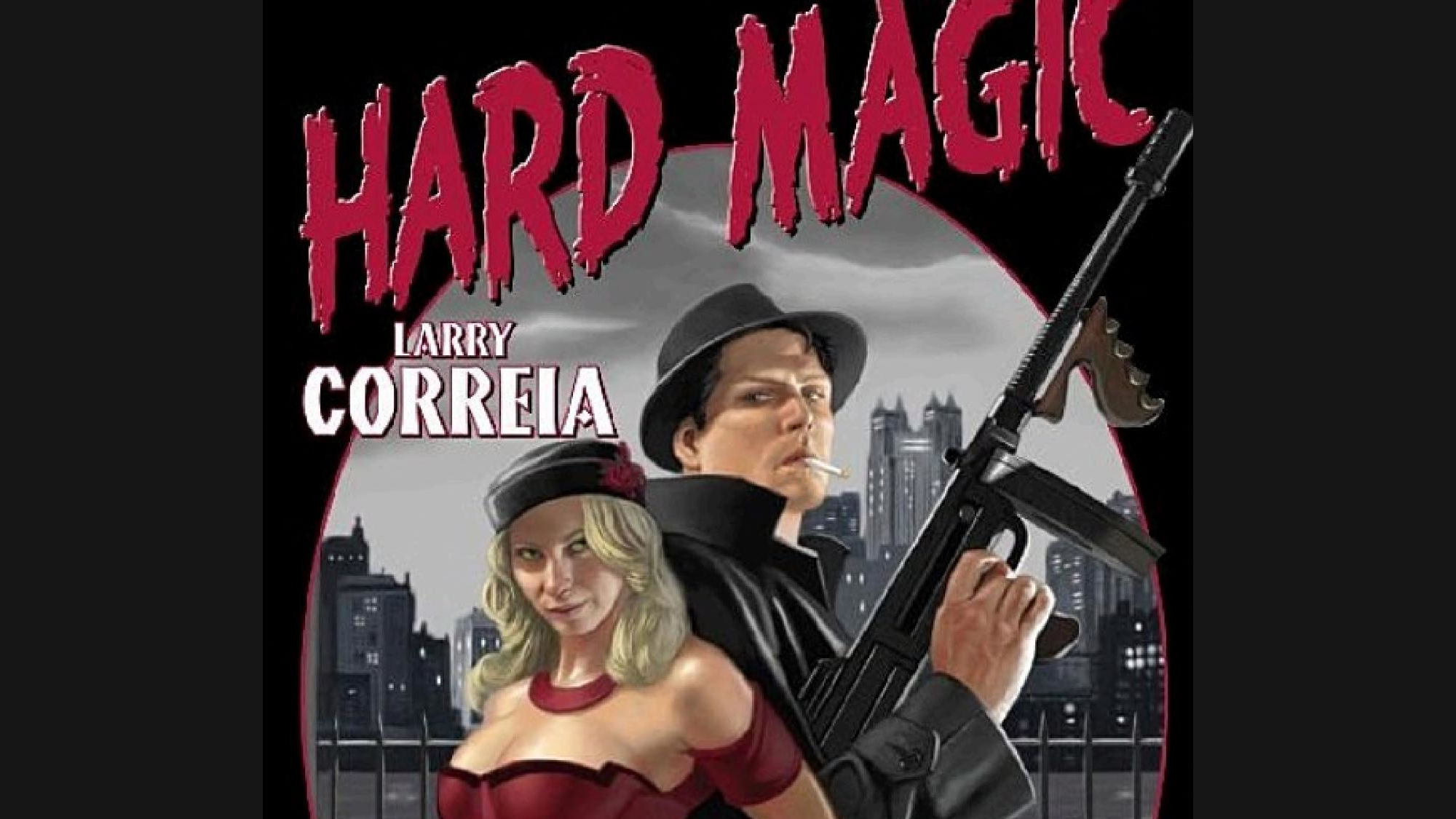
Larry Correia is an author for a particular audience. I am pretty confident that his readers are over 90% male, which is a deliberate positioning decision in a market like books and reading that is so often painted as utterly female-dominated. That means the man has vocal enemies, and that means the only way to really get an impression of his books is to read them oneself.
Shooting Monsters
Larry Correia may be most widely known for his “Monster Hunters Intl.” series about all sorts of magical and mystical creatures that include a good number of harmful entities with humans on their menu, and the main characters of the series are there to make sure there’s someone to stop such creatures, preferably with high calibre ammo at full auto.
Hard Magic shares many traits with the “Monster Hunters” concept, I dare even say that both lead characters of the book have so much in common with certain important characters in Monster Hunters that they might pass as brother from another mother or sister from another mister, respectively, although neither are copies.
Shooting Wizards
The setting is as drastically different as it gets:
Hard Magic takes the reader to an alternative history timeline where Hitler never happened. In fact, Germany never quite recovered from the damage done in WW1, which was ended by a technology that could be considered a technological nuke-equivalent, with long term repercussions.
Instead of the crippled Germany, the big enemy of the 1930ies is Imperial Japan, and the most visible weapons of this world are not the quasi-nukes: much more damaging are magic users, whose specializations borrow a lot of pages from classic psychic talents. Faders who glitch through walls, Fire-controllers, Teleporters, Mind-benders, Telekinetics and everything that one would normally attribute to psi-powers, but in this case it is, or at least it is called, magic.
Reading about it, I constantly saw the rules of psychic powers in “Stars Without Number” in my minds eye, but it goes beyond that — maybe it is a “Traveller” influence, with added powers from literally predecessors? Anyway, it is much more psychic than magic, even though the effects can also be harnessed using “spells”, or, more precisely put, formulae. And it has specializations, costs, tradeoffs and rules.
Magic is a big equalizer: Man or woman, African or Japanese, Norwegian or Spaniard, or American of any shape or form: if you have magic powers, you are a mover and shaker, and if you haven’t got any, you are a normie who will be pushed around, and that’s that. So while the setting is in a culture where the sexes and races are not on the same footing (modelled after our own timeline), all of that goes out the window as soon as you are an “Active”.
Pulp Genre conventions
Plus the whole vibe is deeply Pulp. You know, the genre where big, square-jawed bruisers deck someone with an uppercut like a steam-train, where tough-talking dames nurse a wounded heart under their rough but stunningly attractive exterior, where honest men sort their differences directly, where mad super-scientists struggle to keep control of their weird buzzing devices, and where the worst of the worst in the world are the cowards, the liars, the frauds and cheats, especially rich folk and the politicians in their pockets. Because the basis of all noble things is the good, old-fashioned honour of down-to-earth common men on the ground, and honest girls from the deep country, who work properly with their hands, produce actual goods and do what needs to be done – while the fancy-pants weak-chinned city slickers who juggle a facade of words make things go bad, but are too faux and poseur to be worth a damn in a crisis.
Pulp and Noir morals are sometimes called “grey”, but that is not quite the right term. Pulp characters may run afoul of the law and get locked up, or may shoot an unarmed man, but the morals are always very clear. Noir characters may be ground down by the overwhelming pressure of societal ills, and they may drink hard and smoke without filter, but they know what’s right and what’s wrong when it comes to the real questions.
It stands to reason that the genre is not very mainstream-popular these days. Our civilization is weighted heavily on sophisticated urban intellectual mind-workers, talking in code, and trusting a selected set of authorities to tell us how to behave — we are the very epitome of what’s considered wrong and suspicious in a Pulp world.
Yet it is a strong niche with a passionate fanbase.
What makes “Hard Magic” good?
Pulp Fiction, as a rule, leans heavily on larger than life clichés – to a much stronger extent than classes in an old-school roleplaying game.
A cop has to be a heavy dude with shoulders like a battering ram, except a dirty cop: a sell-out would be lean and weaselly. A criminal with a good heart will be similar to a good cop, usually with a military past. All women are beautiful and either worth dying for or very successfully pretending to be, and all life is tragedy.
Think Sin City comics, Raymond Chandler novels, and Humphrey Bogart films.
Hard Magic manages to take these clichés and gives them texture so even while abiding by the rules of old, every character pops off the page in “3D” as an actual individual human being with very unique character traits. Good character work, giving clichés a relatable face without breaking the archetype.
Personally, I liked the female lead a good long shot better than the male lead … is that personal preference or is it the way they are written and she just turned out better than him? The male lead is the veteran archetype who looks like a ham-fisted brute but is secretly well-read and cultivated. The female lead is the young innocent country hick archetype who had to milk cows instead of going to school, so she is tough as leather, quick like lightning, and fully in tune with her own self. Unburdened by the rules of polite society, she follows her instincts – basically a female Conan who can teleport instead of swordfight.
I am not actually quite sure what exactly irked me about Sullivan. You will have to make up your own mind on that.
But speaking of fights: Damn it, if this book does not contain the most magnetic recruitment speeches I can remember from anywhere. With the charisma of a General Pershing oozing off the page like Vermont maple syrup, or an old pirate calmly and with steely honesty laying out the risks of a near-suicide mission to ask for volunteers, it takes an effort not to stand up and salute.
The story itself is a wild ride that starts at the seemingly classic level of a cop-and-robber-noir story, until the power spikes come out. Then it quickly piles up the skin in the game, until the big, life-altering headaches of yesterday look like a baby shower in comparison with the tough issues in front. The story starts fast and only picks up speed until you definitely need the aviator goggles that biplane-pilots wear when they go right into the storm.
The book has two sequels, and honestly, the way this shit kept escalating I really couldn’t say what the hell they are going to break and burn in the next book, let alone the one after that. It feels already driven to the max.
Larry Correia makes excellent use of locations: the action happens on top of high-rises, in shadowy train stations, sprawling country estates, and on zeppelins, and in each case makes the most of the unique strengths of the surroundings, playing with heights and walls, open fields and wide views, facing off high-noon-style in a narrow corridor or punching the living shit out of each other in front of an unobstructed view for miles and miles – and when it comes to teleporters, combat can be literally all over the place at once.
There is a lot of gripping action going on that made it quite impossible to stop reading before a chapter was done. Swords, bullets, meaty fists, and a heavy helping of bone-crunching gravity, all thrown at the reader in ever increasing frequencies, make it clear that things are going to hurt people, and hurt them a lot.
Where are the pain points?
Going directly off that last point: if you hate violence, steer clear of that book. Violence is the main answer to problems here.
The story is also unapologetically American, so no good read if you hate the US of A.
World-Building wise, the author does not waste a lot of time with exposition. It is a noir world and Japan is a superpower. That is, in one tight sentence, the world. Much of the rest remains unexplained, so readers are required to bring their own grasp of the 1920ies and 1930ies. This is not a big issue because given it is a book for pulp fans, this basic understanding can be assumed.
Modern sensibilities: “Hard Magic” employs a good helping of the original language of the Pulp-era, meaning this book stings a little for everyone who is used to avoid the taboo words of the 21st century. Because they come up.
However, not in a bad way. The good characters are clearly good, and good people come from all walks of life, so keep that in mind before you post flame-wars against the author for vocabulary. The main character even went to prison for standing up to protect a black kid. Yet while in 2011, when that book was published, the demarcation lines between the political camps were not yet so deeply entrenched, they were already marked, so the author knew he was going to make enemies with that kind of lingo.
The story also contains love and relationships, most notably an old one and a budding one, but it seems difficult to fit these in between all the bullets and explosions, so romance takes a tangible back seat. There simply isn’t the time to really lean into feelings of affection when you get stabbed or shot at in ever shorter intervals.
I have a minor gripe with the big bad, in a way where … no, that would be a spoiler. Well, let’s just say there is a point where the story writes itself into a one way street and has to reverse against the rules of traffic to make it to the the finish all right. You will notice it when you read it.
But let’s slot this into suspension of disbelief. The focus of this book is magical action, not strict logic.
So, what’s the verdict?
A deliberate manly man’s book; also good for women who like manly men. Bonus points if you like guns, and definitely a must-read if you like Pulp and Noir.
Not for the soft and tender, but that comes with the genre.
Most importantly: excellent inspiration for roleplayers with an interest in pulp settings.

 PAPIER UND SPIELE
“That means the man has vocal enemies, and that means the only way to really get an impression of his books is to read them oneself.”
Can get a pretty good impression of the man from reading his other words, though, and seeing the people he enthusiastically called friends. His enemies are of his own creation, and damn did he work hard to make them.
I read a couple of his books before he went off the deep end. They were decent. He just radicalised himself into believe that he was owed vast fame and adulation over the rest of the field, starting as a joke but getting nasty as he talked himself into it.
LikeLike