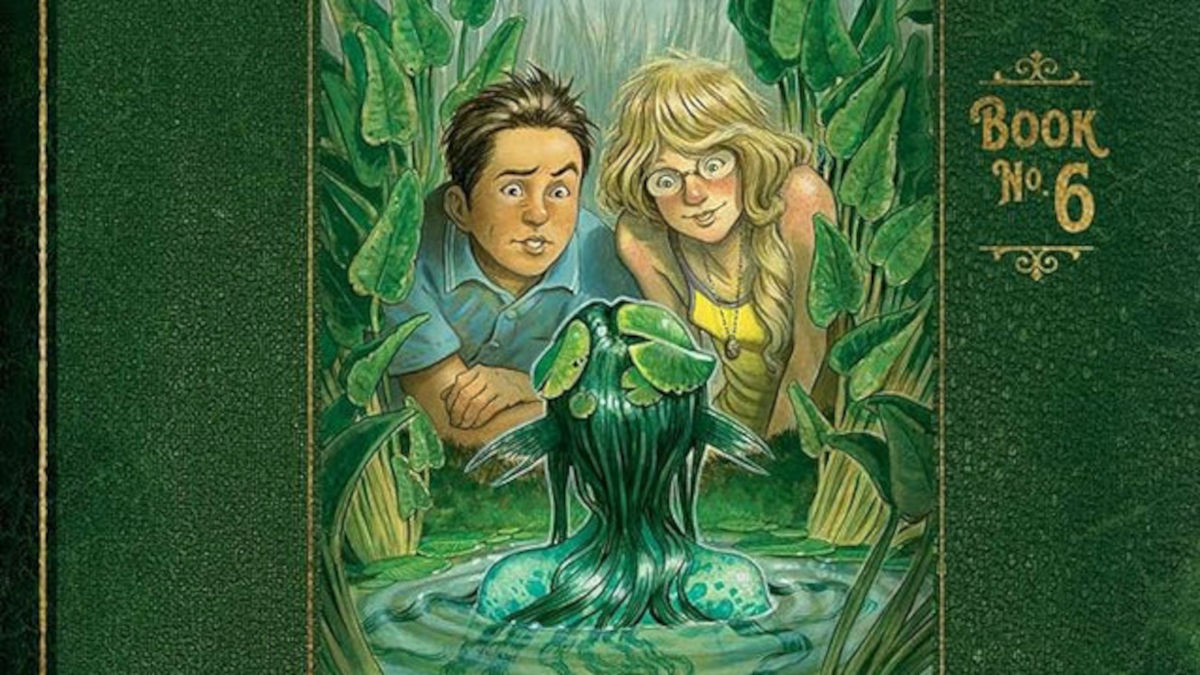
Everybody knows the Spiderwick Chronicles.
That is an exaggeration, of course, but let’s say they are pretty well established even among what may be called “the normies”, because it has been adapted to a pretty solid film. The story is geared for children and describes how the Grace-siblings move to an old “haunted” house and learn that one of their forebears had discovered the world of Faerie before he, inexplicably, disappeared.
The duo Holly Black and Tony DiTerlizzi have, to borrow a film-studio-term, expanded the Spiderwick-verse with three books focusing on an entirely different set of characters, but, interestingly, with the Grace-children featuring as supporting characters, and even the authors themselves as backdrop cast. In the “Spiderwick Chronicles” series these are books 6, 7, and 8. But they are a standalone series so I often think of them as 1, 2, and 3.
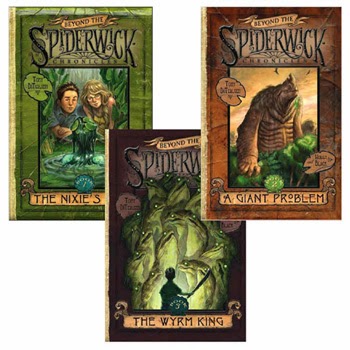
I like it when writers insert characters from one series as background characters in another series, and I hunted down a copy and read the story.
The Family Vargas
The Vargases are a patchwork family: The boys’ mother has died and their father just marred anew, and his second wife brings a daughter of her own into the household. All the Vargas male trio have a habit of burying their heads in the sand when they encounter problems, and they don’t like to talk things out. Conversely, the female duo likes to share and lay issues (not necessarily the truth) out in the open to talk about things. Conflict guaranteed, but as this applies to the grownups the same, and opposites attract, from an adult perspective it is easy to see how this second-marriage-relationship started, and why it must run into problems.
That could even be its own book.
However, “Beyond the Spiderwick Chronicles” is not that type of book. It is an action-oriented children book. So before the marriage runs into these inevitable problems, the children run into fairytale issues. They discover a single Nixie on their front lawn, try to help her, and find out that the world has a second layer most people live blissfully unaware of.
Nick and his new stepsister Laurie are a pretty good combination of lazy & practical versus energetic & head-in-the-clouds, traits which compliment each other very well. And their particular skills also add well to the existing characters of the Grace’s. It seems there went some good thinking into the characterisation of the new people. However, to get that issue out quickly: the character arcs are not really smooth. One might even call them disjointed: they are going from growing closer to falling out, from walling off back to speaking terms and back to being angry. These seem to be mostly rhythm and timing issues .. and they are not simply in the characters, they are also in the plot.
Let’s dive into it.
The dynamic duo
The language level is limited to the intended audience with an age level between 9 and 12. Simple words, simple structure. But the “Beyond” trilogy is a great showcase about story structure. The plot starts quite mundane, then the world of Faerie is fore-shadowed through the girl’s love of supernatural fiction, and her possession of a published version of Arthur Spiderwick’s Guide — which tells us that since the adventures of the Grace Children in the original Spiderwick Chronicles they have managed to get that guide published, the very act that the baddies in that story tried to prevent. Still, owning the Guide and getting anything useful out of it are two entirely different things.
Then the story escalates, and the children dive ever deeper into the supernatural, while their blockheaded father and crystal-bead loving mother, nice symbols of the “mundane”, are left behind.
The first book (Book 6) is doing a good job, the second book is doing even better with the principle of ever increasing stakes: what begins like a children’s squabble becomes a valid threat to the whole area, with nothing between safety and disaster but a gang of children, once the Vargas kids have managed to enlist the Grace kids’ help. By the end of book 2 (or 7) we reach massive tension, and then a big release.
This could be the end of a perfectly executed story. (with a few side issues dangling)
I would call book 2 (or 7) (“a giant problem”) the best of the three.
But there is third book (8) and we have already reached a plateau, so we are running into pacing issues.
The troubling Three
The (well prepared) plot twist to lead into the finale comes right at the end of book 2 (7). However, once you have built to such a gripping crescendo and a giant problem off the table, what are you going to do to keep the story going without deflating?
Book 3 (8) struggles there. It has to get all these plot threads back under control. It must get previously eliminated playing pieces back onto the board, cover up a disconnect between the scale of the problem and the very limited number and power level of the protagonists, re-unleash chaos, and then tie it back up again. And also do something with the grownups who have been slightly forgotten while we were looking at all the action around the kids.
It takes some of plot-hole-patching and deus ex machinas to get that last book rolling and then do an u-turn and bring it to a close for the entire trilogy, including a breakdown and some quick tying-up of the marriage issue. That is a lot to handle for one children book.
Teaching material
Overall, this would be a pretty fine story with solid characters, if it wasn’t for the pacing problem where the middle part steals the finale’s thunder and throws book 3 off balance. The trilogy works as a cautionary tale that even smart, gifted, skillful authors can sometimes write themselves into a corner and have to break out of it if they haven’t kept a solid grip on where the story is going.
How did it happen? I like to think that Black and DiTerlizzi wanted to write only the first two books for “Beyond”, but just as they got the second one printed, the publisher said “make it a trilogy”. But that is just a shot in the dark. An alternative reading would be that while they were at book 2 inspiration struck and they got carried away and went too fast, too far.
Bottom line, there is a disconnect between book 2 and 3 that messes up the rhythm. What we learn is that a solid trilogy needs solid planning that accounts for all three parts, introduces good cliffhangers (which Holly Black repeatedly does with relish!), but also must keep the momentum going with a certain rhythm and continue to raise the stakes in a natural way.
An argument in favour of outlining and planning vs. improvised “pantsing”.
And for kids it is still good entertainment!

 PAPIER UND SPIELE