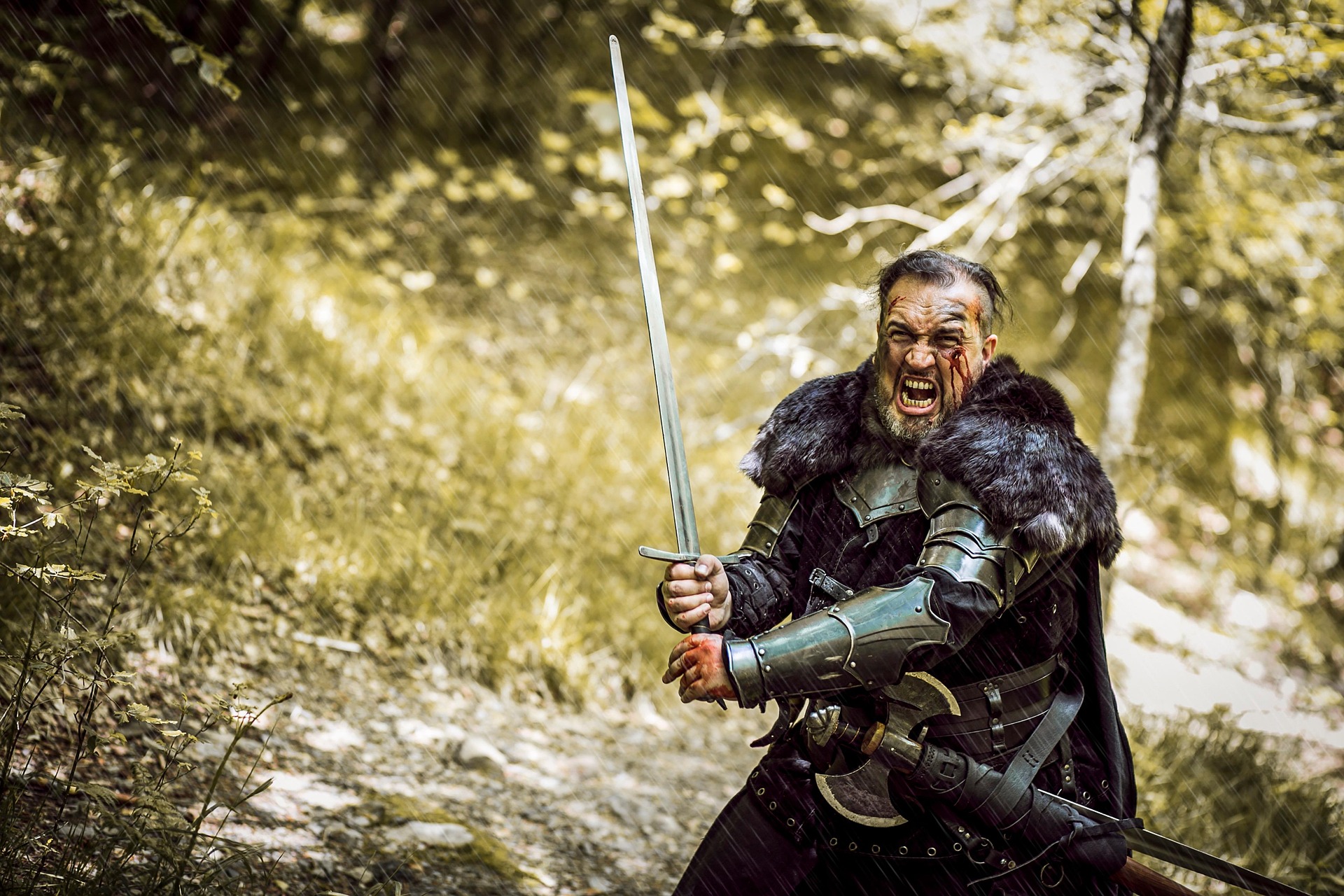
And you cannot say “Thongor” without saying “Conan”. So trigger warning: much about Conan to follow. Thongor and the Wizard of Lemuria: so named is the first of five Thongor novels written by Lin Carter, Linwood Vrooman Carter, who was a toddler when Robert E. Howard wrote Conan. We lost the great REH much too soon: his particularly vivid style remains unmatched since his tragic passing.
Howard’s character Conan has been spun on beyond his day, most notably by Lyon Sprague de Camp and Thongor’s own Lin Carter picking up the pen, and all of them in overshadowed in the mainstream’s perception by the film adaptions of 1982 and 1984.
Why do I talk so much about Conan and his creator Howard when the title of this post is “Thongor”? Because Lin Carter was quite strongly a fan of Howard’s and wished to write a character just like Conan. Thongor is fully and clearly a fan’s hommage to the Conan stories. It even has in its timeline a reference to Hyperborea, so it is set in the same universe, just at a different point in time and on a different continent. Lin Carter does his very best to copy the adjective-heavy and heavily textured style that Robert E. Howard is famous for. He writes of mighty thews, frowning brows, jet-black and midnight-black hair, shaved pates, padding on the balls of feet and lightning-fast blades and everthing else that is the characteristic fare of Conan stories. So I am quite sure his work on Thongor later served well to advertise his application to be allowed his go behind the steering wheel of the Conan-sequels.
Thongor and the Wizard of Lemuria follows the Northland Barbarian (see?) Thongor who works as a mercenary (see?) in the city states of the south (see?) where treachery and superstition rule (see?). He prefers honest dealings to shadow play (see?), dislikes wizardry and snakes (see?) and climbs sheer walls with the iron hard grip of his fingers (see?)
In other words, we are looking at Conan-fan-fiction with the names and places changed.
The story
Co…. I mean, Thongor, escapes from legal troubles by stealing an airship. He loses his way and crashes in the jungle, where he is caught between blood-sucking plants and a dinosaur and expects to die a honorable death fighting the behemoth, when he receives unexpected aid from a wizard. Said wizard has noticed his troubles and wants to recruit him for a very important mission. Knowing how skittish the barbarian is when it comes to orders and threats, and because he is a nice guy, this wizard invites Thongor to help him rather than pressuring him in any way. That works, and the dynamic duo goes out to thwart a very sinister plan by some very sinister characters.
How is it holding up?
Being so Conan-esque, Thongor cannot escape comparison with Conan.
That is an impossible position to be in, so let me get that out of the way and then finally leave Conan behind and speak about Thongor in particular.
Thongor, compared
Conan is absolute A game: he is strong, tough, agile, he is also smart, perceptive and charismatic, street-smart as well as blessed with a quick mind so book-smarts is not out of his reach. He is, one may say, overpowered, almost a Gary Stu. That sounds horrid, but somehow REH pulls it off so that the reader can forgive all this perfection because Conan is just really a good, honest chap on top of all of that, and he even has a growing arc, starting as a wild teen, becoming a daring thief, but always with his heart in the right place, finds friendship among civilized people and learns to respect their hidden strengths that only come out in cooperation, and finally even disposes of a brutal tyrant and wears, as an immigrant, the Crown of Aquilonia, doing his best to be a good and noble king in spite of his rough upbringing in the frozen wastes of the North and in spite of the intrinsic xenophobia that permeates the whole continent of Hyperborea.
What writer can pull that off? Not many, that’s for sure. And so it was necessary to make this post gush over Robert E. Howard even though we are actually speaking about a different person altogether.
Thongor is a bit less OP.
He has all the physical qualities of Conan, and he is also a “honest rogue” like Conan in his twenties was. He is just a bit less sharp of mind, and he does not have the raw charisma that makes everyone like and follow him. As a unique character, he is quite fine, and if you read Thongor before reading Conan, you will like the pretty effortless action that keeps the rhythm up and flows quite smoothly through the whole book.
Next to Conan, Thongor is a bit lesser as a person – but he is still an outstanding hero towering above all of his contemporaries.
As we know, Howard left us too soon and there are many other Conan-books that have been written long after his untimely death. These Conans, by L. Sprague de Camp and Lin Carter, are ever so slightly different in tone. The Conan of the second half of the 20th century is a bit more polished. He is softer, more comfortable, more agreeable… it is not quite the same character all the way. He is a bit easier digestible, if you understand what I am trying to say.
Thongor has some of these same, smoother, more digestible qualities.
Thongor, solo
Looking at Thongor without comparison, it is a fast-paced, easy book that leads the reader from action to action with ever increasing stakes until we reach a world-shaking finale that involves even the attention of the divine. In other words, we are not baking small breads here.
The story is an exciting and very accessible entry in the lists of Sword & Sorcery, and therefore well earns the merit to be the prime inspiration for the roleplaying game “Barbarians of Lemuria“. It also does an excellent job at world building: Lemuria is a continent with various different polities and landscapes, and Lin Carter elegantly drops lore in between story beats, so the reader gets some impression of the overall situation without getting lost in the insignificant details. We get the details when they matter — when they don’t the rough brush strokes suffice.
Speaking of brush strokes: Lin Carter excels at a quick and easy characterisation of all his figures, starting with Thongor himself, who is fleshed out in just a few words, as are the friends he picks up along the way. It does not need much to give a character life, just enough so the reader can form a mental image. Again, I bring up the BoL roleplaying game: this fast characterisation is perfect for games as well: how much backstory do you really need? “Mercenary from the rough north”, “Exiled prince of a coastal city state”, “Disgusting snake-man” … that’s quite enough to pick up and get going.
And with the keyword “get going” we can lose a word about rhythm. Lin Carter just keeps going. There is no part of Thongor where the story bogs down and loses steam. He has a real knack for doing time jumps with just the right amount of detail, and jumps between split parties with an easy confidence.
Thongor reads a lot like the retelling of a roleplaying campaign, and many a gamer can learn a thing or two from Lin Carter’s well-timed, entertaining pace and his eye for the important bits.

 PAPIER UND SPIELE