
Yes, yes, I know, I am late to the party, as always. Everybody else has long looked at the system, played it and written or talked about it. But so what. Better late than never.
And also, long time no post: Between a lot going on in meatspace, reading way too many books in parallel which always gets in the way of finishing them, and a transitioning phase between games where multiple campaigns have ended and new ones are just scrambling to begin.
But let’s concentrate on the now and look through
Shadowdark.
A phenomenon has stormed all through the roleplaying scene for a few years now: Shadowdark. Before, everyone spoke of OSE, it was the king of the OSR. Then, OSE began to fade into the background, the spot at the top became free, until suddenly a new champion emerged. All of a sudden Shadowdark was everywhere I looked. As was the author, Kelsey Dionne. Interviews, podcasts, mentions all over social media. Everyone loved her. There was some sort of kickstarter that pulled in some wild sum of money, a fantastillion dollars.
All of Gaul?
And yet, not everyone was in love. In the obscure corners of the hobby, a few hooded mystics muttered and hissed in their gaming dens: “Fake OSR”. “New School”. “FOE”. “Fraud”. “5e disguised as OSR”.
Fakery or Trve OSR?
So what’s true? Is Kelsey the new messiah of the OSR, the Dice-Phoenix to burn away the barriers and ring in the era triumphant of Old School? Or is she a terrible FOE secretly scheming to convert all good, honest OSR-bros to Daggerheart?
Spoiler alert: The answer is right on the back of the book. But let us try and arrive there by picking through the contents.
When I started this post, I had never played Shadowdark, I hadn’t even looked at the rules once. But given the starkly contrasting opinions I had to go and find out what’s trve true. Plus, I had to do more than read the rules, I also needed to play the actual game to pass judgement.
Part 1: the reading.
First impression
By the first surfacey looks of it, Shadowdark appears like a younger brother to the Black Hack. Most of the style is exactly the same, only the Title Font it took from Delving Deeper. None of that matters to our question and its true allegiance, though: the fonts are free.
The rulebook is not liteweight. 300 pages and counting, that’s a mouthful for an OSR system, but that is by habit, not by nature. We accept tomes like Dungeon Crawl Classics, so why not. The nature of OSR is not the format, it is all about the content.
Art
Nothing wrong with the Art.
Good, solid Black & White images of threat and danger, as it should be. This is the way.
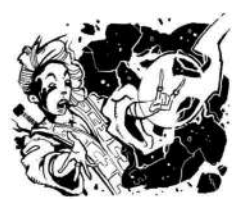

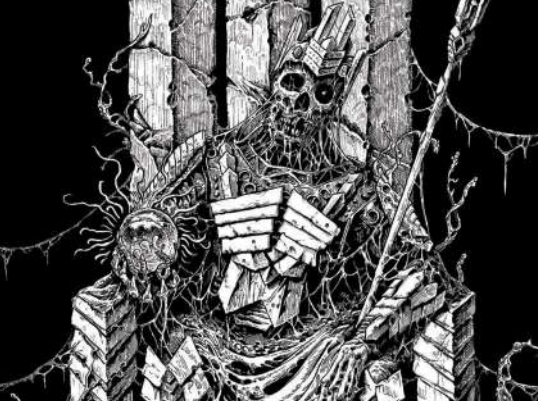
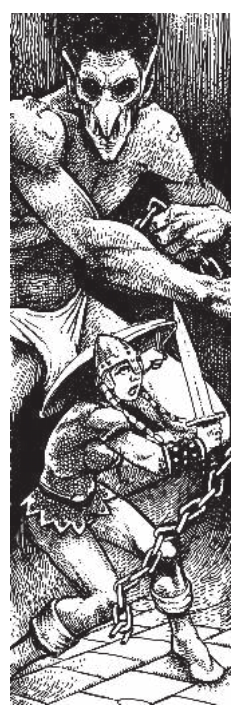

No complaints at all.
Content
Speaking of DCC: While the visual design and some of the underlying rules philosophy is so clearly taken from the Black Hack, Shadowdark also seems to owe quite a lot of its general design ideas and playing style to Dungeon Crawl Classics. In addition to that, it loves and embraces Simplicity above all. There is the near-singular focus on the d20 as a core mechanic, which DCC also promoted in some ways, but not in others; so it is a common design idea between Dungeon Crawl Classics and Shadowdark, but only Shadowdark really pulled it through.
On that note, the famous DCC-“funnel” has also been co-opted into Shadowdark under the name “gauntlet” for a stable of weak low-HP level zero peasants where they can die or earn their first D&D level. But let’s not jump ahead and go through it down the line.
We start with a quick overview of some rules.
Difficulty Classes, and a d20 WIS check for Morale instead of the traditional 2d6.
Movement is in zones, not in feet: again, simplicity, and one that is a serious load off the GM’s shoulders, because distances are often given terrible importance.
Modifiers range from -4 to +4, giving the attribute scores a lot more weight than in Original D&D, and that looks a lot like 5e. On the other hand, even B/X already went to -3/+3, and AD&D added granular distinctions at STR 18 that make that first random roll for attributes way more important than it (arguably) should be. So these modifiers are a definite bridge built towards the bonus-spoilt 5e-audience, to lure them into the dungeon.
Ancestry
“Ancestry”. This word is usually used in very modern roleplaying games that make little difference between so-called “races”. Modern audiences love to level playing fields, so they like their mechanical differences between giants and gnomes to be minimal. 5e is a good yardstick for that: it tries to keep everyone more or less the same, aside from a few cosmetic features like pointy ears or purple skin: some sort of cosplay, to keep it “fair”.
A few good dice rolls and a pixie can be as strong as a goliath, it just has a different attribute that gets pumped up.
So the word “Ancestry” is a slight flag that signals: “I am modern and new school!”.
However, we can quickly relax: under the title “Ancestry” things don’t fully shape up in the way that the title threatens.
Goblins do have “Keen senses” and cannot be surprised. Dwarves are mechanically tougher than everyone else. Elves get better eyesight. These are actual, tangible rules differences. So it is the bland and nigh-pointless “Ancestry” in name only, while it presents in fact an actual difference and true differentiators between the species.
Old School Check: Passed.
Level Zero
By design, everyone starts as a civilian. People have a real, productive-like job and a low amount of hit points: in this, again, Shadowdark mirrors the idea of DCC, but skips the intense skill-focus of its predecessor: simplicity rules. Level zero newbies are weak and ineffective, that is the important part. Once they manage to qualify for a full fledged level 1 character (at 10 XP or when they deserve it through a great deed), they can pick a class and get to roll real HP and get “talents”; basically special treats to support mechanical individuality between characters: another borrowed concept from the d20 era of D&D.
Characters
- Everyone gets feats under another name, randomly chosen, this time with a 2d6
- Fighters have a weapon speciality that gives them a bonus to attack and damage with a favourite weapon.
- Clerics are called “Priests” and they are more flexible than the D&D version. Cheekily, the rules demand a deity, despite the people’s tribunals. Priests don’t have to wait to cast spells: they start with two slots right out of the gate. I see the shadow of 5e.
- Thiefs are like thiefs, but they do not have the classic thief skill ladder. Instead, they get advantage on checks involving thief skills, and do 1 plus half their level in extra damage on a backstab.
- Wizards start with a whole three spells, and their feats allow them bonuses like advanced spells or to start with a magic item. Another mish-mash between old school and new school, but it fits with the old school precept of having and collecting resources to use.
- We have various level-titles, a classic borrow from old-school,
- And languages.
20 Backgrounds give special skills like contacts or former careers.
But Alignment goes back to classic three-tier, which I find charming.
2d6x5 starting gold instead of 3d6x10, but prices for equipment are lower too.
Unsurprisingly, Encumbrance is in slots, which is more or less established procedure these days as a common alternative to the old coin-weights and the newer pound-weights.
Weapons are pretty normal, armor is slightly conservative, so the game is not on easy mode: people will get hit.
That’s another fat point counting towards passing the OSR-test. OSR means that combat is dangerous and should not be entered lightly.
Levelling up
Experience is different than usual: Once more, as in most aspects of this game, simplicity is the guiding principle. So in Shadowdark there is no counting of coins and weighing of gems to arrive at precise values: Mundane stuff gives no XP. Normal valuable stuff (like a bag full of gold) yields 1 XP. Incredible, well-prized valuables (like a great magic item or a giant diamond) that are hard to get yield 3 XP. Legendary quest-goals (like the hoard of Fafnir the dragon) yield a full 10 XP.
You collect relatively few XP that way, but on the other hand it isn’t divvied up between party members: everyone involved gets the full number, low as it is, but undiluted; and you level up with smaller amounts of XP.
At every level-up you re-set your counter to zero and start again to collect “your level”x10 XP before you advance. So you need 10 XP to reach level 1, then again 10 XP to reach level 2. From there you need to gain 20 to reach level 3, then you need 30 to reach level 4, then 40 to level 5. You get the gist.
A nod toward modern systems: there is no difference in levelling thresholds between classes.
That means levelling is faster than in old school D&D but still has an old-school way of getting steeper. Much steeper even: remember that a full dragon’s hoard is 10 XP. Which means in theory that you need to plunder four dragon’s hoards to get to Level 5. That is more work than it looks. Well played, Ms Dionne.
At every odd level you gain another Talent, somewhat counter-acting the earlier differentiating through talents; but that is a clever nod toward the old school way of differentiating through behaviour. Shadowdark helps modern players to ease into the mindset by giving them a differentiator on paper, then as they slowly get more similar in cold numbers, they automatically develop personalities during play and arrive at the ability to be different as persons.
Once more: Well played, Ms Dionne.
The Gauntlet
Let us return to the “Gauntlet” once more, or the “Funnel” for DCC-veterans.
The process to arrive at a character is as follows: Everyone generates 4 level zero peasants. This should be strictly randomized to avoid “over-investing” in a character: keep them at arm’s length yet!
The idea is that most characters should NOT survive the gauntlet. It should be merciless and deadly. Level 0 peasants who fall to 0 HP die instantly!
Still: despite aiming at a high casualty rate, to the point of dark comedy, this gauntlet should not be unbeatable: by rewarding smart play and informed risk-taking for tangible rewards, the gauntlet subtly teaches the values of the Old School.
Each player ends up with one character who got out of their by a mix of smart play, tenacity, and sheer luck. This character has earned his chance to rise to the top. And if a player loses all four of the little proto-adventurers, why, just roll up 4 new peasants and send them right after the others. This too is a lesson in Old School: don’t cry for Sir Bob the Adventurer: dust yourself off and roll up Sir Jim the Adventurer!
Random Tables and Freedom of Choice
A staple of Old School gaming are random tables, and we do have them in Shadowdark: You can roll for names, you can roll your ancestry, class and spells, your deity, your languages and alignment, weirdly specific random encounters (“albino kraken”, “blind mammoth”, “wild-eyed playwright”, “Sir Galvin”, “Baron Clard’s wife”, “Uncle Istvold”), and monster mutations.
Variations in style are presented: going fast or going chaotic, heal easy or heal hard, grant XP for the killing of monsters, or don’t! These are all free options in a buffet of styles that allow a GM to make the game easier or harder, as the table desires.
Monsters, Treasures, and Spells
Monsters are classic stat blocks relatively close to the way you know them from OSE,

And there are a lot of them. Stats enough to carry a GM through dozens of campaigns. Treasures are a fun one, they also come with their own tables and range from “bent tin fork” to named magical items, artworks and gemstones. There are also magical weapons and magical armor, as well as cursed items.
Magic
I have mentioned that Shadowdark takes some pages out of DCC’s book. And DCC is most famous for its “mercurial magic”, which is magic that is less stable than the reliable effectiveness of classic old-school magic.
In OD&D or B/X, you have your spells, you cast them, and they do what they are advertised to do. Every. Single. Time.
DCC flipped that script and made magic volatile. It wasn’t the first system that tried to make magic a bit wilder than the simple flip of a light switch, but it was the one that went the farthest.
Shadowdark follows this path, albeit again following the mantra of simplicity, so where DCC gave outcome tables for every spell (what an idea!) Shadowdark makes it hinge on a dice roll.
Once again, this brings some balancing pluses and minuses.
It allows for failure and success:
Roll d20 + attribute mod to reach 10 + spell level and the spell works. Roll too low, and it doesn’t. But roll a natural 20 and you can double the spell effect. And on a natural 1, there is a mishap. That can be rather unpleasant, can cost you casting ability, at lower levels it can even be deadly!
On the other hand, the rules throw out “Vancian” magic: On a failure, the spell is gone and must be re-memorized. But on a success, it stays. Keep rolling successes, and you can cast the same spell all day long as often as you like!
For magic users, this is a massive advantage compared to the classic “fire & forget” system.
Bottom Line
So: Old School or New School?
Lay the book on its face and look at the back, there it is written: The perfect blend of modern and classic.
That’s the truth.
The answer is Yea.
Shadowdark proposes the OSR style to audiences who discovered tabletop RPGs via modern systems; it picks them up where they stand, offers them a warm welcome, it advertises something more interesting, and helps them find their way into it.
It does not run roughshod over tried and tested systems, it picks them up and plays with them in a sensible way, adding safety here and risk there, keeping the balance. And while it is not 1:1 aligned with classic D&D, if the GM knows what’s what, it is easy enough to make fully compatible with B/X or any other classic Old School RPG.
An important aspect of OSR playing style that is less present is resource management. Much of the classic games is devoted to how much equipment a group can carry and how the resources slowly run out until the lack of items, light, or food becomes a problem that may end lethal. This aspect includes exploration speed and the time that torches burn or food remains edible. Resource managment is completely absent from modern gaming, and consequently it is toned down a lot in Shadowdark. But only toned down. It is still present, and losing your torches will still end you in the Dark.
In the end, the rules hold up to scrutiny; the core of this game breathes Olde Schoole Renaissance.
About Part 2: the playtesting, I’ll try to publish something by tomorrow.

 PAPIER UND SPIELE