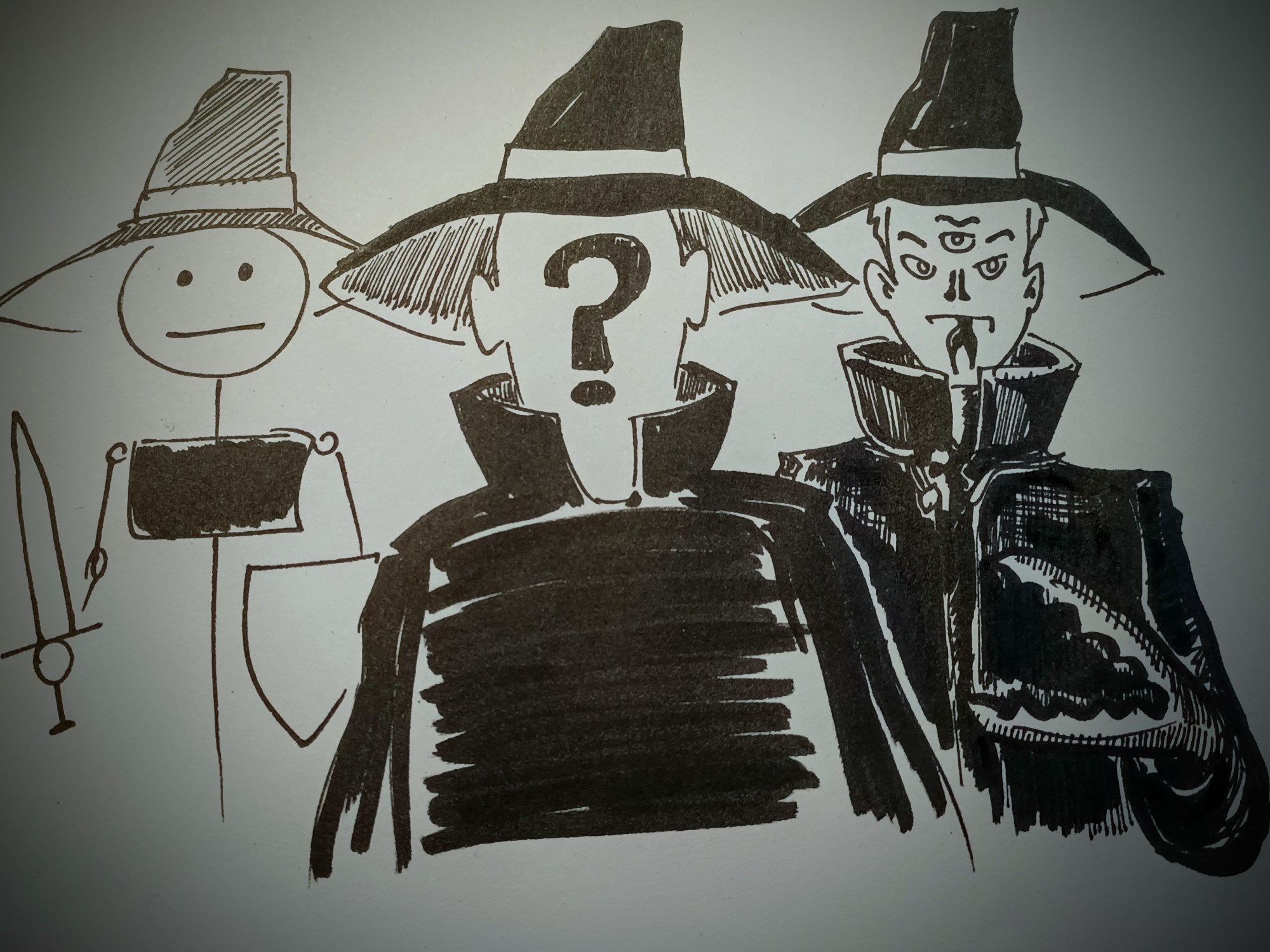
There was a recent discussion on Discord about Bestiaries: it started with the statement that Lamentations of the Flame Princess hasn’t one, and that this is an oversight or a negative aspect to the game.
I disagreed, and still disagree, although the debate got me thinking about the positive sides to Bestiaries. It is no accident that the “Monster Manual” of AD&D is famous and much beloved; and it is not by chance that to this day many wait for Monster Manuals or Bestiaries, for example in the new edition of ACKs.
- First, what is a Bestiary,
- then, why do I think we don’t need it for LotFP,
- and then, what is good about them?
Towards a definition
A bestiary is a collection of creatures complete with stat blocks. They come in variants, some have very short and minimalist descriptions (think Original D&D), others delve deeper into the minutiae of the creature, their lairs, their habits, their strengths and weaknesses (think AD&D and beyond, even up to 5e) – case in point is the “Demilich” (not even a full Lich!) who takes up two full pages in the 5e Monster Manual, what with typical stats, Legendary Actions, Lair and Lair Actions, and even an example. That’s a lot to read, so a lot of prep. The book provides all the necessary details. It requires that the DM is ready to sit down and learn things about the creatures, makes notes and stays consistent to keep the power levels and experiences right.
Contrast that with OD&D, where text is relatively sparse,

and the stat block is all mysterious abbreviations.
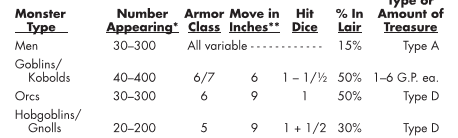
They require the DM to be familiar with the creatures in general, to know the main things and to fill out the details on the fly. Much about the feel of the game depends on the DM in question.
AD&D has the famous granddaddy of Monster Manuals:
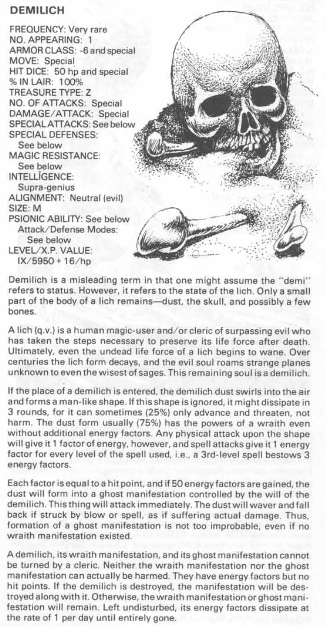
And even at this first edition the previously mentioned Demilich spills out over the equivalent of a full page. Including specific methods; and the stat block looks nothing like the OD&D one. Due to popularity, this seems to be the ideal way, and 5e does a great job following the example.
So — why don’t we need that for the various publications of Lamentations?
The irrelevance or even detriment of the Bestiary
Dungeons & Dragons is a game about delving deep into the bowels of sunken ruins, in the dark, the mysterious caverns where monsters, slimes and deadly traps lurk, and murderous foes lie in wait. Pretty scary thought. But in the actual game it is not all that scary. It can be very thrilling, it can be a game of life and death, dangerous encounters and gut-wrenching losses of characters that have grown near and dear to the players. But horror? No.
I believe that the reason for this is because we know the drill. We have a pretty solid mental image of a goblin, of an orc, of a gnoll or a spectre, even of a demilich. And what is solidly known is not all that frightening.
Lamentations of the Flame Princess is not a classic Dungeon Delving game like standard D&D, it is “Weird Fantasy”. Strange events, unsettling experiences, threat and fear, delibitating sickness, maybe even the end of the world … that is what we are going for with an earnest game of LotFP. And we do not get that with 3d6 cardboard cutouts from page 25.
Weird Fantasy lives by the unique, and by the stark contrast with the normal. As horror does.
James Raggi calls it “a sense of wonder” — something that was surely present in the earliest adventures of Original Dungeons & Dragons, but that has, as I put it in the discussion on Discord, “eroded”.
Lamentations of the Flame Princess builds strongly on human foes: most enemies you will meet in a “typical” LotFP-module will be humans like bandits, soldiers or witches. After all, the usual time frame orbits the 30-years-war, which Raggi has repeatedly called a particularly dastardly time in history (he used other words, but the gist is that).
And the human enemy is, I believe, full of story potential; even more so than the classic fantasy races. A goblin is awesome (in fact, goblins are my favourite fantasy creature) but it will ever be the “other”: it is just not the same if you cut down a green-skinned, spindly-limbed ugly with pointy teeth or if you hack down a young man with a weird rash on his face and a dirty knife. With the young man you will wonder what made him attack you. What was going on here? How will people react when they hear about the fight? Killing a goblin will never carry that same weight. Now make the foe a woman instead of a man and you already multiply the unease. My god, why did she attack me? Will people think I am a psychotic murderer?
Now, do you need a bestiary for that?
Empathically no. A human is a human, they all have the same stats as you, your character.
And then, the unnatural, the monster:
A LotFP-adventure should not revolve around some stat block; it should be mysterious and do the unexpected. It should be a thing that you meet in this one particular adventure and never again.
That’s why I like my Lamentations without standard stats. I don’t fancy the lure, the temptation, the trap to default to a standard, which takes away from the moral quandry, from the mysterious and from the unsettling; in other words, it takes away from what makes Lamentations different and special.
The game is better thanks to the lack of a block of numbers to describe the essence of the encounter.
The necessity of the Bestiary
That said,
the others in the debate brought up valid points.
- One of these was that we cannot expect every Referee to be so well-versed in classic D&D that he can easily conjure up a foe from thin air. Many a gamer will be new to the experience and may be stumped without some pointers. What should a foot-soldier, a cavalryman, a knight, etc. be like? What is my frame of reference? For a referee with less than several years of experience, that can be tough.
A participant in the discussion described that as “the DMs suck”, but I find that too harshly put. Everyone has to start somewhere. Can a book make that start easier? Maybe.
- Another point made is the wild animal. How do you stat a fox, a wolf, a hunting dog? What about a python or venomous snake? What about an owl or hawk, or, if you are hunting for food, a hare or deer? That said, what about the horse you are riding? What does it take to bring that down and spill you into the grass at high speeds?
Rather than leave the referee – or even the “green” referee – forced to improvise such a negligable side issue on the spot puts undue stress on the GM, maybe with a negative effect on the adventure overall. Can we not lift that needless burden from the host?
Yes, that can be mitigated by picking up the existing monster lists from B/X or BECMI, or even AD&D. But would it not be interesting to bring in the special flavour of the LotFP mindset from the get-go, rather than via a detour across the smooth, dare I even say bland, “standard”? With also the (quite small, but still) extra effort to adjust AC, as unarmed standard LotFP AC is 12, not AD&D’s 10.
And thirdly, personality matters. Some DMs excel and revel in the invention of stories, and even the best of them must sometimes be relieved of the routine jobs or they will become repetitive. So they could profit from a “typical” description of the normal, so that the abnormal can breathe and stand out better. Again, LotFP’s creator James Raggi has touched on this in his Grindhouse Referee book, speaking about Adventure Creation:
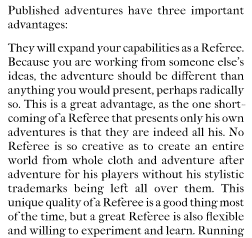
There is a different trap hidden in the conviction that one’s own imagination is strong enough to carry multiple campaigns unaided. This is particularly dangerous when we enter the realm of the weird and horrific. Variety is key to keep things unknown, and we can always learn from the descriptions formulated by others.
Conclusio
Overall, my preference stands: I don’t need nor want a LotFP bestiary, I think we have enough creature examples from other systems, literature and film, and the effort to adjust AC is manageable. We also do have the Random Esoteric Creature Generator; a book specifically designed to aid the process of giving unexpected form and life to unique encounters — that is, to the main monster of a story. Very OSR, it offers decisions to roll with dice and lists of options for instinctive inspiration. But it is not meant to create random fruit vendor #4: it is meant for the special foe.
Also from the Grindhouse referee book:
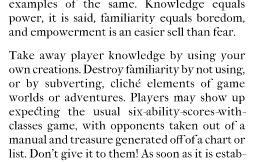
At the same time, I do understand the arguments in favour, and how a Bestiary can, at times, maybe even often, be a valuable tool in the hands of a referee. The deciding factors are narrative talent, inspiration, creativity, and even prep time.
So, Bestiaries, a plus, a minus or a neutral tool?
How strong is the true need?
How dangerous is the deceptive lure of an easy default, especially under the duress of a fast-moving game? The drive towards the easy, the already-done, the tried-and-tested …. the cliché? Espcially in the age of nigh-unlimited sources, where the most common are so overused that we sometimes know them and what makes them tick better than ourselves.
Food for thought.
Do find more LotFP topics here.

 PAPIER UND SPIELE