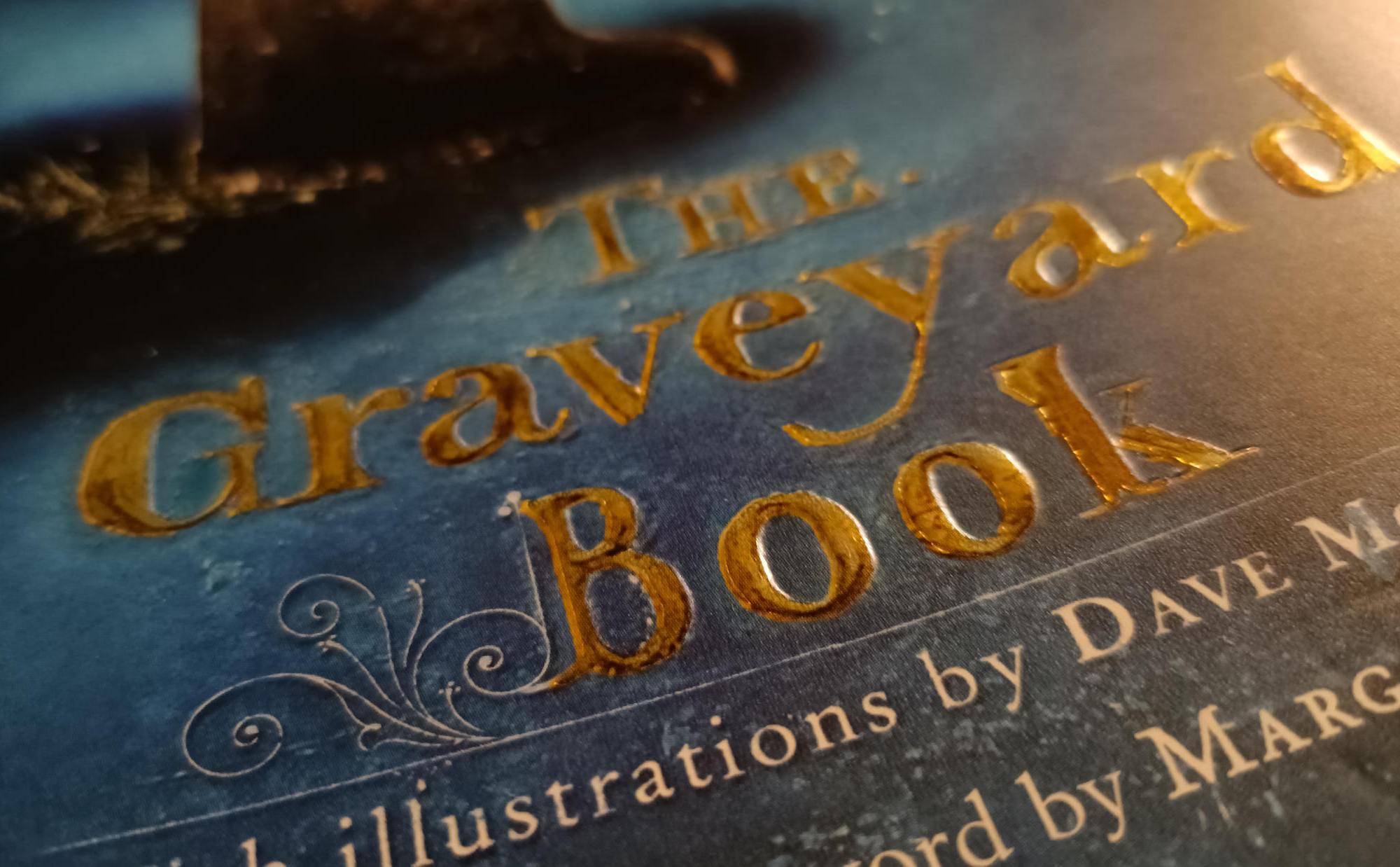
Neil Gaiman: who does not know him, or at least of him. Neil Gaiman is what one would call a prolific writer, with a large body of very influential work, including famous comics (“The Sandman”) and many novels (“Neverwhere”, “American Gods”, “Coraline”, “The Ocean at the End of the Lane”, and a cooperation with Sir Terry Pratchett with “Good Omens”), and the majority has also been adapted to the movie or TV format, so his fame is cemented beyond the circle of readers.
In other words, he would provide lots of material for blog posts here. For today, I pick “The Graveyard Book”, a unique take on death, or rather, the thin border between life and death, and coming of age, leaving behind childhood and embracing the world of opportunities that comes together with the weight of adulthood.
The story feels quite accessible to young readers, in part because of the mostly simple sentence structure, but in another, larger part due to the deceptively innocent mindset that permeates the descriptions book: a mindset that delivers unsettling and even chilling events with a playful ease. It holds quite a bit of gravitas for grownups who see beyond the surface and have an understanding of the plot’s implications, even though much is left to the reader’s imagination.
And armed with that imagination it feels almost wrong that the book is actually meant for readers between the ages of 8 and 12 – regardless of sentence structure. Although, given that innocent wording and vague descriptions, it is possible to believe that to the young and open-minded, “The Graveyard Book” may simply be an entertaining adventure book with a cool and interesting hero who grows up in unusual circumstances.
There are secrets within secrets, and a certain recurring topic tied to the name Hempstock, and there is also a big twist, which a grownup can see coming from a mile away, but even so it flips the story from slightly threatening all the way up to Oh shit! in the space of just a few paragraphs.
What is the plot?
We start rather abruptly with a harsh and cruel murder, which makes the Graveyard Book tough on parents. Yet the terrible is hidden in vague descriptions. They hit hard in a soft tone.
“The hunt was almost over. He had left the woman in her bed, the man on the bedroom floor, the older child in her brightly colored bedroom, surrounded by toys and half-finished models.”
A man called Jack is tasked with eliminating a whole family, which he does, all quiet and easy. But then he messes up: the little toddler escapes. The boy waddles away into the night and finds refuge in a graveyard, protected by its denizens: the dead, the very dead, and the not-living.
They do not allow the living into their midst easily, but it is a peculiar situation, and so they make an exception, imbue the boy “Bod” (for “Nobody”) with certain skills that allow him passage and camouflage on the ancient graveyard, and they raise and school him according to the adage of “it takes a village”.
And yet, as a child grows up it must go out into the world.
“In the graveyard, no one ever changed. The little children Bod had played with when he was small were still little children; Fortinbras Bartleby, who had once been his best friend, was now four or five years younger than Bod was, and they had less to talk about each time they saw each other.”
True company for the living, we learn, is only in the living world.
And in that world there is the man Jack, who remembers that back in that one night he messed up and lost one of his targets: a failure that neither he nor his colleagues ever forgot — a blemish on his honor and his status among his peers.
Myth and Potential
The Graveyard Book combines the normal and the fantastical seamlessly, reminding the reader that the world of mystery — call it whatever you want — is only hidden from us, not gone, that traditions have meaning, even if we have forgotten about them, and that life has meaning, even if we are too young, too old or too bent to see it.
“You’re alive. That means you have infinite potential. You can do anything, make anything, dream anything. If you change the world, the world will change. Potential. Once you’re dead, it’s gone. Over. You’ve made what you’ve made, dreamed your dream, written your name.”
Once again, a strong message for a grownup, maybe a gentle nudge for a kid.
The Graveyard Book is one of Neil Gaiman’s most famous novels, despite the fact that it is geared towards younger audiences… or because of it? It is a bit simple for grownups, but laced with hidden backstory, even with some shifts of perspective that still manage to preserve the mystery, and it explores with nimble skill the fuzzy borderland between night and day, death, undeath and life, and magic, fantasy, and the role they have to play in the mundane. All of which should appeal and serve as great inspiration to a certain sort of people — like writers or roleplaying gamemasters.

 PAPIER UND SPIELE