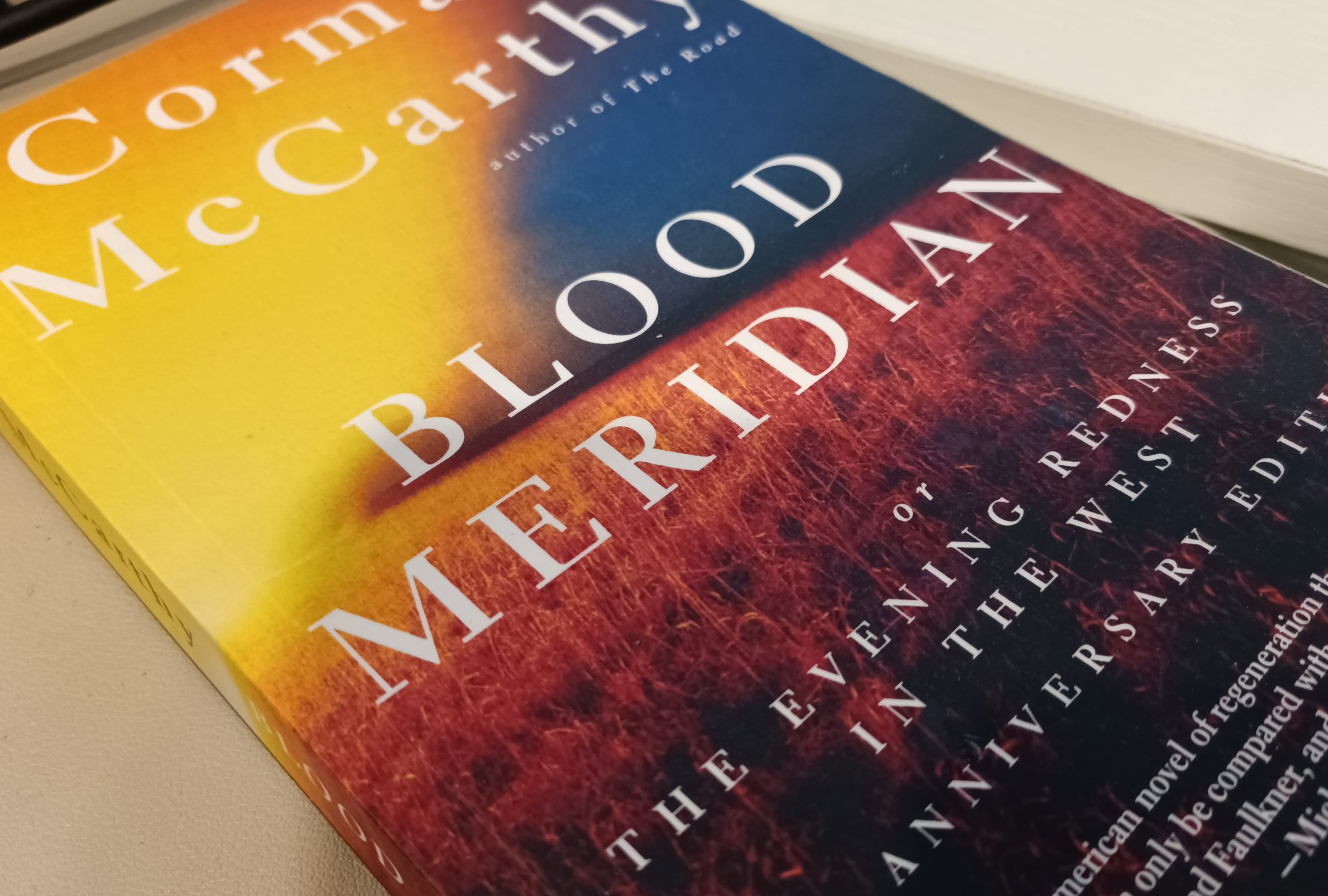
Another tough read, for various reasons. The content is hard to swallow. And the book does not come with guardrails, neither moral nor punctuation-wise.
Cormac McCarthy’s Blood Meridian has a bit of a reputation. I have seen it called a “Red Flag” if found on a bookshelf, or a celebration of unchecked violence; or “toxic”. On the other hand, people also point to its finely chosen wording and literary quality.
Blood Meridian is a book that stirs up emotions. The author, Cormac McCarthy, cleverly manages to get under everybody’s skin, be it sooner or later, be it with violence, with fear, or with barbarism against the living, the dead, or even against items. Blood Meridian has impact. And if a reader should manage to get used to the bad things in the course of reading, McCarthy soon sneaks in something new to shake things up and bring even more impact.
What’s happening?
Blood Meridian is a complex beast to unpack, despite its deceptively straightforward plot. It is not about the plot: it is about the decisions.
The stage is the Wild West, but it is absolutely no tourist brochure for orange sunsets over the open range. The West in Blood Meridian is truly Wild, as in untamed. “Based on historical events” says the blurb, and that is so: A Glanton gang did exist, and some of the names and descriptions seem to be lifted right from real life. One can only hope that the actions depicted are pure fantasy.
“The kid” – our protagonist – has grown up hard and rough, with violence a constant, and now “the kid” comes into a borderland town, meets a creepy, cruel guy called “The Judge” who instigates a lynching, then “the kid” falls in with some bad people and joins their gang to go south into the borderland between the US and Mexico.
That region of the west is largely void and empty, no-one to tell people what to do or what not to do; at first glance that sounds like freedom, but Blood Meridian wastes no time to make it clear that you really don’t want that sort of freedom: it is a freedom where anyone can do whatever to anyone else, provided they have the means to do so, and to refrain from cruelty is quickly seen as weakness and exploited by those more cruel.
The kid narrowly survives a troubling and deadly journey into the basically ungoverned wastes. He ends up in prison and it looks bad, but then he is picked up by a group of ne’er-do-wells under the so-called command of a guy named Glanton, with that creepy “Judge” also a part of the crew. This man Glanton has a job from one of the local Mexican district gouvernments: Kill the Apache tribes that are rampaging through the waste killing settlers and traders.
And for proof, they collect the scalps of slain Apache warriors. But one shock of black hair looks much like another, so over not that great a span of time the Glanton crew decides that there are much safer ways to collect bounty than to actually hunt and kill murderous warriors. How about peaceful Indians? How about Mexicans for that matter … the very settlers they are paid to protect? The journey of the Glanton gang is characterized by a terrible moral and civilizational devolvement; starting at the already low level of hired killer and spiralling ever downwards, giving way to some of the most despicable depravities imaginable.
This resonates especially around the Yuma ferry … but now that would be a real spoiler, so I will leave this part to you, dear reader.
What’s the issue?
Blood Meridian, and by extension, Cormac McCarthy, gets some flak from people who claim this book is a wanton celebration of gore. I disagree completely. Blood Meridian does not make it its business to lecture the reader about the proper way to think about the atrocities that it describes. It follows the chain of events as they happen and never once pauses to reflect about right or wrong – that is, not openly and as on the nose as our culture has developed to expect it. “The kid” as our main viewpoint character doesn’t express any opinions if he can help it; other characters have to insist and push before he ever takes a mild stand, if that. This silence makes some readers uncomfortable. They expect someone to call out and shame bad behaviour. To cancel Glanton. They feel that without a vocal moral authority in the fiction, that must mean the author condones or even advertises the lifestyle of the Glanton gang.
However, they miss an important point: While the kid does not say much and does not discuss things, he acts; or acts not – and when the decision is his, he tends to act counter to the whispers of evil.
Here’s my take:
People in this book routinely do things that polite society would like us to hide and ignore or at least sugar-coat: they rape the living and the dead, they murder the innocent, they lie, manipulate, despoil and plunder, and then they molest children and murder some more, and they use racial slurs and expletives without regard for the sensibilities of the reader in the cushy fauteuil.
However – and I don’t think I am spoiling much when I add that – all this gruesome behaviour does not end well. You can bully and murder a lot of people as long as you have a gun, ammo, and no sheriff behind you. But at some point you will meet someone who brings violence back full circle and murders you. Sometimes that someone may even be your fellow murderer beside you. This is a subtle – maybe a bit too subtle? – way to drive it home that the way we live today: with laws, courts, and even obnoxious societal rules like greeting and saying thank you; is actually a fantastic and wonderful way to live.
We can complain and criticize laws and courts, and rebel against societal rules – but we do not really want them gone. None of us want to exist in such hellish borderlands as depicted in Blood Meridian. Good Riddance to the 1840ies! We are safe to rebel and criticize in the comfortable zone of security provided by the ever-present constraints of civilization. Free and happy communities of farmers out in the lands without lords are only happy until a Glanton gang comes along and needs some more scalps. A land without order is not a happy land.
What makes it special?
Blood Meridian is not truly the story of “the kid”, like a normal book would be. It is a look into the abyss; a dance with evil. It draws the reader’s attention in many ways: for example by insisting to make direct speech and narration indistinguishable without context: When you start into a sentence, you can rarely be sure if this is description or quote, until the sentence ends with a “said Tobin” or it is followed by an answer.
The author carefully balances long and short sentences, dry remarks of fact with bible-adjacent sermons; and there are scenes of carnage that echo the Old Testament and fall on some middle ground where they are not just dry remarks but get a bit more texture; just enough to invoke some vague memory. McCarthy describes brutal atrocities sometimes in an offhand sentence, and at other times in great detail. Sometimes he lets them happen off-screen, sometimes they swirl by with a flourish.
Most striking is this dance of words in the middle part when the gang crosses deserts like the prophets of old, and Judge Holden lays out parts of his philosophy of the world: That God is absent (which is one reason why he continues to tease “the ex-priest” Tobin relentlessly), and that War and Murder are the most advanced ways to compete: the master of all games, with life and soul on the line.
Cormac McCarthy did not simply write this book, he composed it.
Like a sidewinder snake the text moves eternally back and forth between short, dry remarks and mythical lectures, and juxtaposes the verbose with the silent.
One more dance that grows very familiar is the way that kindness comes back to haunt people. Whenever someone shows mercy or stays his hand, this is a mistake, and oftentimes a deadly one. Surrounded by beasts in human form, it betrays weakness, and beasts attack the weak. The text follows a strange and stunning rhythm.
Not for nothing is the Judge always described, even shown, as a magical dancer.
Who in all hell is Judge Holden?
That’s a question that fans and scholars can mull over for a long time coming. The name comes from the real-life Glanton gang which had an important member called “Judge Holden”, according to an autobiography called “My Confession” written by a Samuel Chamberlain. This real life 1840ies Judge Holden is described very like the one in the book: extremely tall and heavy, mostly hairless, and pale, creepy, brutal, but smart, educated and extremely well read. Cormac McCarthy’s version is almost like that, only dialled up even further. Judge Holden in the book has zero hair, not even eyelashes, he is gigantic and bulky but with nimble feet and fingers. He knows every plant and animal, sketches pencilwork with uncanny likeness, and speaks an incredible variety of languages shaming even that real Holden. He shoots like the best of them, has been to nigh-every place on earth, and is a paragon of science and philosophy.
Throughout the book it is simmering that he is more than just a man; some weird creature, a demon or fallen angel, maybe Satan himself? People whisper that he cannot die, and his hairless skull reminds us of Death personified – which also vibes with his deep fascination with natural sciences, bones, history and archaeology. At times I was not sure if he was truly a person, and not a figment of imagination, the devil on the kid’s shoulder – for why is he so unreasonably smitten with the kid above most others? Why these constant advances to draw the kid into his confidence? – but then he interacted with people in ways that the kid never would, and others spoke about him to the kid, so it remained a nagging feeling, returning like a sequence in music, but ultimately that’s not it. Rather, the Judge is smitten with the kid because it eludes him so stoically; starting with their first encounter, and repeating again and again.
Judge Holden is a Concept made flesh. Massive, pale, hairless flesh.
Is he living Evil, War in human form, or Violence, is he the Devil or the Antichrist? Does he represent Cold Science? No. Or is he the personified History of Man? Some of those fit better, some fall short or miss the mark. Ultimately I cannot fully decide, which is probably what Cormac McCarthy intended.
One thing is for sure: I don’t want to meet this guy.

 PAPIER UND SPIELE