Maybe you know Diogenes, or Dio for short, of Dio’s Dungeons – a usually smart and enterprising Australian gamer with a sharp and inquisitive mind. He likes to question dogmata, poke holes into Old School rules sets, experiment, make changes and test … all the good things.
Well, recently he wrote something like a slap in the face. Something that cannot stand. His “most cynical post”: D&D is obsolete, play video games instead. I struggled to wrap my head around it, because it only made sense to me as a parody, a jest. And yet, he claimed (within the text, but also in person) that it was written in earnest. So in earnest I must work through and oppose it.
Take a moment to read his post which, according to Dio, has “resonated” with “quite a few” people, and “totally echoes” some people’s sentiment.
So, here are my thoughts about it, because it certainly does not echo mine. If anything, it raises my hackles and reverberates like Melkor’s shrieks in the wastes of Araman:
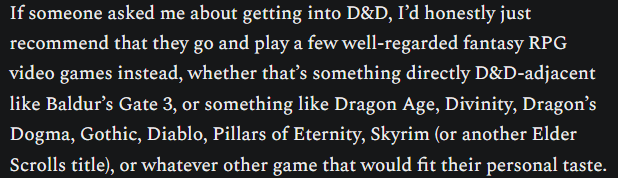
D&D as a “fad”, tabletop games “obsolete”, Baldur’s Gate 3 or Diablo as a better option due to their versatility and ease of use.
What “fad” holds out for 50 years(!) and is still alive and well? Old gamers from the 1970ies return to it. Young children under the age of 10 discover and love it! At this point D&D has outlasted most other pastimes, spawned younger spinoffs and descendents and infused western culture with fruitful ideas that enriched other games, films, art, books, comics and manga, and many many more.
Barring a smattering of exceptions (many of them quite loud, but still exceptions), roleplaying started out as freak-fringe, first a complete outlier, then a hobby for the weirdos and losers, then even went through a satanic panic, before it found serious attention of the mainstream. It even arrived so thoroughly in the mainstream consciousness that many people now outright deny that the hobby was ever NOT mainstream! That they claim that RPGs were always the cool thing and it was viciously gatekept by a well-established elite of blasé elitist roleplayers basking in the glory of ruling the tabletops and barring poor, sad outsiders from the admission they desparately craved.
That image is absurdity itself: The very core of the hobby — creating worlds and adventures on your own, in small cells of threes and fours – is what made it so accessible to the freaks, the downtrodden and outsiders in the first place. The same characteristic makes the claim of “gatekeeping” so bizarre.
To roleplay, you need nothing but imagination and two friends. You can start a group right this instant and nobody can stop you – no company, no church, no government, no sports club, least of all other gamers. And lo and behold, this non-existing bar to entry is the very reason why it appealed to the freaks, the hated and the bullied and why big money has such a hard time to sink its rotten fangs into it.
Freedom
Roleplaying is by nature decentralised and free. You cannot force creative people (who are the core and lifeblood of the hobby) to pay monthly fees like braindead consumers. Creative people create! Nothing can stop them. Buying permission to use prefabricated, authority-approved building blocks in a “correct” way is the very antithesis to creativity.
And yet that is exactly what video games are. You can make them as open world as you like, they will always be limited by the reach of the prefabricated building blocks (just travel far enough from 0/0/0 in Minecraft and you see that there is no such thing as a ), and they will need machines with particular attributes to function, and this is where the rotten fangs of big money find purchase. This is where you CAN demand monthly fees and press your consumers into subservience. And this is where they are consumers: They can pick from options and they fulfill the missions, collect their points and use the equipment, all of which follow norms and “correct” ways.
On a very surface level, this is also true in D&D, where you have XP and a dungeon, and you can go to shop for equipment.
But the soul of D&D lies elsewhere, not in fixed lists and standardized rewards for routine actions: it lies in the creativity of its players and their infinite ideas to circumvent and rearrange the tricky situations they encounter.
Players can ask questions and find gaps. They can burn the door with flammable oil. They can trick the ogre into smashing the golden portal. They can turn around and do something completely different from the get-go, if the fancy grabs them they can never even enter the dungeon!
Try that in a video game.
The timetable conundrum
But let’s go on. Fifth paragraph.
“With video games, the player can play at their own pace, gaming at a time that suits them”.
Yes, playing all alone and solo can be done without worrying about the timetables of others. And yes, the greatest killers of gaming tables are regular jobs and love. It is a trope grounded in sad reality that players and game masters were lost in great numbers either to the demands of working late, or rising early (“sorry, no game today, I have to finish a presentation for an early meeting tomorrow”) as well as to finding a non-gaming romantic partner or even marrying (followed by a hostile stance of the spouse against sharing precious free time with a table of oddballs and dorks).
However, “players can see what’s happening on the screen with no effort” once again harks back to the creative core of the hobby. People never flocked to roleplaying because it saved them from a “mental load” or provided “strong visual stimuli”. Cinema and TV did all that far better.
The strength of roleplaying are free decision making and creative expression. The heavy gamers did not fall in love with adventure trees or mass-produced cutouts, they flocked to the freedom of a shared and co-created mind-space.
(even to tabletop wargamers, I dare presume, the situation on the playing field matters more than the mini figurines, and if they had to choose one: free decision making or fancy minis, they would choose the decisions and make do with a post-it-note for a unit)
In the comments he speaks of a minimum viable product, condensing the game to a core gameplay loop, and one megadungeion per GM.
No. Think bigger.
Stopgap?
Dio writes that he can’t help but see D&D and tabletop games as a “stopgap” method of entertainment, a brief interlude between old standard boardgames and the opportunities of the internet.
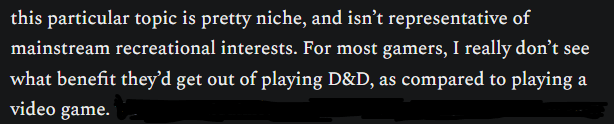
Pretty niche, it may be. It went through a decade as a mainstream-spectacle with a fair share of posers and phoneys, where it became a known quantity for shallow media circus… I mean circles.
Creation is Active
But that was never a normal state of affairs. Creative endeavours like writing novels, stage-acting, acrylic painting and the, yes, active narrative participation required for meaningful tabletop roleplaying are, by their very nature, not a thing for a majority. Driving cars or having a pet are majority pursuits. Tuning cars or training hawks demand time, effort, and head-space. They will never be a majority thing. And they do not need to be.
It is a mistake born from capitalist framing in mass media to think that everything MUST always grow and reach ever wider audiences, yield ever rising amounts of money, and sprawl ever farther.
That is how economics work, and even skill — but it is not how hobbies must work.
Do you see model train enthusiasts wring their hands and cry because they are few in number? Do free climbers give up their passion because more people go hiking on marked trails?
Nay!
And neither should they.
Not cool
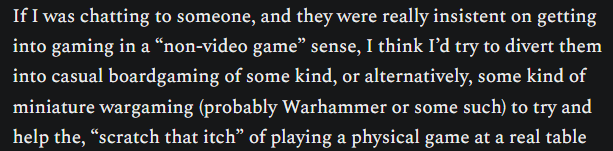
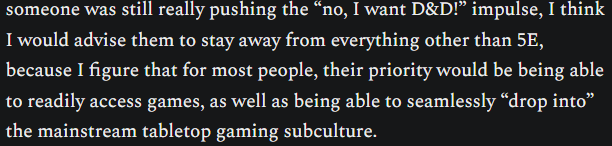
And here is where the piece really crosses lines. At this point I was seriously thinking Dio was trolling the reader. It is one thing to accept that a hobby is not for everyone, but quite another to actively discourage, torpedo, honest seekers of the game. Preventing them from reaching their goal!
No Dio, this is just too much to stomach.
To me, this sounds like an all-or-nothing mindset: either we must be mainstream like watching the Football World Cup, or we close up shop, throw all rule books into the fire and melt the dice down into poker chips. What nonsense is this?
It is not necessary that roleplaying is mainstream, and it is not necessary that it is ever growing. But it is necessary that its doors are open and that those who are a good fit for it can discover it, learn about it, and find fellow players.
The idiotic claim of the agents of evil, the foul liars, that there was “gatekeeping” going on — it would suddenly become a shocking reality if gamers were to actively discourage interest!
We do not need to be in every household, but every household must have the option to find us.
Democratise Creativity!
World of Darkness is not liked much in some corners of the OSR, but don’t judge too rashly:
Firstly, no game did more to make female players see something in the hobby. Vampire, the Masquerade with deep character play and high quality artwork spoke to female teenagers like no green slime or dwarven cleric in black-and-white crosshatch ever could. Thus the “Storyteller” System was a power engine that rebranded roleplaying from weird into interesting in the eyes of many a girl.
Secondly, Vampire-Co-Creator Mark Rein-Hagen is the source of an excellent quote (some words omitted) to express my point:
We no longer tell stories – we listen to them. We sit passively and wait to be picked up and carried to the world they describe. We have become slaves to our TVs, permitting an oligarchy of artists to describe to us our lives, our culture, and our reality.
There is another way. Storytelling on a personal level is becoming a part of our culture once again. That is what these games are all about: not stories told to you, but stories you will tell yourself.
Diogenes writes that 90% of dungeon masters are frustrated novelists who lack the work ethic to actually write a book or create a video game, “idea guys” who will never “make anything worthwhile”, so they “just run shitty D&D games” that “won’t even develop into a campaign”.
So what?
Who says that only a published book or a video game is “worthwhile”? What makes anything “worthwhile”? Again with the capitalist downer.
Roleplaying is a hobby. Its payoff is no “viable product”, there is no campaign quota. The payoff is the good time that we have, the adventures we share, the moments we remember.
In one answer, another user described his frustration with bad games: games with too little effort on the part of the players, or poor pacing, or poor planning. Which made him think about his “fun:time spent” ratio, and thus led him to think that video games and reading yielded more bang for the buck.
And yet, he could not banish that desire for the special something that only a tabletop RPG can provide: raw improvised creative action born from one’s own mind.
Don’t banish it!
Never give up creating
Deny that “oligarchy of artists”, developers, and corporations power over you. Chuck away the “ready access” to “good graphics” for “low effort”.
Be a human, not a consumer statistic!
Live and create!
Embrace and enjoy your ability to shape something that did not exist before. Invest the time, find that precious shared time slot with your friends, recruit their spouses too! And if your local friends truly cannot shake off the shackles of overtime and stress, go online. We have the internet, and there is a globe full of gamers on every continent.
Talk with them!
Start games!
And spin your own original stories.

 PAPIER UND SPIELE
There is no more ideal field of play than the tabletop.
LikeLike