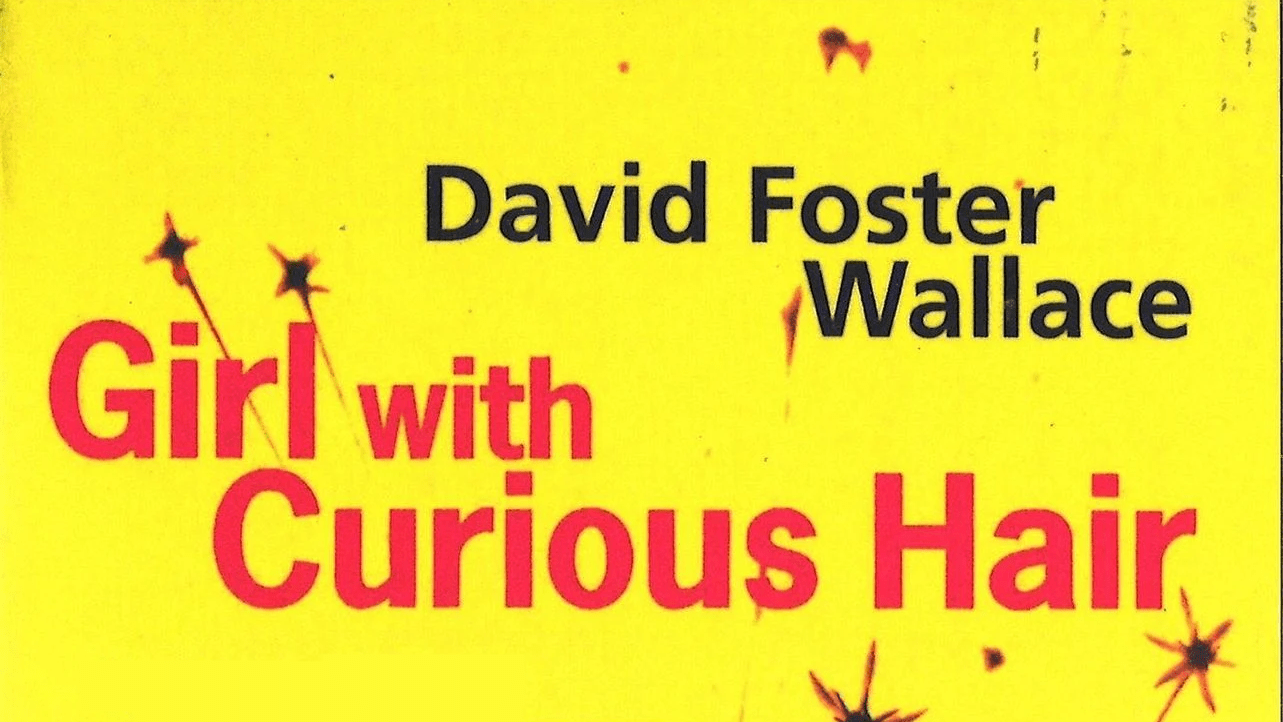
David Foster Wallace has a very gripping, sometimes overwhelming way of regarding the world. The writer is most famous for a novel called “Infinite Jest” (which I do not (yet?) know), but I read a collection of short & medium stories collected under the title of one of them: “Girl with Curious Hair”.
The narrative style(s) is (are) quite unusual in various ways. Most striking though is, in all variations encountered in this book, the immense amount of detail. Wallace describes the world in a ramped up way that most of us would not be able to gather even if we lived thrice as fast as everyone else. His world is characterized by an acute vision of detail on a level that makes reality at once incredibly bountiful and also terrifying and almost painful. The stories in “Girl with Curious Hair” also reveal that his way of telling is not the same in every story. There are quite different atmospheres, for example in Lyndon and in the MacDonald’s bit.
He has a way of describing the cruel disregard for human life and wellbeing in a casual, nonchalant way that is at the same time excruciatingly detailed. And while the things that happen in these stories are bizarre and over the top, it is this shocking level of detail that still anchors it all in moments and vistas we know from our own lives – which makes them believable, full of characters that are hyper-real, too close for comfort, and thereby disquieting and unsettling. Do we want to live in a world where the things in these stories happen, and where people behave like that? Decidedly No! But do we have a choice? These are things that happen – Wallace captures the beauty in the hideous, and the ugly in the pretty.
Overall, I would say David Foster Wallace has a clear recurring sentence style in the sense that he is no friend of brevity. He takes his time in descriptions and goes deep into the whole experience – he has to! A direct and factual mind cannot convey this vivid diversity of life. And he uses language in experimental ways; including fourth-wall tangents, drug-induced craze, shifts in POV, wild dialect, and fiction within fiction. Strap in! It is not a casual read.
What’s happening?
Two women in a complicated relationship are ground through the relentlessly fake machinery of flashy showbusiness, torn between what they want and what they think they should want.
A desparate attempt to save a semi-distant, almost anonymous life in the cold and soulless atmosphere of a parking garage.
A sociopath richkid looking for kicks by associating with anarchic punks engages in the joys of eating the forbidden fruit, breaking rules and hurting people. How being above the normal class makes it easy to slip completely sideways and out of humanity.
A politician’s dedicated aide working so much overtime that he loses his boundaries, his identity and his self in the process – same as his boss. Lives lived entirely for others until it becomes hard to hold on to what makes one person that person.
Hearsay Revenge-porn out in the deep country, where big-city-rules don’t count: an epic confrontation between folk-hero and rich-kid – told in stories by people haven’t been there themselves.
A couple of annoying bastards are priming a woman before a high-stakes Late-Night-Interview. They try to make her play a role they decide for her and find the idea ridiculous that she might answer honestly.
A jigsaw-puzzle of disparate characters thrown together by fate, marketing, and bizarre circumstance, trying to cross the inhumane eternity of midwest farmland while holding on to identities – this one is particularly long and interrupted by asides, flashbacks, explanations and premonitions.
What unites all these extremely different tales is that they all show us a glimpse or more of confrontations of personality and inner life with outward personas that are either fake or at least disconnected from inner life. The stories in this book, as I read it, invite us to look behind the curtains that surround us, or that we surround ourselves with, and maybe, in the long run, be more congruent. But that one is more an interpretation on my part, seeing as how the incongruence invites suffering, failure, and damage to the protagonists or their environment. The main point is: behind every exterior waits a universe; sometimes a beautiful garden, sometimes a desert, sometimes an abyss. Don’t be content with observing the exterior. See the reality behind it.
Some quotes
“Does your husband still look at you the way he used to?” asks the television.
“Save to say not,” Dee says drily, drinking.
“She drinks too much,” Julie Smith says to Faye.
“It’s for the pain,” Faye says, watching.
Lyndon seemed to forget I was here, in an outsized chair, in the corner, my coat puddled around my lap as I sat, watching. I watched him read, dictate, sign, and inital all at once. I watched him ignore a ringing phone. I noticed how rarely such a busy man’s phone seemed to ring. I watched him speak to Roy Cohn for twenty solid minutes without once answering Cohn’s question about whether Verett Dirksen could be shown to be soft on those wo were soft on Communism. Lyndon looked over at my corner only once, when I lit a smoke, baring his teeth until I put the long cigarette out in a low ceramic receptacle I prayed was an ashtray.
“You knew about the secret post-accident strain when I didn’t til it was too late and Chuck Junior was temperless and gone?” asked a disbelieving Glory Joy, pale, tight of lip, hip-shot. She come back over, toting menace. I sympathied Glory Joy, told her how Chuck Junior had suffered a spell of his optical dislocation over to the feed store once after I once slapped him on his back over a humorous joke, and how he’d dislocated, and I’d seen, and how he’d swore me to an eternity of silence about his secret.
Was me supposed to tell you how, on that one fine dark day a pentecost’s throw from Ascension, we all of us got levitationally aloft, moving around the seated form of Minogue Oklahoma’s expired T. Rex Minogue.
The window over the sink of my kitchenet is cleaned off from the hard rain last night and it is a morning with a sun, it is still early, and there is a mess of green out. The trees are green and some grass out past the speed bumps is green and slicked down. But every thing is not green. The other trailers are not greeen and my card table out with puddles in lines and beer cans and butts floating in the ash trays is not green, or my truck, or the gravel of the lot, or the big wheel toy that is on its side under a clothes line without clothes on it by the next trailer, where the guy has got him some kids.
Everything is green she is saying. She is whispering it and the whisper is not to me no more I know.
I chuck my smoke and turn hard from the morning with the taste of something true in my mouth.
For lovers, the Funhouse is fun.
For phonies, the Funhouse is love.
But for whom, the proles grouse,
Is the Funhouse a house?
Who lives there when push comes to shove?
Fact: all Illinois communities, from well-built Chicago down to Little Egypt, have their origin and reason in the production of nourishment. The soil of Illinois is second only to the Nile delta in terms of decayed-matter percentage, fertility.
As mentioned before — and if this were a piece of metafiction, which it is NOT, the exact number of typeset lines between this reference and the prenominate referent would very probably be mentioned, which would be princely pain in the ass, not to mention cocky, since it would assume that a straightforward and anti-embellished account of a slow and hot and sleep-deprived and basically clotted and frustrating day in the lives of three kids, none of whom are all that sympathetic, could actually get published, which these days good luck, but in metafiction it would, nay needs be mentioned, a required postmodern convention aimed at drawing the poor old reader’s emotional attention to the fact that the narrative bought and paid for and now under time-consuming scrutiny is not in fact a barely-there window onto a different and truly diverting world, but rather in fact an “artifact”, an object, a plain old this-worldly thing, composed of emulsified wood pulp and horizontal choruslines of dye, and conventions, and is thus in a “deep” sense just an opaque forgery of a transfiguring window, not a real window, a gag, and thus in a deep (but intentional, now) sense artificial, which is to say fabricated, false, a fiction, a pretender-to-status, a strawhaired King of Spain – this self-conscious explicitness and deconstructed disclosure supposedly making said metafiction “realer” than a piece of pre-postmodern “Realism” that depends on certain antiquated techniques to dcreate an “illusion” of a windowed access to a “reality” isomorphic with ours but possessed of and yielding up higher truths to which all authentically human persons stand in the relation of applicand – all of which the Resurrection of Realism, the pained product of inglorious minimalist labor in counteless obscure graduate writing workshops across the U. S. of A., and called by Field Marshal Lish (who ought to know) the New Realism, ….

 PAPIER UND SPIELE