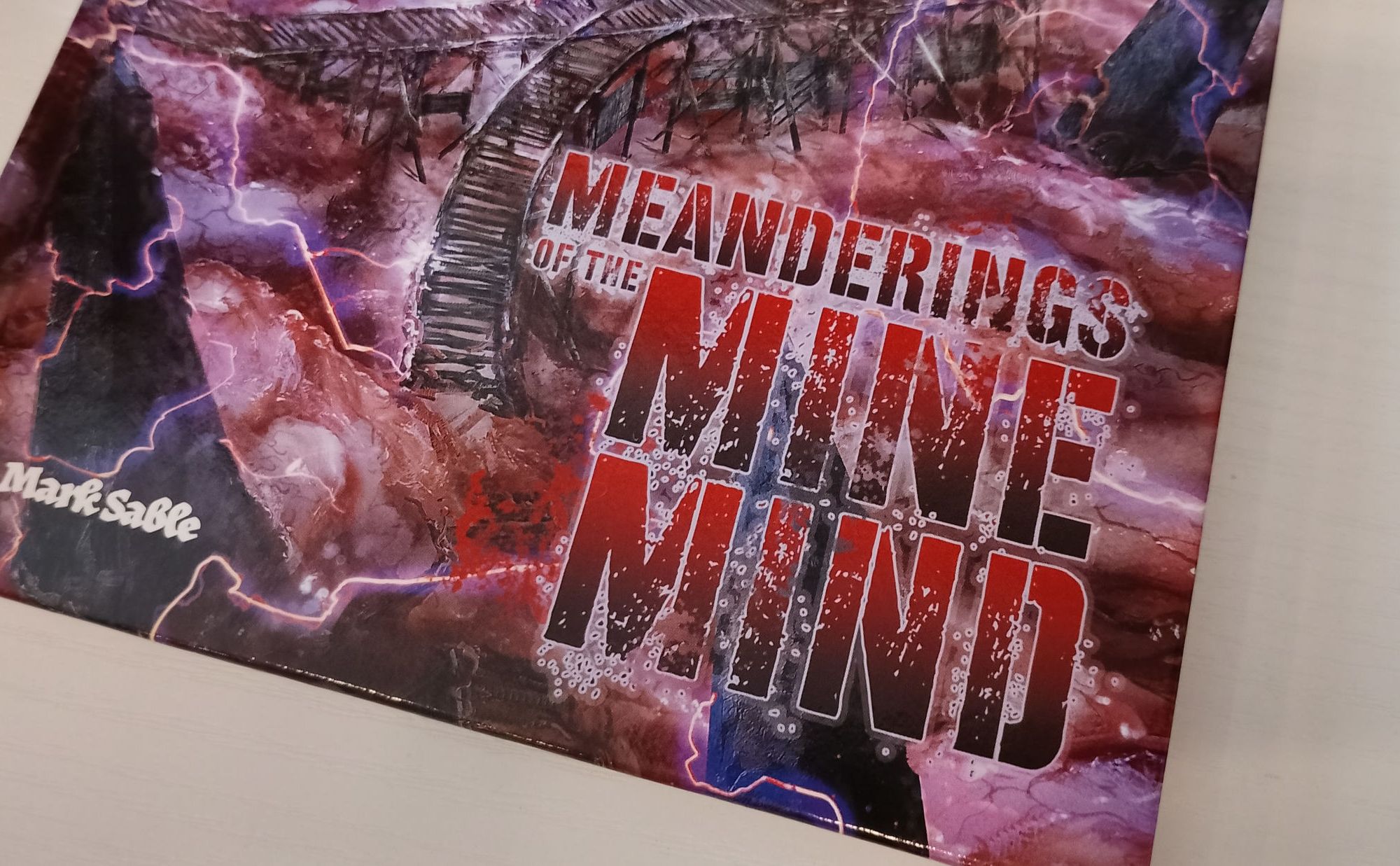
An introductory adventure – characters on levels 1 to 3 can succeed with that one – and easily adaptable to any OSR game. In fact, I cannot shake the feeling that the module was getting more Lamentations of the Flame Princess-ified in the editing process than it was in the first version? Some of the “weird” elements have an air of having been added after the fact. However, I’ don’t want to go deeper into that here to avoid spoilers.
Concept-wise the Mine Mind is quite a fine idea with the potential to look at the world in new ways. Which is always a big plus. And it is flexible in its whereabouts, so it can be dropped into any existing game world wherever there is potential for mining. It takes some personalization at the table, though, because it packs together a number of very different ideas and stacks them together room by room, not unlike a classic TV-show format, where episode 4 has not too much in common with episode 2 or episode 7, apart from the recurring main cast and the overall setting.
However, that can be good or bad, depending on play style at your table.
What is it about
A silver mine that went haywire: The party encounters, one way or another, a silver mine that has stopped operating. The miners are protesting, several of their number are missing, weird things are happening in there, they won’t go in to keep mining. A couple of soldiers are trying to make them. It is an opportunity to make a quick buck by clearing out the problem, putting the miners at ease and getting the mine running again, or, if they want, to mine themselves. There is also someone who disappeared and needs saving. And rumor has it that some bandits are holing up in that mine, and there is a reward on their heads. So reasons aplenty to go in and take a look.
Going into the mine the party will quickly find out that things are out of the ordinary in here: Odd effects that seem to make no sense and beg to be explored. And solving the riddle of the odd mine will provide a glimpse into greater things, give fresh context to world views, and even comes with the potential to (catastrophically) change much of the campaign map.
The weaknesses
- For what the “mind-mine” will turn out to be, the adventure is too small. There are only a handful of rooms, relatively close going by the given size, and that very proximity taxes believability. How are the miners missing when you meet them everywhere you turn? How are the bandits hiding here when you can hardly help but run into them? How do they go in and out past the guards if there is just the one entrance? This whole setting needs more 3D, excavation shafts, alternative routes, and space.
- The adventure feels like a number of largely disconnected ideas thrown together, and so if it wants to be more than a quick fun session, if it wants to be part of a campaign, it needs the hand of a seasoned game master to expand on the skeleton and make it larger, more layered, and provide transitions that give it more unity and softer transitions. Which means it is maybe an intro-adventure for the players, but not for the GM.
- It has elements of time travel that puts the adventure firmly on our known Earth. Something that needs to be adapted if the adventure was to be included in any non-Earth or faux-Earth game worlds.
- In some ways the adventure expects the player characters will be searching for silver veins to start mining for ore themselves. Certain things can only happen if the players start looking for ore. A fair assumption, but under no circumstances a given. Players are unpredictable, they will just as soon decide to become silver miners as they may reject the very notion of even touching a pickaxe. This may need some prompting.
- Given that silver-mining is basically the frame of the adventure, it would have been great to have an aid for the GM for judging the weight and evaluating the worth of ore. The referee will have to decide on that, and be careful about it: give the PCs a silver mine and you give them the potential to unbalance the campaign’s economics.
Obviously that is not much of a concern if we are talking about a one-shot.
The strengths
- The very tightness of the material as presented is not only a weakness but, in the hands of an experienced GM, also a strength: the rooms in the adventure are the bare bones of the setup, which the referee has to know, and they are easy enough to memorize or note down relatively quickly, given their small number.
But these bones are rather separate from each other thematically, so they do not get in the way of free imagination: in between the rooms that are on the map, there is opportunity. There can be placed any number of additional rooms, levels, hazards, and challenges to give the mine more room to breathe — and to give the GM a chance to describe how the surroundings are like a normal mine, but also how they differ and how the atmosphere starts to become more unsettling and lose the aspect of rock and ore the deeper the party advances in this place — and encounter places that may help them guess something of the true nature of the mine before they get to the finale. - The bandits need their own way to get in and out of the place, and that provides options to “Jaquays” the place up in a way that links it better to the surroundings depending on the game world and previous or follow-up adventures — meaning, the mine has the potential to become an important part of the world, and one that anchors the PCs and gives them a stake in the region.
- The water wheel to keep the mine dry is a very fine idea. I think it would be served a bit better deeper inside, and needs some thinking about how it connects to the deeper rooms, but given such grounding it provides an ingenious puzzle for the party. They will have to keep the thing going, and that’s an interesting logistical challenge and will force them to return to this spot repeatedly to relieve whoever is tasked with powering it.
- The many odd effects of striking silver veins provide good opportunities to give the players resources they can use in later adventures, and also problems to overcome and experiences that may alienate them from the normal folk outside, given they may receive knowledge that will make them sound crazy if they spread it.
- The truth behind the mine is pretty grand and can offer tough metaphysical questions for clerics, if they dare confront them, and if the GM can present them with the right measure of uncertainty.
- In true LotFP-form the “Meanderings of the Mine Mind” carries some small potential to wreak significant havoc in the game world.
Conclusio:
Comparing it to the “other” great LotFP-introductory adventure “Tower of the Stargazer”, this one provides less in the way of complex “introducing”. But to balance that out it is more flexible and does not require the same exactness as the Tower does in some places.
It needs an experienced referee to refine it. But it certainly provides an interesting (and even dangerous) basis to work from, diverse situations to test the players’ wits and otherwise many useful building blocks to expand upon for future adventures.
Be sure to expand on the map: regard it as a first suggestion, change it, give it more levels, more connections and more rooms. The author himself adds a mention that there may be much, much more to find way, way deeper than what we see here, and that GMs should add those ourselves for subsequent adventures. So do that right away: let your imagination go to town. And if you have it, combine it with apects of the excellent LotFP-source book “Veins of the Earth”: I can see those two working together quite nicely.
More Lamentations of the Flame Princess on this blog.

 PAPIER UND SPIELE