
2d6.
The baby sister of the 3d6 attribute bell curve. At 2d6 most rolls will come up between 6 and 8, while the extremes of 2 and 12 will be much rarer – as opposed to the flat probability of 1 d 20, where a result of 1 is exactly as likely as a result of 7, 12, or 20.

Throwing two six-siders is a time-honored tradition that powers not only D&D’s Turning of the Undead, Reaction Rolls and Morale Checks, but also whole game systems. Traveller is the most prominent example from the pioneering era of roleplaying games.
More modern examples are
- Stars Without Number and the sister- or daughter-games Worlds without Number and Cities without Number, which all marry Traveller’s 2d6 for the skill rolls with D&D attributes and D&D d20 rolls for combat,
- but also Troika!’s d66 character generation
- or Maze Rats with 2d6 combat and skill rolls, and its abundance of 6×6 tables to populate the game world and replenish magical spells at random,
- as well as the horror-adventure game Best Left Buried.
One other very dedicated 2d6-game is Barbarians of Lemuria.
Barbarians of Lemuria
In best Old School tradition the system evokes the literary genre of Sword & Sorcery (or sometimes called Heroic Fantasy), best represented by Robert E. Howard (Lots of iconic characters, including Conan the Cimmerian who rises from Northland Barbarian to High King), C.L.Moore (Jirel of Joiry) Fritz Leiber (who coined the genre name “Sword & Sorcery” and wrote Fafhrd and the Grey Mouser), Michael Moorcock (Elric and the Eternal Champion) and Lin Carter (Thongor, and the titular Lemuria).
Main pillars of the genre are that the world is not a nice place. The powerful people are usually evil, civilized people are weaklings — and likely liars — while rough, rugged barbarians from the ice peaks are tough and honest. But not nice either: You will encounter them as bandits and pirates, and it is not usually great to encounter such: violence is common and often final.
But let us leave literature behind for now (important as they are for the intended atmosphere) and focus on this game system, which lets you step into the shoes of a 400 pound war-axe swinger who confronts psychotic priests and vile wizards.
Quick Character generation
Characters are built with a very simple point-buy-system that is fast and easy:
- Take 4 points and put them in attributes ( namely Strength for raw brawn + extra damage in melee, second Agility to hit in missile AND melee combat, or threading a needle, third is Mind for your thinking cap, and Appeal to make you seem friendly or trustworthy, or maybe just attractive, depending on your character concept)
- Then 4 points into combat (melee, ranged, initiative, and defense),
- and 4 points into education/past experience.

Basic competence gives a roll of 2d6+0, being really bad makes it -1, being really good +1, and then we quickly reach epic proportions with +2, +3 and +4. Instead of individual skills, Barbarians of Lemuria lets you pick up to four career paths (that’s the education/experience part) and grants you bonuses to any action that may fall under that umbrella.
Think Risus’ Clichés.
An important detail: unlike in D&D, you do not get heaps of hit points, you get 10 + your strength score. That means you are strong as 4 random mooks right from the get go — but that is also pretty much where you remain. So you are a true hero already when the game begins (because you won’t meet many people as strong as you are), but even with advancements over time you will not get to a point where you can survive 80 arrow shots.
You may have 11 to 13 HP at start, go K.O. at zero … and die at negative 6.
Yet, remember the genre: this is not grimdark. It is heroic! You are larger than life.
Neither a Conan nor a Krull just dies randomly. You have “plot armor” in the form of Hero Points, which can preserve your life when you would usually die. Think film-wise: The hero falls out a window into the stormy sea far below.
Is he dead? Of course not! Hours later he is thrown ashore by the waves, exhausted and without his possessions, but alive, and is nursed back to health by honest fishermen… a staple of the genre, triggered with Hero Points.
Hero Points let you enforce Luck, add some new fact into the narration, survive a horrible accident, turn a success into a legendary success or twist a failure in a critical moment around to succeed after all.
These Hero Points are simply recovered after every adventure, but you can also “buy” them if you choose to suffer a catastrophic failure instead of a regular one. Fail your sneak attempt, but not only get discovered: get stuck in a broken floor-board! You are at a severe disadvantage now, but you get a fresh Hero Point.
A handful of the most important, most devious, and most dangerous villains have their own version of Hero Points, called Villain Points, which allow them sneaky genre tricks like escaping in the nick of time or having a random henchman step into an arrow meant for them.
Roll with intent
All the above about dice probabilities aside, just like in Stars Without Number, it is generally advised to throw the dice only when failure will raise the stakes and make things more complicated. Roll under extreme circumstances outside of habitual tasks; when it matters.
Don’t roll all the time!
Generally the GM is advised to assume competence and heroism: let all actions succeed if stakes are low and a failure would just slow things down without real consequence.
A good rule of thumb is not to let a roll of the dice
determine whether a character succeeds or fails
in a task, but to determine the level of success or failure.
Assuming competence is perfectly in tune with these rules: all characters are exceptional people who lean towards success, and, as true heroes: if they fail it is not because they were not good enough. It is rather because of some intervening circumstance, like rock crumbling under their mighty grip, or a hostile creature interceding.
Mechanically, the difference between awful and above average is not enormous, and even with a small number of points invested in a background, most rolls will already be successes.


And the success threshold is usually 9.
At 2d6, you can expect a roll to be close to a 7. That means you only need 1 point of attribute and 1 point of skill and you will reach the 9 and succeed 60% of the time.
Advantage and Disadvantage
Just as we know it from many other games, there are Boons and Flaws: Boons are situational advantages like being a very immune guy getting into contact with a virus, or being a light sleeper when a murderer tries to sneak up: In such cases you roll 3d6 and disregard to lowest score.
Conversely, you roll 3d6 and drop the highest result if you have a Flaw, like when you run away with your hands tied behind your back or if you are a country yokel trying to navigate the big city.
Nice touch : Boons and Flaws stack in this game.
Much better than in a very popular modern iteration of a certain game system.

Combat
All weapons do 1d6 damage, although light weapons do so with a Flaw – roll 2d6 and take the lower result – while heavy two-handed weapons do it with a Boon – roll 2d6 and take the higher result. Very heavy weapons like massive ship machinery will do multiples of that, but such threats are rare and not a staple of the genre.
Melee weapons add the Strength bonus, missile weapons add half the Strength bonus, rounded down, both use Agility to hit, and melee gets modifications for distance:

(measured by the weapon’s range increment)
As a true mythic hero of the Pulps, characters (and maybe big bads?) can just “shake off” some wounds too: If they suffer a wound and get the opportunity, they can spend one of the aforementioned Hero Points, forego an action and instead take a breather, think of their loved ones or call out to their gods, and nix 1d6 damage suffered.
Speaking of damage suffered:
The chances to get hit are modified by a combat skill called “Defense”, so a PC can point-buy less offensive capabilities and instead invest in some deft dodging and parrying.
And once there is a hit, armor reduces the damage taken:

And it also makes witchcraft harder (see Arcane Cost) – but that tells us that unlike in D&D our intrepid witch or wizard can indeed don a chainmail hauberk.
However, armor is not very strong by design: Lemuria is supposed to be a hot place so heroic people can run around showing their rippling abs.
Mook Rules
Hit Points or Health:
- “Lifeblood” is [10+Strength bonus] for Heroes and important NPCs.
- Lesser opponents have Lifeblood between 5 and 9.
- Random Mooks (“Rabble”) have only 1-3 Lifeblood, meaning they will generally fall after one hit.
Death
If someone falls to Lifeblood zero, that someone is knocked out. At negative Lifeblood, inflicted by deadly weapons, wounded people are bleeding out 1 point a round until they reach the full –6 where they die.
On the way there they can still be stabilized with a roll of 2d6+Mind+Career minus negative Lifeblood level against a target number of 9. In other words, the deeper the wound or the longer the bleeding, the harder it gets for the medic to bring our hero back from the brink.
A hero who does not go under zero can shake off half his lost Lifeblood with a short breather. The rest of the damage heals at a rate of 1 per day,
or double that if a competent healer succeeds on a moderate (= normal) task roll.
Magic
The Magic System works with something like a Mana Pool, where Arcane Power is spent to power spells – depending on the complexity (Magnitude) of the spell it costs more “AP” (as does the wearing of armor) and the roll to succeed gets more difficult. Destroying a lock or door would be a spell of the First Magnitude. Destroying the wall and half the building is Second Magnitude. Levelling the city is the Third Magnitude.
Recovering Arcane Power is needlessly complicated with various kinds of AP recovered at different intervals and at different times of day. But it has a very important core: Spells of the Third Magnitude – wild spells that could level whole buildings or start a plague – are so drastic that they not only hurt the caster, they also lower his Arcane Power permanently! This can also be paid for with an Attribute point.
On the topic of hurt: Because of genre conventions (Magic Users in Sword & Sorcery will usually be alien/demonic or they will be evil or crazy or both) there is, by the book, no Healing Magic in Lemuria.
Otherwise the rule book has Mass Combat Rules (“Wars of Lemuria”) which I will test at a later date, GM tips for heroic games and a wealth of information about Lemuria and its city states.

Experience and Advancement
How do these heroes level up?
They don’t level up in the narrower sense of the word. They just get points and with these points they can boost their attributes and careers and get better at doing things, buying more Boons or buying off Flaws, training swordplay or picking up a new career path.
But their Lifeblood remains as is: Barbarians of Lemuria won’t ever go into battles with 147 Hit Points to tank the first five volleys of enemy arrows like it’s nothing. That means that they will always need to respect the Riddle of Steel.
They also won’t get rich: To bank their Experience Points, they have to follow genre conventions again: they don’t save up to build a fortress, they party hard, spend all their loot, or lose it in some creative way, and then they get 2 XP for a normal adventure, 3 if they burn their wealth in a very evocative way, and only 1 if they invest wisely and hold on to some money.
Fafhrd and the Gray Mouser are a good example for Sword & Sorcery heroes who regularly collected huge amounts of valuables and then lost it all through reckless spending, thievery, in a fire, a sunken ship or any other way imaginable, bouncing back and forth between rich and poor like Yo-Yos.
Everywhen
A Child of Barbarians of Lemuria is the game Everywhen that takes the same base rules and streamlines them for all manner of genres — sci-fi or modern or prehistory or what have you — as a sort of 2d6-simplified-GURPS.
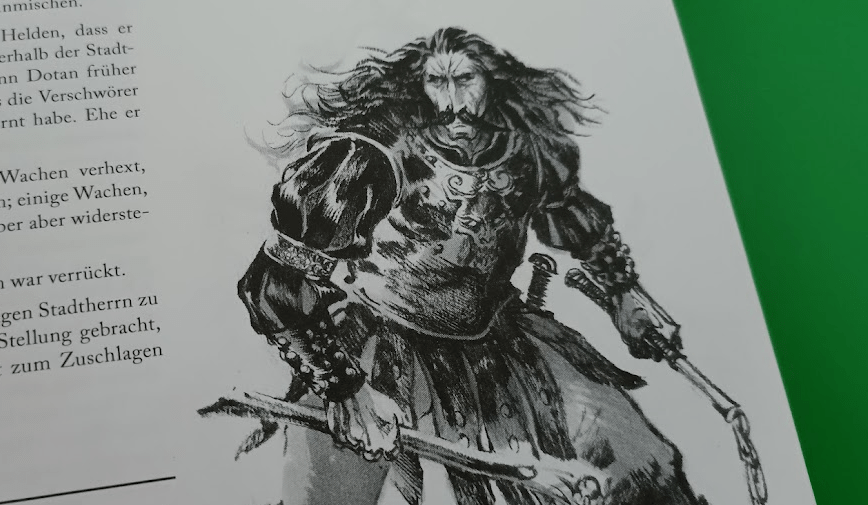
Photos are of the German Translation from the Truant publishing house, which has much better Art than the English Language “Mythic” Rules
(Sorry, “Mythic” Art team)
And meanwhile there exists the “Mythic Plus” edition of the new publisher, Ludospherik, which is a complete redesign, but with the original rules preserved as they are. Only the optics are improved.

 PAPIER UND SPIELE