
An attempt at creating a shared Sandbox world:
After playing in a game set in the wild, undefined spaces between cities of the Minaean Empire — some of that recounted here in the posts about Sandboxing and the Cockatrice Hunt — I attempted to add to that setting, running my own game in the same area at the same in-game-time: With the village of Blemish and its surrounding settlements.

Given that the GM who created this land had done a massive amount of work within Roll20, especially having a veritable army of tokens for PCs and NPC. I attempted to do the same; alas, with a tiny fraction of the experience handling the “VTT”. And that showed.
From the GM seat’s perspective I would need to admit I was so slow and, to say it in my local idiom, “patschert” in organising the maps and tokens that I must be thankful that only two players appeared, and those were old hands with a strong GMing background; had more signed up, even entirely new ones, they may have been dismayed and given up on the server or, worse, the OSR.
I must do a lot better working with this VTT business.
But we live and learn!
And the two players who did show up were gracious enough to give words of encouragement.
Comparing Notes
A Shared World, simply speaking, is one setting where multiple games, campaigns, and GMs work together, and where the results of one campaign may influence another. I.e., if the setting would have Arachgar the Black Dragon as a dangerous force of nature, and one party in one campaign was to kill Arachgar, then he would be gone in the other campaigns as well; and the tale of how he fell would be told around campfires and tavern tables in all the land.
Basically the way the game was intended to run back at its inception in the 1970ies, when Gygax wrote about 50 players in one campaign: by common understanding not all at the same time, but divided in multiple parties sharing the same home settlement and a bunch of adventuring locations.
Obviously, multiple parties in a shared world, that demands communication, rumors to pass around from one GM to the other and from one group to the next. Difficult to achieve and maintain, sometimes difficult to align in the sense of a consistent timeline, but since when does the OSR shy away from “difficult”?
Material
I started out unfamiliar with the larger setting outside of the five villages the original DM had created, and was surprised to discover that the larger cities mentioned were part of a very well-known published setting. I did a bit of research into this official game world, and also discussed some of the local aspects with the original DM.
Then I collected a number of maps that would most likely feature in the story, and simple random tables to allow for the sandboxy freshness I was aiming to achieve.
For the game session, as advised by multiple parties, I provided a number of pregens churned out factory-like from https://character.totalpartykill.ca/basic/ .
I had done similar in the past, in a B/X one-shot, and I generally like to refer players to the option at Totalpartykill, created by an excellent gamer and blogger whom I was lucky to meet and share circles with back in the heighday of Google Plus.
Problems and solutions
System
Initially I wanted to run this game in ACKS II, basically as a playtest. Why? Because I want to incorporate an economy that makes sense and a way to handle mass combat well; ACKS provides both of these off the shelf. But I found that given the demands of real life on my time, and the demands of learning Roll20 on top of that, did not allow me to learn 600 pages of new rules … even though they are based on Basic D&D. ACKS is a complex beast with multiple moving parts that influence one another. I did not manage.
So I decided to compromise, especially for the sake of accessibility to a wider player pool. I defaulted to B/X, which is somewhere between close and identical to Labyrinth Lord, BFRPG, BECMI, LotFP, and most of all, OSE. In other words: there should be no shortage of potential players. Yes, the economy doesn’t make sense, I will have to live with that. For mass combat, there are always the inspiring By this Poleaxe, which I like for PCs included in the battlefield, and the wonderful Book of War, which always satisfies but shines most brightly with PCs as commanders.
Battle Maps
My usual go-to of visualization in online RPGs is scribbling in Google Jamboard, but Google has already announced that they are going to retire it, so that can’t stand. In this case, Roll20 was already a standard of the server. I learned much about Roll20, starting at basically “clueless” and attempted to create enough maps to cover the most important locations, but with the idea of scribbling new locations free-hand when the party went off course. It should be a sandbox after all, so any direction is a valid one.
I introduced Roll20 in my Stars without Number game as well, and experiences of either game fed quality in the other, and on top of that I asked to be allowed to snoop in yet another game that uses Roll20. But I still have a long, long way to go.
As would become apparent during the game.
Technique
Especially the use of tokens is a constant issue so far, as I tend to misplace them (there are folders for tokens, so there must be a way to organise them properly), or they refuse to move where I want them to go, or suddenly a right click gives me some unexpected result… n00b problems leading to some disappointment at the table.
During the game I struggled with losing audio and internet connection for short bursts, suddenly missing a needed map, and overall: staying on top of the developing situation, playing the NPCs, and controlling the technical aspects, at the same time.
There is only one remedy to these issues: To keep trying and to keep training. We live and learn.
The story

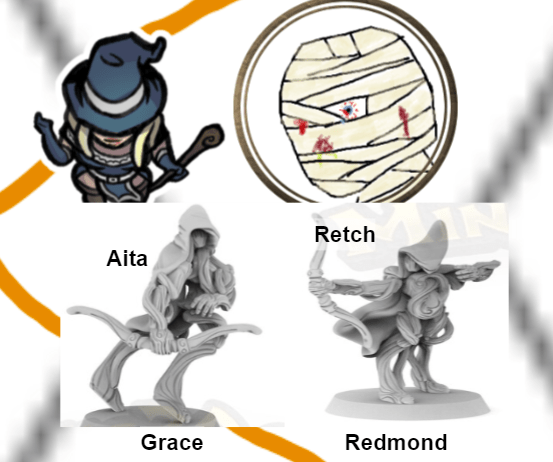
The Wonky Business Sandbox game started in Baron Erengard’s Stonehaven Castle (both of them established facts in the existing game world), with our two heroes, Aita the magic user and Retch the fighter, getting tasked to transport a mysterious parcel to a mysterious recipient over in Stoinker. They asked for more muscle and got two NPC bowmen as support, Grace and Redmond.
No plot
They picked up horses and went on to some overland travel, which I had decided to run according to the principles of the Sandbox, meaning, there was no pre-determined plot. Instead, I was going to have the world run as it would, and consequences follow player action.
Unbeknownst to the players, the parcel was of great significance, and I expected them to open it and take a peek, but they proved to be loyal retainers of Baron Erengard, and did their job as tasked, without undue delay and without fault. A better man than Erengard might praise them for it.
Random Encounters and Reaction Rolls
On the road I rolled a random encounter and it turned out to be “Wizards”. I let them meet a wagon with two travelling wizards and their guards. Reaction Roll: friendly! Retch greeted them and they talked. Since Retch suffered from light leprosy, one of the wizards, Master Wheremon, gifted him with herbs and instructions how to use them; no promises given as to the effect, but better than nothing, the wizard said.
At the night camp they met the regular post-rider between Wonky and Blemish, Merrix, and made friends with him. He shared rumors with them, about kobolds harassing farms in the east, and refugees fleeing them to live in squalor in Blemish. Also of the people of Eewton and their distrust of people from the west in general and Baron Erengard in particular.
The party and Merrix shared night-watches, and right during the first of those, Retch’s, another random encounter struck: Wolves! How many? One.
Okay, one wolf all alone in the night, that makes not too much sense. So I changed this to a stray dog rustling in the underbrush.
Retch went to investigate and surprised the dog, which (reaction roll: 7) was unsure how to react. He attempted to scare it away, but failed, and — faced with aggressive barks and bared fangs — retreated.
That’s 10 XP for the dog.

The dog, happy about its victory over the intruder, did not follow but kept hunting what it was hunting before he showed up. Once it was gone the group went investigating and discovered a narrow hole in the ground, which slim Aita crawled into, to discover a buried ruin.
Alas, they had no tools to widen the hole, and decided to meet back here in six days time to check this out, hid the hole and went back to bed. Merrix promised to wait for them here at the chosen day and to bring shovels.
Blemish
In Blemish (after a day with no random encounters) there waited the fabled Roadside Tavern, also established fact from the original GM’s designs. And there were three beggars haranguing the party, calling out for m’lord’s mercy.

My plan was to have these three beggars be more than beggars: influential among Blemish’s criminal elements, and possible sources of trouble who would retaliate if treated badly.
But the players treated them most nicely and gave from their meagre possessions without reservation. So the beggars were thankful, spoke words of blessing, and looked at the party with great benevolence.
Inside the tavern they were challenged to a game of skill at throwing axes, and after an initial round of losses, they aced a round of “double or nothing” with two critical successes against the local champion’s also-fantastic performance — three axes in the bull’s eye!


So Retch came out of it with a net profit and a local reputation to be a most awesome axe-wielder; which will earn him respect in the future.
Whittle’s Bridge and ancient ruins
Continuing their travel towards Stoinker, I rolled another random encounter; and to my surprise, it was once again “Wizards”. What are the odds? I decided to make it the very same two wizards; physically impossible due to direction of travel, but we are speaking of wizards.
When quizzed how they could be here, they evaded the question and mumbled something about a shortcut and forgotten books that they just HAD to go and get for their travel to Minaea.
They inquired about Retch’s health and re-stated their hope that the herbs would help his condition, then the masters Wheremon and Foxtrott gave the party a tip: at the upcoming Whittle’s Bridge, they would do well to give a present and leave it on the bridge’s reiling.
At the next night stop, near an ancient altar and broken ruins, no encounter all night — at this point I had a very particular encounter in mind, but on a roll of 1-3 on a six-sided die, and I rolled a 6 for a peaceful night.
The next day they reached Whittle’s Bridge and followed the wizards’ instructions to the letter.
So they reached Stoinker, found a sizeable troop of soldiery occupying the “Blood-Village” with its famous slaughterhouse, and met the commander, Captain Mart. He received the package, found the secret seal of the Baron’s safe and unbroken, and threw the two of them some silver coins for their troubles.
And here we ended the session in a safe haven.
No enemies slain, no treasure collected, no casualties. But a world grown wider.
The way forward
There was potential for trouble, and the PCs were weak with very few hit points, so a very bad outcome was always in the cards — however, the party evaded every piece of trouble, some by luck and some by exemplary behaviour.
I did not manage to convey the threat enough, though, I think mostly due to being distracted with the handling of the new challenge of managing Roll20, so as a quick summary: “We rode to Stoinker; found something on the way that we will check out next week, and handed over a parcel to its recipient” the adventure might have come across as way too easy.
But at least the journey to Stoinker served well in the way of world-building for my intended Wonky Business Sandbox Campaign: We have met the Baron, know that there is some connection to the soldiers lounging in Stoinker; we know the Eewtonians don’t like him. We know of the kobolds terrorizing the east, we know of Whittle’s weird bridge and met two odd but friendly wizards, and Merrix the steadfast post-rider.
Lots of potential sandbox-plot-hooks, and as one player called it very aptly: a world of whimsy.
I hope to continue this game and will, until then, use opportunities to train and get better at Roll20; when I get routine enough to keep talking while changing maps, and when I don’t misplace tokens between layers, my GMing will get more fluid.
For now, I have, and will try to continue to, expand the shared world.
And maybe manage to prove my concept: That a Sandbox is superior to a railroad. Our two theories:
Theory a) Freedom of Choice is why we play this game. Exploring our characters and the world as we see fit makes RPGs better than video games. Random encounters, reaction rolls and surprising developments for both players and GM are the bee’s knees.
(This is my theory, so be prepared to see my bias shining through)
Theory b) Sitting around making plans is boring. Talking is boring, and decision-making is hard. Therefore a DM needs to present an adventure as a series of fixed plot points and the players experience those, having fun and being entertained by well-prepared situations — of course, within those limits, the players can make their decisions.

 PAPIER UND SPIELE