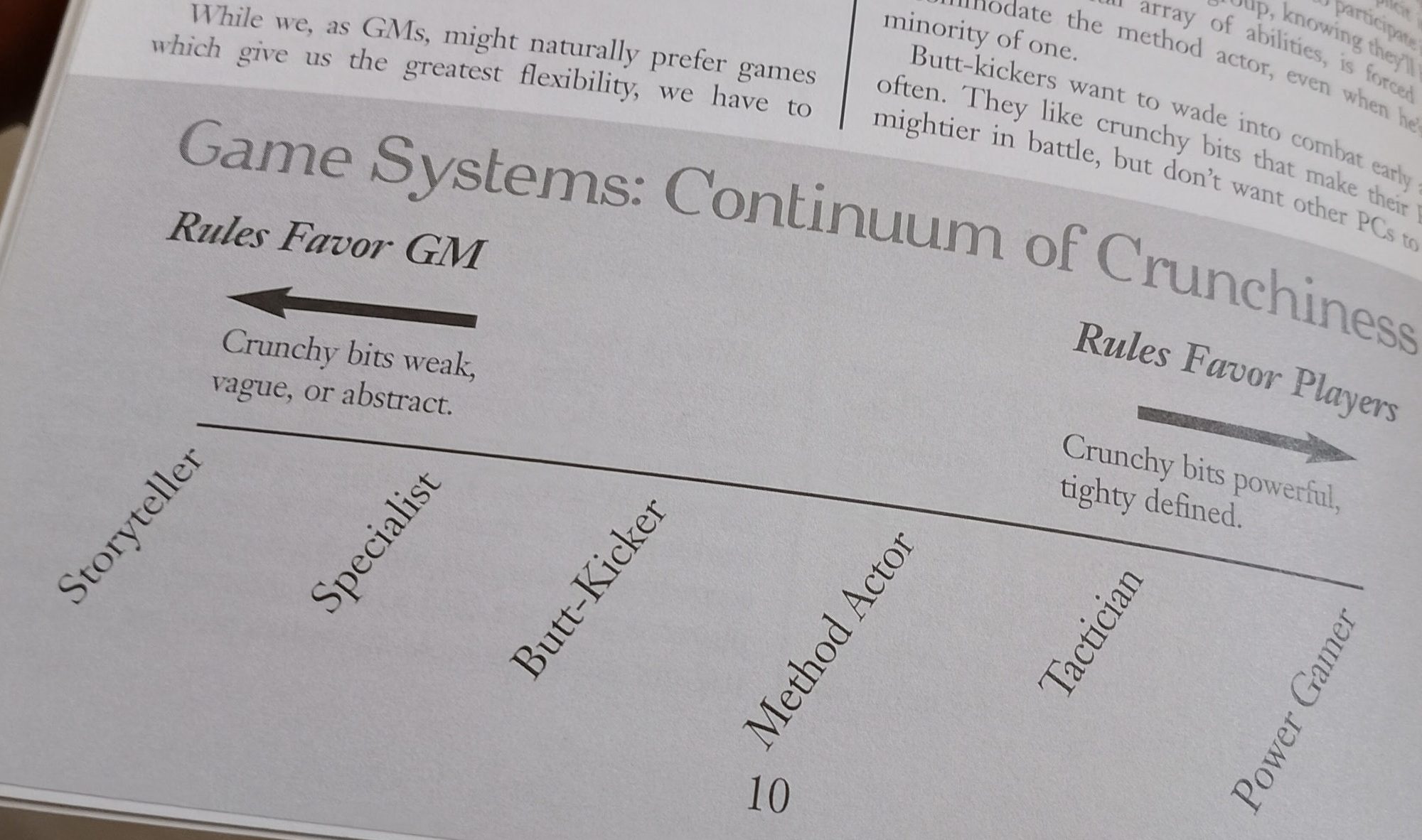
Yesterday a friend called me to discuss something he made with the help of AI tools: he had fed the machine a list of existing armor from a D&D-inspired rules system … okay, let’s not beat around the bush here, we are talking about Stars Without Number … and asked it to expand on that with new and exciting armor alternatives. Now he asked for my input to judge if the results were working within the framework of the rules.
I did provide my input, but the moment cast into sharp focus that I don’t care about that stuff. At all. I am all about the story.
It brought back my emotions from that time not long ago when that same friend and two other players were picking items from an armory, and they spent a full hour and some more of real-time going through the assorted metal implements to pick the ideal item for the job at hand, and for potential situations that might come up, and to debate the merits of their respective choices for the rest of the evening.
I, meanwhile, took roughly five or seven seconds:
“I’ll take a shotgun and a kevlar vest.”
“And what sort of ammunition do you take?”
“A pack of standard buckshot and a pack of slugs.”
“No stun rounds?”
“No.”
I was done, while the others went off the deep end comparing various guns and ammo types, and how well or how badly the rules translated the real-life equivalents into the game, and if there should not be much higher or more granular boni for particular ammo types.
Granularity
I am well aware that there is a big market for this type of thinking: I have seen heavy, system-agnostic equipment books bound in hardcover that serve as a springboard to introduce all sorts of special items into a campaign with a little tweaking on the part of the GM.
This is the home of GURPS, which I played quite extensively for a decade. GURPS takes (or at least took back in that decade! I lost sight of what they are doing now…) great care to go into deep research and do their very honest best to go as near as humanely possible to simulationist gaming. Their damage ladder: 1d6-2, 1d6-1, 1d6, 1d6+1, 1d6+2, 2d6-1, 2d6, 2d6+1, 2d6+2, 3d6-1… gives so well-balanced results in actual play that only a d% system will have a good shot beating it in terms of reliability.
Story first
However, I don’t care for that much technical detail. My focus is on what’s happening within the fiction, and as long as that maps relatively consistently with expectations learned from the real world (small calibre having less stopping power but weighing less so I can pack more rounds) that’s enough for me. Consequently, I am drawn to relatively simple rules systems like OD&D, Maze Rats, Macchiato Monsters or Into the Odd; but I also like to feel that things still make sense, which is a big plus when it comes to Lamentations of the Flame Princess. (I can hear some of you shout out in disbelief: LotFP and “make sense”??? – but yes! Parallel dimensions and body horror aside, economics-wise the rules are a perfect blend of relative realism and easy handling, the combat rules philosophy follows a dependable logic and even most of the monsters and parallel dimensions are built with a certain consistency). What I do not care for is special rules for the damage resistance of fur coats versus leather jackets, potential differences in damage between saber and arming sword, or how durable different brands of boots are. To my mind, the allocation of 1d6 or 1d8 hit points to a first level character is already so abstracted that it will not be possible to map the difference between a 130 and a 124 grain 9mm bullet in it – and even more importantly, it will always need a good deal of make-believe to accept that higher level characters with 36 hit points cannot be downed with one blast from a shotgun. This is where story comes in, where we have to interpret and say, for example, that the shot itself hits a wall and a hailstorm of plaster and wooden fragments bites the character’s cheek and neck, rather than assuming that he just stoically took a 12-gauge to the chest and shrugged it off.
Players and expectations
This brings me neatly back to good old Robin D. Laws. Once upon a time Laws wrote a pamphlet for Steve Jackson Games that was called “Robin’s Laws of Good Game Mastering”. At that time the material made great waves in the scene, as it tackled a very common problem of game masters all over the world: the issue that they had a table full of people in front of them, and some of them were super engaged and others dozed off, and they struggled deeply trying to keep everyone invested.
Robin D. Laws posited 7 “player types” that were drawn to and engaged by different things in a game. The “Power Gamer” (often a sort of derogatory term, but in this case describing a gaming style) on one end, the “Storyteller” (also sometimes a derogatory term in certain circles…) on the other. Robin D. Laws theorized that the Power Gamer is a low-trust player who wants to win the scenario. He wants excruciating detail in a game system, to make sure that he (and let’s face it, that is 99% of the time a he) can reliably predict his success rate. For sure he does not want to give the GM any leeway to spoil the outcome with unfair shenanigans a la “somehow Palpatine escaped!”
The Power Gamer wants detailed rules covering as many angles as possible that he can learn and use, so that he can argue his way to victory based on the written word: “No, GM, your big bad is dead! Because the melting point of reinforced titanium is at 1668 degrees celsius, and according to book IV of the extra dragon nostril flames of an umber dragon hit 1900 degrees celsius. The escape pod is toast!
On the other end of that theory sits the Storyteller whose greatest desire is to experience a gripping narrative. This demands of him great trust in the GM, and he is willing to accept all sorts of weird happenstance as long as the story gets the richer for it.
“The mayor raises his hands. ‘Fine! You got me! Or did you?’ A flicker of his eye towards the door comes almost too late for you: the door springs open and here’s Janet, your twin sister, carrying two submachine guns and opening fire with that pearly, happy laugh that you know so well.”
“My god!! That’s why they were always one step ahead of us! Now it all makes sense – it was Janet all along!”
“Indeed so. Now what do you do?”
There are six other types, but you get the drift: Robin D. Laws posited that a successful game session must contain elements to please each of the player types present in the session in order to engage the whole table: that is quite easy if the tastes of the table are skewed in one direction, let’s say, combat (player type: butt-kicker!), in which case you just have to start violence any time you notice the players losing zest. It is quite hard if you need to unite the interests of a “Specialist” who always wants to play a supercool invincible Ninja with a demon-possessed, 870 years old Katana and a “Tactician” who wants to make detailed heist plans with those of a “Method Actor” who wants to revel in genre-appropriate dialogue.
Robin’s Laws of Good Game Mastering, once hailed as the Egg of Columbus of RPGs, have since been less popular over time – we all know how easily our hobby gets excited about making theories and how quickly we fall out of love with them soon after (cough, GNS, cough). And obviously you cannot sort humankind any better into 7 player types than into 12 zodiac signs.
But I find that they provide excellent guardrails at the table that just plain work in practice.
Long story short
Long story short, I care about lore and a fine story and the decisions of characters, I like simple rules that don’t get in the way, and I like to trust the GM to make fair rulings. That makes me almost a clean Storyteller type, if it were not for the fact that I don’t need a structured plot, and much rather ascribe to the “emerging story” school of thought prevalent in the OSR. I don’t need a grande finale where all the lose ends come neatly together in the emotional climax of the campaign… no, no: if the players find a shortcut and derail the whole enemy plot in session 3, congrats! We are dealing with the fallout of that development and whatever the original plan was, that’s done and forgotten, and if the seeming central character of the story suddenly fails a death save and sucked into the depths of a swamp hole, then apparently he wasn’t the central character after all.
A few others in that group care a lot about equipment, calibre, and science development trees to invest points into the refining and upgrade of either ship weapons, scanner arrays, or xenobiology, and when they spring a trap they want to know exactly how it works and if that is actually physically viable. They also get salty if the enemy wins in a situation, and discuss that for real-time months. Almost clean Power-Gamers.
They want to win and be the best in the galaxy, including at xenobiology. I want to experience the struggle and challenging situations that create a mostly consistent storyline. My first job as a player is to decide if I can accept that half the session will be about equipment and point-scoring, because that’s what the majority at that table cares for – and that is valid and okay. My second job is communication: The GM needs to know that I am not thrilled about these topics, and what topics I *am* thrilled about. Without that he will never know. Communication is key.


