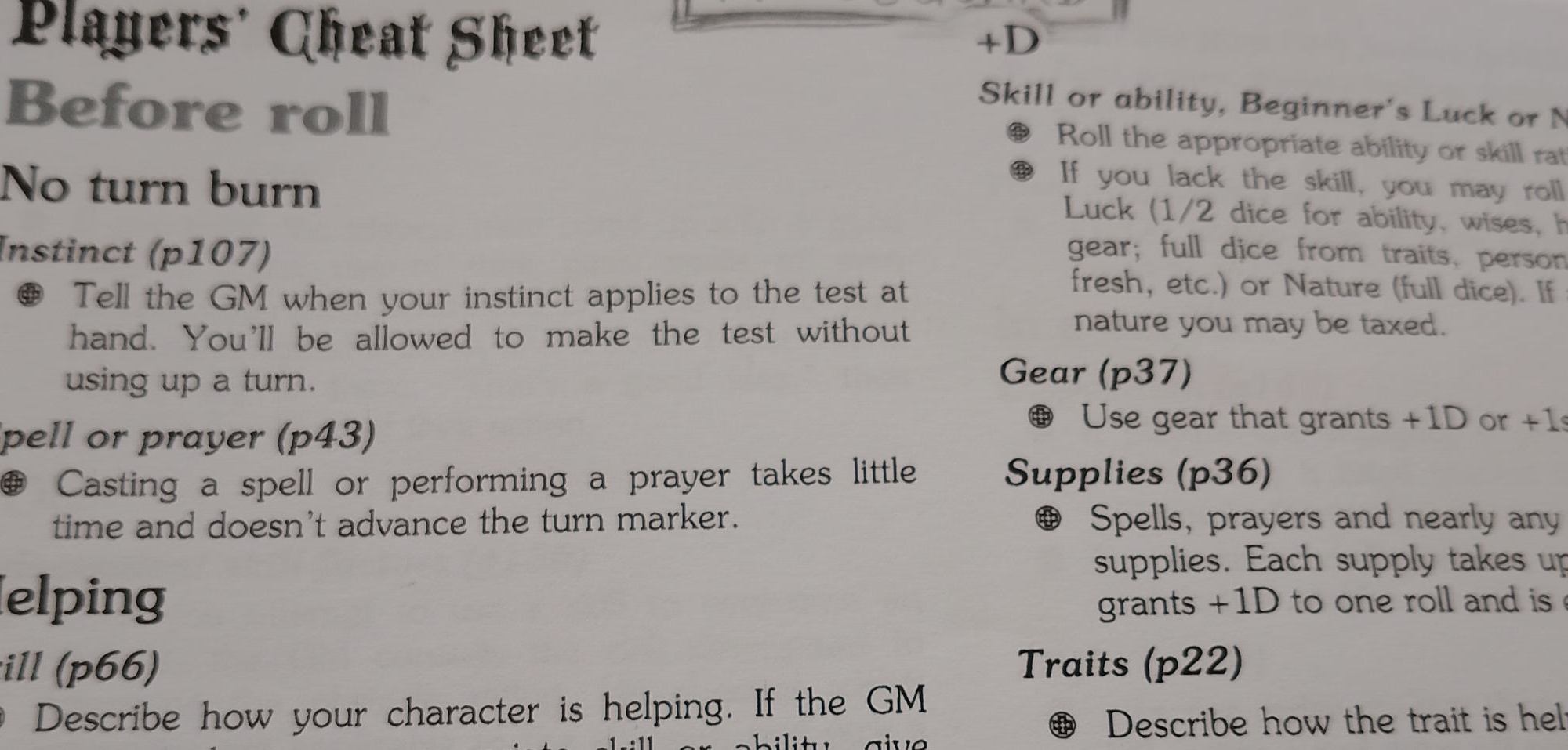
Some time ago a fellow OSR gamer dared offer a game using the system “Torchbearer”. Torchbearer is not a very common game in the spaces I see. It is based on a system called Burning Wheel and sister to a relatively well-received game named Mouse Guard. But it has its own special twists.
At first people were slow to answer the call, but then when he repeated his offer, a few players came out of the woodwork to gather round the proverbial fire.
None of us had played this game before. And lo and behold, we all struggled a fair bit to get into it and wrap our dulled and D&D-addled minds around such different game mechanics driven by a specific playing philosophy.
Different how?
You know how D&D is all about gaining gold and rise in levels to become a hero, then a superhero who can take wounds that would fell eight or more lesser men, and finally bloom into a Lord, a mover and shaker in the word, to start a barony and maybe a kingdom, where higher level people and great lords are worth much more than any random nobody (first- or even zero-level figure). On the way up, D&D is characterized by a remarkable freedom of choice and movement, where players can shape their destiny in many personal, individual ways, each as a singular person on a unique quest.
Torchbearer is not like that at all.
There are storygames, which work with almost pure narrative mechanics or even specific turns of phrase to trigger specific moments or outcomes.
And there is FATE Core, where the mechanics draw from a strong meta-viewpoint to put the group into shared, mutually supported action with narrative outcomes, which is probably the closest of all those in terms of how things work in Torchbearer – closest but still not the same.
Meta narrative framework
Torchbearer unfolds in a hostile, hard world where humankind, elves, dwarves et al huddle behind well defended town walls in small enclaves of order amid tough environments. adventurers go through a process called “The Grind”, which weighs them down through hunger and thirst, fear and anger, exhaustion and wounds.
Going out into the unknown and failing at tasks brings consequences, including quite heavy mechanical tolls to pay for exhaustion and hurt.
Still, Torchbearer is not necessarily deadly: The threat of death is something that you must usually(!) invite deliberately through your own actions – only if the players choose to enter into a lethal confrontation, a “kill conflict”. (Other types of conflict are “capture”, “convince”, “drive off”, “trick or riddle”, or even “other”)
Insofar it seems almost cushioned – only that, for one, once you open that door to deadly violence, it can come rather swiftly, to you or any of your comrades: a very real and present threat, because any sort of conflict is quite easy to lose.
Also, for another, there are “conditions” that weigh down a character: an adventurer can become hungry, exhausted, angry, sick, etc., and these have to be alleviated under certain specific conditions – so being angry does not simply go away by calming down, you have to be in a certain place (in a camp or a town) and align certain activities successfully (pass a Will test level 2) in order to nix that condition. If one of them collects too many conditions, they accumulate to reach the “dead” condition, which means, the character breathes his last, weighed down by all the adversity that was encountered.
The rules
Torchbearer is pretty ritualistic, with few given character options by the book, but a multitude of individual consequences for choices and actions.
The characters
Characters are from a “stock” (race) and “class” and have a “home” (social milieu), each of which translate into particular mechanical basics and a few skill points. They have, often, an Enemy, a strong rival at the beck and call of the game master to complicate their lives. They have a belief, a creed, and goals, which form the basis of the advancement system (with Fate points and Personality points, which slowly provide more or better skillsets and other mechanical assets).
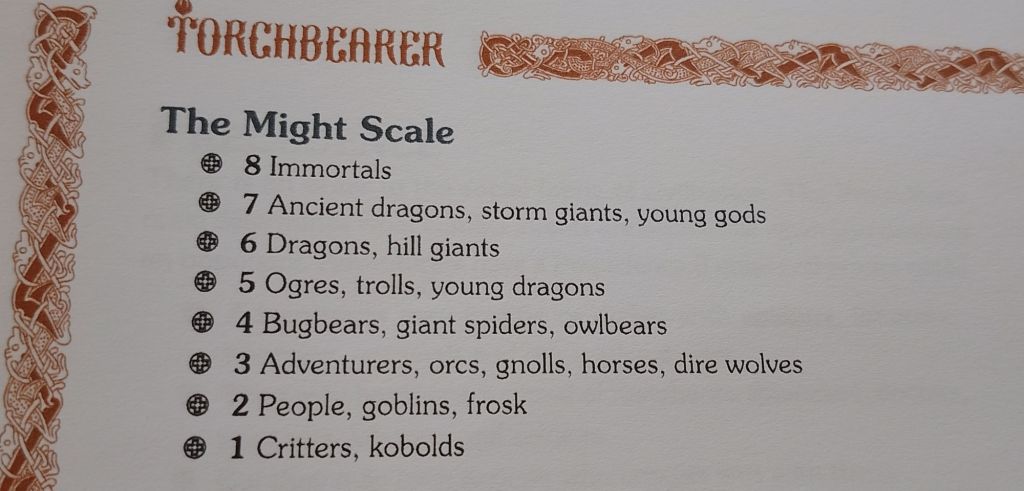
Raw abilities are Will, Health, Nature (meaning cultural personality on a scale of 0 to 7) and Might (inner power), plus connectedness to the world in the form of circles and resources, and social standing. (again we see the strong influence of storygaming)
Overcoming Obstacles
Obstacles can be creatures, terrain, something going wrong, or constructions, or anything really that stands between the party and their stated goal. To overcome it, people need to test either a skill (and with so few to start with, most likely they don’t have the one they need) or abilities, and they need a certain number of successes in their dice pool to overcome the challenge. Depending on whatever hindrances they have they will lose a number of dice from the pool, and if one or more of their comrades describe a good narration how they support the action, they get an extra die, and they may have a bonus due to their character generation choices. Either way, it is a gamble. And failing means consequences (conditions like “fear”, “anger”, “hungry”, “hurt”, …) that cost dice for future challenges and hinder the character in various ways. For example, they can block his character bonus for next time.
There is a meta currency to pay for more successes, but that is the same you need for level-ups, so it is a really tough call to give up these points.
Conflict procedure
When the GM determines that the players have triggered a conflict, he has to decide what sort of conflict we are looking at – based on the players’ wording. That decides what is at stake: Embarrassment, rejection, having to run away, or death. Then the character stats like Might or Precedence decide how strong the team is.
They decide who of them is declared “conflict captain”, and that conflict captain must roll the dice for “team disposition”, subject to the situation and the conditions of the team members. Team members can help with that roll if they have an appropriate skill.
On his part, the GM determines the disposition of the opponents.
The overall disposition is then divided among the team members as “hit points”. Now the conflict captain decides three actions for round one, and assigns these three actions to suitable characters, while the GM assigns three actions to the opposition. These can be something like maneuver, attack (reducing enemy hit points), defend (restoring friendly hit points), where “attack” can be different things depending on what type of conflict we have in front of us.
The assigned characters act, the others can help them, provided they can come up with sensible narratives. Should team members get taken out, their open actions can be redistributed to other characters.
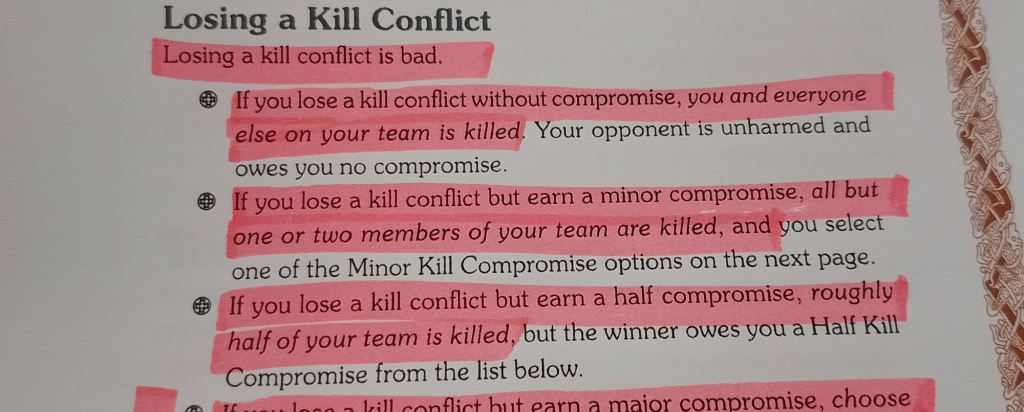
If one side reduces the other to zero hit points, it wins, and gets its way, for example, wiping out the opposition. However, if the winner also took damage during the conflict, the parties have to decide on a compromise. Meaning, if the party is reduced to zero, but the enemies also took damage, it is not a TPK but something else. There are minor compromises, half-compromises, and major (painful) compromises. The loser makes an offer to the winner, and then they debate what the outcome should look like.
A clear victory, of course, means the loser simply got their asses handed to them and that could mean the adventure is over. So careful with those “kill conflicts”.
Locations
Each sort of location has a number of options and associated costs to determine what happens or can happen there. We have camp phases where certain things can happen, but the GM does not present new problems during a camp phase, except if the players fail a roll, in which case the GM gets the opportunity to introduce a “camp twist”.
In “Town Phases” characters enter a town and get certain opportunities at Gates, Homes, Guild Halls, Temples, etc. Also, the moment they enter a town all remaining food they carry goes stale, to reset the clock and force them to buy fresh rations.
There can be “town disasters” which mean that the players cannot enter the town phase and have to remain in adventure mode, meaning they cannot rest and recuperate. However, if they can rest in a town they can cash in their fate- and character points and maybe level up, meaning, they can learn new skills or become wiser or stronger.
Our game
Our small group – me a magic user with a handful of tightly limited spells and a strong, tenacious rival from my home village – had heard of an old, abandoned dwarf mine and were contracted by an NPC to go and check it out, see if it still contained some valuable ore, and bring some of it, which would be shared on a 1 share each basis, including the NPC who gave us the info.
The mine
We looked for it and discovered the entrance thanks to a skill roll. However, that entrance wasch was blocked by an ogre. We tricked our way past the ogre and checked out the deeper ways. Already we were collecting “Grind”, meaning we started to get exhausted and hungry, and we did not have enough resources to alleviate that, nor could we go back out to enter a camp phase, because then we would have to brave the ogre again, albeit weaker because of the collected mali.
We discovered the ogre’s surprisingly civilized living quarters, but the magical clock made a ruckus and we had to hide or something. Hiding in his bedroom seemed idiotic so I suggested we run out and deeper into the mine, trying to get to the crossing faster than the ogre. We tried that, but one of our number failed. He got snatched up by a magical carpet that rolled up and captured him.
Still, we were away from the ogre. Deeper in the mine we found an old mineshaft elevator, which we short-circuited to get it going. Sadly, in it was a blind cave bear which we had now brought up to us. Conflict! We tried to drive it off rather than kill it, to avoid getting killed ourselves, because we had very little light and that animal looked super strong, so odds were bad.
We rolled surprisingly good and managed a win with major compromises; which meant that the bear was driven off (running up towards the ogre) but the elevator was wrecked and fell down into the abyss. Also, the guy in the carpet was right in the way of the fleeing cave bear, and the GM determined his fate, finding that he, already weighed down with a number of consequences and immobilized, had now been trampled and was dead.
We collected his squashed body while the bear and the ogre were fighting at the entrance, then attempted to climb down the shaft. That went rather well and we discovered a part of the mine where ore was left behind. We filled whatever sacks and satchels we had with ore and returned. We didn’t have the load capacity to bring our fallen friend so he had to stay behind in his wicked carpet. Lucky for us the ogre was now asleep in his room. I suggested we murder him in his sleep but the associated challenge, including multiple skill rolls which, if failed, would trigger a kill conflict, made it clear that this was silly. We went sneaky but failed, and the ogre woke up, so we ran like hell out into the wilderness before he could get out of his nightgown, into his boots, and after us.
The town
We reached the town and got pocket-picked on the way in, losing a seizable amount of our ore. We did not want to take that lying down so we spread rumors and started a bardic narrative about the evil fella who took our hard-won ore that had cost the life of a friend. That succeeded and the thief’s fence came forward to return the ore to us, and gave up the identity of the pickpocket. Said criminal was angry about this turn of events, so our group gathered a mortal enemy.
However, we got our loot back and got a number of resources.
It was quite a tricky thing to figure out the economics of the game, and how resources and bids worked to buy things. Somehow we got through that, healed up some conditions, bought rope and new food, etc, and picked up a rumor about a dwarf city. One of us was a dwarf, so faced with the decision to either go back to that ogre for more ore or to that dwarf city, we took the dwarf city. On the way we encountered a cult carrying some heavy stuff, who tried to recruit our cleric for their cult, which we managed to fend off, although at some loss to reputation. Then we met my own old magic mentor and I was able to save him from a bird attack, although at some loss to my resources and conditions. He gave me an interesting new quest which might lead to my learning new magical spells, which I eagerly accepted – something that would bring me into direct confrontation with my chargen-made-enemy.
We also saw something down a steep hill and retrieved it with great effort, again getting conditions, so now we were already pretty banged up and hoped to get halfway safe to the dwarf city to heal up. Alas, turned out our dwarf had in his chargen that he was an outcast, so he did not in fact have any friends in the dwarf city.
Around this time the players flaked out one by one and we decided to throw in the towel on this campaign.
Conclusion
It can take a while to warm up to that system, and it sometimes feels needlessly complicated, even artificial in its adversarial baseline. On the other hand it certainly has its merits and its charm once you get into it a bit, especially the interesting way that NON-combat conflicts can play out with very clear narrative results and with the evocative character generation. On the other other hand the conditions can really start to be annoying, especially when you get hungry and exhausted at every turn and hardly ever get a chance to get all fit again, as well as the darned lack of skills at the start – something that should go away after a few level-ups, bit by bit, but it can be a drag. Also, mortal combat is so terribly mortal, you can’t really dare a bloody fight most of the time, and while that is by design (a game to NOT have murderhobos) it can be severely limiting, because sometimes some asshole really needs to be shanked and you just can’t because you are bunch of hungry, sad, angry, tired wussies and the asshole has like Disposition 6. On the other other other hand again, it brings back some atmospheric building blocks of roleplaying games that often fall by the wayside: the “Grind” is not unlike the pressure of “Wandering Monsters” in the way that it keeps up pressure to get things done and bring home a win rather than to tarry and meander .. only it is more effective than the wandering monsters in ways, as the Grind affects people regardless of their level and you can’t forget it in the heat of the moment because it is so baked into the system and its rituals.
I’d say it is mainly a game for plotters, potential book-authors, literates, classic poets who like the idea of creating a story following a set of rules with particular processes within certain constraints of genre and atmosphere. Certainly something to give a shot, as even if it is not your cup of tea as a game some of the underlying gaming philosophy can be valuable to inform more traditional roleplaying games, and some aspects of what can happen in certain places may inspire player and GM alike to mix things up in their own campaigns.


That was a great read! While I have the first edition of Torchbearer, I have not run it yet. Now I want to after reading this.
LikeLike