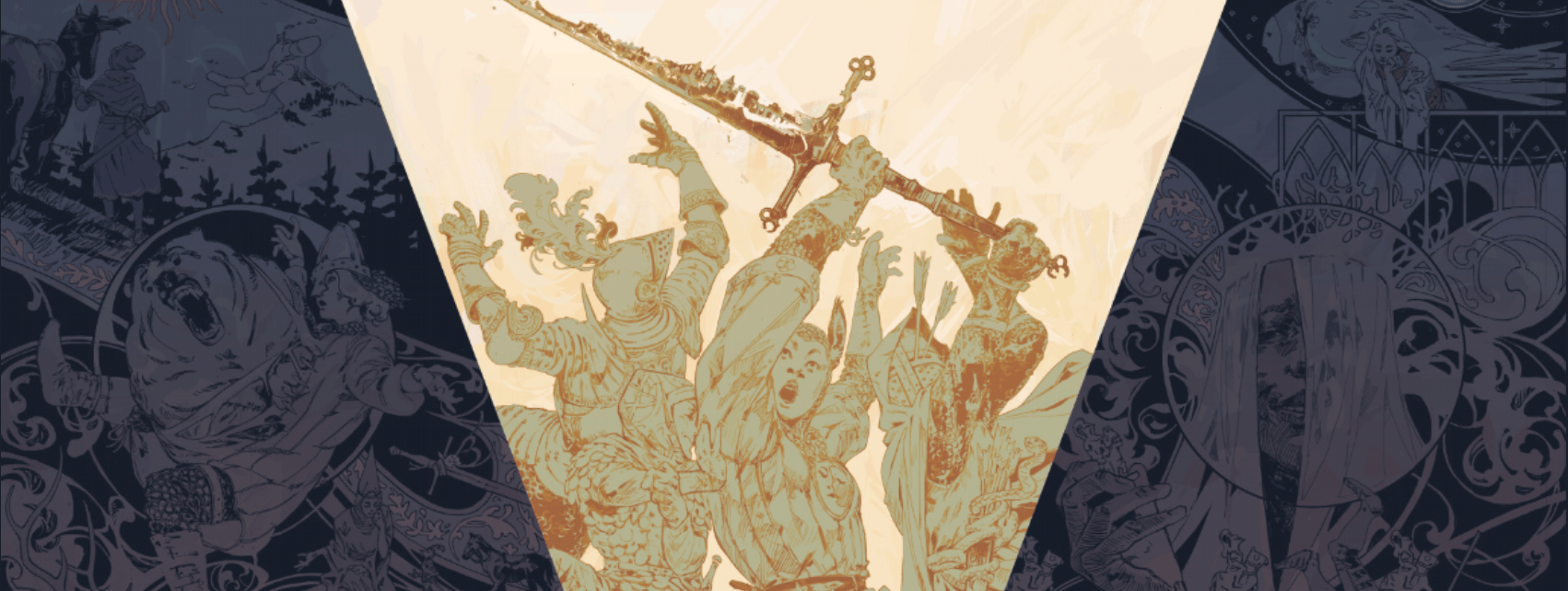
I have spoken about Into the Odd and Electric Bastionland often. And for some time now there is a new entry into the ledger: Mythic Bastionland, which goes back in time, way before Coal and Industry, let alone Electricity, and massive cities. We enter the realm of magic and myths, when the whole land was still Deep Country, and when brave knights on massive battle chargers roamed the wilderness to pacify the land and prepare a more civilized future.
Mythic Bastionland uses mostly the same framework that we already know from the earlier games, but the collected experience from those forerunners shows: The knights of Mythic Bastionland benefit from a cleaner, more evolved package even with the same, tried and tested brevity in the rules.
Atmosphere
Into the Odd was all about the machines and the weird underworld, muppets and oddities. It was a place of science with direct access to the stars. That is not a fitting mindset for Knights. And Chris McDowall recognized this. Money and debt, the main and dominant driving forces of the City of Bastion, is all but removed from the game: Bartering steps up, and coins are an afterthought. Instead, the motivator of the gaming loop is Honor. More precise, Glory.
What gets the knights out of bed and onto their horses every day is the Quest for Glory. For with enough Glory they are deemed fit for greater things.
Still there is more than enough room for weirdness (Oddity) in this knightly world, especially when it comes the spiritual leaders of the realm, the Seers. I felt strongly reminded of the recent film “The Green Knight” with Dev Patel as Sir Gavain: There we see a Quest going through a borderland between the Fantastic and the Mundane, and an ultimate question posed: how worthy are you? Will you choose honor or pleasure?
Mythic Bastionland fits very well with that mindset, I believe.
Dice Pool
There used to be a change back then, because in Into the Odd if several players ganged up on a beast, it stood no chance: With the “auto-hit” mechanic even the strongest menace had to succumb to numbers. In Electric Bastionland this was (over?)corrected by pooling the dice and counting only the highest result. Many players loved this change, but I felt that it kind of nerfed the idea of cooperation. There was a clear limit where ganging up lost its appeal, as too many dice lost their meaning, rolling high but not high enough.
That’s different now: We still pool the dice and still only the highest hit counts for damage. But other good rolls can be used for good things too. This represents a clear step up, a golden compromise between capping damage and inviting cooperation in a fight. We will hear more about the details in a moment.
Overall, the main dice mechanic is the d6+d12 (finally some love for the d12!), either for random tables or for attribute rolls, which makes the bell curve a bit more swingy between 2 and 18, with a flat probability between 7 and 13 instead of the stronger pull toward the 10.5 that we know from the customary 3d6.
New Attributes
Instead of the STR, DEX and WIL / CHA that we know from the earlier Bastion games, now we only have one body stat, called VIGour. Otherwise there is CLArity, which means focus and intelligence, including aiming and noticing things. And than there is SPIrit, which translates to motivation and willpower.
Mechanically, most attacks target the body, but the referee is called to include threats to the other attributes too. As usual, getting cut down until the VIG stat drops to zero means you are dead. But there are more uses for the attributes:
Getting to VIG 0 without a physical hit means Exhaustion, which slows the knight down.
Getting to CLA 0 means concentration is flagging and that neutralizes Hit Protection, or, in this game, Guard.
Getting to SPI 0 means your heart is no longer in it and you barely function: your lackluster attacks are all Impaired.
To restore SPIrit, a knight can follow his passion or enjoy a Sacrament. As knights do.
To restore CLArity, a knight receives guidance from the mysterious seers.
To restore VIGour, rest in warm hospitality or partake in a feast.
Glory
All Knights seek Glory.
Glory can be collected by following the Oath and seeking the Myths, for one: All knights who participate in mythic quest to investigate massive happenings are rewarded with 1 Glory. A young Kinght Errant who collects 3 Glory can be called a Knight Gallant, worthy to be included in a ruler’s council. Gain 6 Glory and you may be considered to rule a domain yourself.
Now there is the tough pill to swallow for powergamers and traditional levellers:
Glory does not make you a better fighter. Time does.
The passage of Time
Unusual for a roleplaying game, in Mythic Bastionland the table can decide to jump forward in time at certain moments; either a little, or month, or a season, or 20 years. This jump of 20 years is also the way to advance mechanically: ageing from a young fellow to a mature, experienced knight, allows the player to re-roll the attributes and take the new one if higher. Alas, fast forward a second set of 20 years and the first back pains and eyesight troubles may rear their ugly heads: to become an old knight, once more roll the attributes, and if the result is lower, that is your new stat.
Beyond that, advancing a Generation loses an old knight 1d12 VIG. Reach zero due to ageing means you die peacefully in your sleep.
Quite an interesting mechanic, and I hope to see it used in practice soon.
In a dry test, a random Knight started with a VIG of a whopping 18, so he had no chance to grow stronger in maturity.
Alas, in his old age that knight dropped to VIG 6 ! Apparently our friend had not looked after himself as he should have.
Advance another age and he rolled 9 on a d12. Dead. And that after such a golden youth!
So, if that is all, how can I advance my knight and become better?
For one, with narrative truth. Meet people, get people to owe you, and collect artifacts, that gives you more impact in the fiction.
“Bruh!” say some, “we want something tangible!”
Well, to those I say: Knights are already nigh-unstoppable forces of nature. A Knight can single-handedly destroy a warband of two dozen non-knighted rascals. How much stronger do you want to get?
Feats & Gambits
What makes knights so stunningly strong is that they can use Feats & Gambits, two extras to the combat system that normal commoners cannot hope to match.
Knights can, if they want to, go into every combat round with a strong extra attack die, extra combat tricks (like binding, unhorsing, shield shattering, or extra damage), and strong parrying (to neutralize one attack die against them) – provided they can succeed on a save in the connected attribute. If they fail such a save, they cannot use any such tricks in this combat any longer until they have rested. So in practice, many will focus on the Feat connected with their strongest attribute in order to maximize its use with relatively low risk.
The gambits are more of the aforementioned tricks: Since only one die actually counts for damage, all of the lesser dice that hit 4 or higher can be poured into such tricks, including damage boosts. Potentially, if you attack with a pool of five dice and your highest roll is a 12, and every other roll is 4 or more, you can do 16 damage in one roll.
Not if your foe is a knight of course: a knight could use “deny” and nix that 12-result.
Hard to sketch down in such few words — it all makes more sense at the table than in grey theory.
Hexcrawl and Domain Game
Now, given that our knights can age, grow old, and die, it makes sense to think about the realm. Mythic Bastionland uses a hex-grid to map the land, and a knight who found lots of glory and witnessed a ruler dying may want to take the reins of gouvernment in their own two hands.
Both of these features are explored: The hexcrawl is needed to navigate the realm without time-skips of months, and there are simplified rules to steer the fates of a domain, complete with random disaster, court intrigues and infrastructure management. Chris McDowall is very open about his worries that such a game about realm administration may turn many players off, so he chose to continue his usual instinct to simplify and focus on personal interaction rather than number-crunching, and the result looks quite serviceable. It is built as a natural evolution of his old “Expedition” idea developed during the creation of Electric Bastionland and focuses on what happens in the throne room at the “Table Ronde”, where the ruler tasks his council to take care of things rather than to go out and handle everything on his own self.
But still things stay action-oriented: The Oath still holds and riding out to seek the myths is still on the agenda even if you have turned into a greybeard duke who commands multiple warbands that clash in battle with enemy raiders and rival warbands.
“The course of the game may create new Landmarks or remove or alter existing ones“
The Myths
The narrative engine of the game are the Myths: various encounters or threats to the realm that grow and evolve in the background, first met through visions or rumors, then signs, and often, finally, meeting the issue head-on. There are 72 Myths collected in the rule book, and they follow a systematic that makes it possible to create more on your own.
Generally every Myth goes through six stages until it is either defeated or resolves itself … or changes the realm for good. The six stages each come with a specific narration that advances the “plot”. Interestingly, these scenes of Mythic encounters are more or less fixed in their description and outcome: things are pre-ordained. Once the evolution of the Myth is done, the situation is resolved the knights that honored their vows and “sought the Myths” are rewarded with Glory.
That sounds rather static in some ways, but that’s why we have a hex grid and various hazards, curses and encounters on the way, and random tables .. and the creativity of players and referees. Know that one of the main tenets of Mythic Bastionland is the so-called “Primacy of Action” – which other games have called “Narrative Truth”. Which means that actual interaction and improvisation have the power to give the set framework of a Myth new spins.
Conclusion
Into the Odd was an innovative stroke of genius with its outstanding combat mechanic. While the following games developed various aspects of that system further and explored new ideas, my impression is that it is this game, Mythic Bastionland, where Chris McDowall has really hit his stride and lifted the idea to the next level.
I can hardly wait to play and run this game in the wild.


